

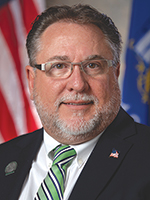
Photo of Rob Brooks
R Wisconsin House · District 59

Rep. Rob Brooks

Compare
Total votes
575
all sessions
Attendance
99%
8 missed
Near the chamber average
With party
100%
of cast votes
Near the chamber average
Bipartisan score
0%
crosses aisle rarely
Near the chamber average
Sponsored
402
bills & resolutions
Near the chamber average
Committees
5
assignments
402 bills and resolutions

Sponsored bills

Total
402
Primary
402
Co-sponsor
0
This page
402
matching current filters
Primary AB 173
Failed · Wisconsin House · Lead sponsor
Relating to: regulation of pharmacy benefit managers, fiduciary and disclosure requirements on pharmacy benefit managers, and application of prescription drug payments to health insurance cost-sharing requirements. (FE)

Maddy summaryAB 173 regulates pharmacy benefit managers (PBMs) by requiring them to disclose formulary details and drug costs to health plans and patients before enrollment. It prohibits PBMs or insurers from penalizing patients for choosing specific pharmacies within a network or charging different fees for the same pharmacy services. The bill also mandates advance written notice (at least 90 days) to patients when drugs are removed from formularies or moved to higher-cost tiers, including exception request procedures. These changes directly affect PBMs, health insurance plans, and patients covered by those plans, aiming to increase transparency and choice in prescription drug coverage.

Failed Mar 23, 2026 0 co-sponsors
Primary AB 252
Failed · Wisconsin House · Lead sponsor
Relating to: the notice of an investigation of child abuse or neglect or unborn child abuse provided to appropriate authorities of the U.S. Department of Defense. (FE)

Maddy summaryAB 252 requires Wisconsin child welfare agencies to notify the U.S. Department of Defense within 24 hours if they investigate child abuse or neglect involving a child or unborn child whose parent is in the military (active duty, reserves, or Wisconsin National Guard). This affects military-connected families in Wisconsin and child welfare agencies. The law limits the notice to only the child's or expectant mother's name, address, and the fact that an investigation has started - no additional details. It also reinforces confidentiality for all related reports and records, restricting disclosure to authorized personnel only.

Failed Mar 23, 2026 0 co-sponsors
Primary AB 32
Failed · Wisconsin House · Lead sponsor
Relating to: access to public high schools for military recruiters.

Maddy summaryThis bill requires public school districts to allow military recruiters access to high school common areas and school events during the school day, as mandated by federal law (10 USC 503(c)). It specifically prohibits schools from denying this access based on whether they allow college recruiters or employers, but explicitly states that classrooms during instructional time are excluded. The law applies to all public high schools and takes effect for the 2025-26 school year. It directly affects school districts, which must adjust their policies to comply.

Failed Mar 23, 2026 0 co-sponsors
Primary AB 367
Failed · Wisconsin House · Lead sponsor
Relating to: exemptions from minimum wage, overtime pay, and recordkeeping requirements for minor league baseball players.

Maddy summaryAB 367 exempts minor league baseball players covered by a collective bargaining agreement (CBA) from standard labor laws requiring minimum wage, overtime pay, and detailed recordkeeping. Specifically, it creates new exemptions in state labor statutes for players whose CBAs explicitly define their wages and working conditions. Employers are no longer required to track these players' hours or maintain standard payroll records. The bill applies only to players under such CBAs, not to all minor league athletes. This is a procedural change to labor law exemptions, not a new pay standard.

Failed Mar 23, 2026 0 co-sponsors
Primary AB 368
Failed · Wisconsin House · Lead sponsor
Relating to: prior authorization for coverage of physical therapy, occupational therapy, speech therapy, chiropractic services, and other services under health plans.

Maddy summaryAB 368 prevents health insurance plans from requiring prior authorization for the first 12 visits of physical therapy, occupational therapy, speech therapy, or chiropractic care per treatment episode. It also eliminates prior authorization for non-drug pain management (like therapy) for chronic pain patients during the first 90 days of treatment (up to twice weekly). Health plans must explain coverage denials in plain language, apply similar copays for these therapies as for primary care, and decide on reauthorization requests within 3 business days. This bill directly affects patients seeking these services, healthcare providers, and all health benefit plans or self-insured employer health plans in the state.

Failed Mar 23, 2026 0 co-sponsors
Primary AB 196
Failed · Wisconsin House · Lead sponsor
Relating to: rehired annuitants in the Wisconsin Retirement System. (FE)

Maddy summaryThis bill changes Wisconsin's retirement system rules for state retirees who return to work. It allows retirees who rejoin state employment (after a 75-day separation) to choose whether to keep their retirement annuity for up to 60 months, instead of having it automatically suspended. If they elect to keep the annuity, their new employer must pay equivalent retirement contributions to the system. The policy directly affects state retirees returning to jobs where they work at least two-thirds full-time, while ensuring retirement fund contributions remain intact.

Failed Mar 23, 2026 0 co-sponsors
Primary AB 525
Failed · Wisconsin House · Lead sponsor
Relating to: repeal of obsolete tax credits and tax provisions. (FE)

Maddy summaryAB 525 repeals 138 outdated tax credit and tax provision sections in the state's tax code. This directly affects taxpayers and state tax administrators by removing obsolete rules that no longer serve their intended purpose. The bill targets specific sections, such as expired credits and redundant requirements, without creating new tax policies. This action simplifies the tax code by eliminating provisions that have been deemed obsolete.

Failed Mar 23, 2026 0 co-sponsors
Primary AB 606
Failed · Wisconsin House · Lead sponsor
Relating to: regulation of hemp-derived cannabinoid products, renaming the Division of Alcohol Beverages as the Division of Intoxicating Products, creating an occupational tax on hemp-derived cannabinoid products, alcohol beverage warehouses and production arrangements, granting rule-making authority, and providing a penalty. (FE)

Maddy summaryAB 606 regulates hemp-derived cannabinoid products by creating an occupational tax on businesses selling these products, alcohol warehouses, and production facilities. It renames the state's "Division of Alcohol Beverages" to the "Division of Intoxicating Products" and grants this new division rule-making authority to enforce regulations. The bill also establishes penalties for violations of the new rules. This directly affects hemp product businesses, alcohol warehouse operators, and the state agency responsible for oversight.

Failed Mar 23, 2026 0 co-sponsors
Primary AB 188
Failed · Wisconsin House · Lead sponsor
Relating to: reduction of penalty surcharge when certain fines or forfeitures reduced. (FE)

Maddy summaryAB 188 requires courts to reduce the 26% penalty surcharge proportionally when a fine or forfeiture is reduced or suspended. It applies to most state and local fines (excluding specific traffic violations, financial responsibility cases, and safety belt offenses). This ensures individuals with reduced fines pay a lower surcharge based on the adjusted amount. The bill directly affects people who have their fines lowered by courts, making the surcharge calculation automatic and fairer.

Failed Mar 23, 2026 0 co-sponsors
Primary AB 351
Failed · Wisconsin House · Lead sponsor
Relating to: virtual credit card payments in health insurance policies.

Maddy summaryAB 351 requires health insurance companies to accept virtual credit card payments for premium payments. It directly affects policyholders who pay premiums and insurers who process those payments. The key provision adds virtual credit cards as a valid payment method, alongside traditional cards or electronic transfers. This change aims to provide consumers with more flexible payment options for their health insurance coverage.

Failed Mar 23, 2026 0 co-sponsors
Showing 81 to 90 of 402 bills
Previous 1 8 9 10 41 Next