

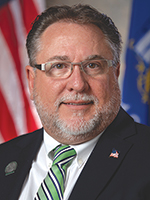
Photo of Rob Brooks
R Wisconsin House · District 59

Rep. Rob Brooks

Compare
Total votes
575
all sessions
Attendance
99%
8 missed
Near the chamber average
With party
100%
of cast votes
Near the chamber average
Bipartisan score
0%
crosses aisle rarely
Near the chamber average
Sponsored
402
bills & resolutions
Near the chamber average
Committees
5
assignments
402 bills and resolutions

Sponsored bills

Total
402
Primary
402
Co-sponsor
0
This page
402
matching current filters
Primary AB 151
Failed · Wisconsin House · Lead sponsor
Relating to: a presumption that equalizing physical placement to the highest degree is in the child’s best interest.

Maddy summaryAB 151 creates a legal presumption that courts should prioritize custody arrangements allowing children to spend roughly equal time with each parent, whenever feasible. This applies to all custody cases filed after the bill's effective date, directly affecting parents and judges determining physical placement. The law requires courts to assume equal time is in the child's best interest unless they find, based on evidence, that it isn't - considering factors like geographic separation between households. The bill modifies Wisconsin's custody statute to make this equal-time presumption the starting point for court decisions, with specific attention to practical realities like distance between parents' homes.

Failed Mar 23, 2026 0 co-sponsors
Primary AB 11
Failed · Wisconsin House · Lead sponsor
Relating to: pelvic exams on unconscious patients and creating an administrative rule related to hospital requirements for pelvic exams on unconscious patients.

Maddy summaryAssembly Bill 11 mandates that hospitals must obtain written informed consent from a patient before a pelvic examination is performed solely for educational purposes while the patient is under general anesthesia or otherwise unconscious. This bill creates a new statute requiring hospitals to ensure this consent is secured. Additionally, it directs hospitals to establish and maintain written policies and procedures that enforce this requirement for educational pelvic exams on unconscious patients.

Failed Mar 23, 2026 0 co-sponsors
Primary AB 8
Failed · Wisconsin House · Lead sponsor
Relating to: agreements for direct primary care.

Maddy summaryAssembly Bill 8 establishes a legal framework for "direct primary care agreements" between health care providers and patients. These agreements allow patients or their employers to pay a direct subscription fee for a defined set of primary care services, rather than billing an insurer on a fee-for-service basis for those specific services. The bill outlines criteria for valid agreements, including requirements for written contracts, clear disclosures that these are not health insurance, and rules regarding termination and patient selection. It prohibits providers from declining or terminating an agreement solely based on a patient's health status or other protected characteristics.

Failed Mar 23, 2026 0 co-sponsors
Primary AB 244
Failed · Wisconsin House · Lead sponsor
Relating to: posting the child abuse and neglect reporting hotline in school buildings. (FE)

Maddy summaryAB 244 requires school boards, certain charter schools, and private schools participating in specific programs to post signs in their buildings. These signs must display the telephone number for the local agency responsible for receiving and investigating child abuse and neglect reports. The bill mandates that these signs be placed in a conspicuous, public location within each school building. This aims to make the child abuse and neglect reporting hotline easily accessible to those who need it.

Failed Mar 23, 2026 0 co-sponsors
Primary AB 228
Failed · Wisconsin House · Lead sponsor
Relating to: tax incremental financing districts containing qualified data centers. (FE)

Maddy summaryAB 228 creates specific provisions for tax incremental financing (TIF) districts that contain qualified data centers, affecting local legislative bodies and data center developers. It exempts these "data center districts" from a 12 percent limit findings requirement when being created or having their project plans amended, provided all project costs are related to the data center. However, a project plan for such an excepted data center district cannot later be amended to include costs unrelated to the data center. Additionally, the value increment from these excepted data center districts cannot be included when calculating the 12 percent limit for other TIF districts.

Failed Mar 23, 2026 0 co-sponsors
Primary AB 262
Failed · Wisconsin House · Lead sponsor
Relating to: findings of fact when the court grants less than equal physical placement of a child.

Maddy summaryAB 262 modifies the legal requirements for courts when determining child physical placement in custody cases, directly affecting parents and children involved in these proceedings. The bill changes the threshold for when a court must provide specific findings of fact regarding its placement decisions. Currently, courts must provide these findings if a parent receives less than 25% of physical placement time. AB 262 increases this to 50%, meaning if a court grants one parent less than half of a child's physical placement, it must enter specific findings explaining why a greater allocation is not in the child's best interest.

Failed Mar 23, 2026 0 co-sponsors
Primary AB 163
Failed · Wisconsin House · Lead sponsor
Relating to: redeterminations of eligibility for the Medical Assistance program and database confirmation for public assistance program eligibility. (FE)

Maddy summaryAB 163 requires regular eligibility reviews for the Medical Assistance program (a public health benefits program) every six months, replacing automatic renewals. Recipients must report changes affecting their benefits within 10 days or face a six-month loss of coverage. The bill mandates state agencies to cross-check public benefit databases against death records and other state databases (like employment or prison records) every three months to remove deceased individuals and verify eligibility. It also establishes data-sharing agreements between agencies to confirm applicant information using sources like federal benefit records, with all eligibility reviews required to be completed by January 1, 2026.

Failed Mar 23, 2026 0 co-sponsors
Primary AB 286
Failed · Wisconsin House · Lead sponsor
Relating to: interest earned on coronavirus state and local fiscal recovery funds. (FE)

Maddy summaryAB 286 redirects $172 million in interest earned from unused coronavirus state and local fiscal recovery funds to the general state fund. It applies to funds held under specific state appropriations (section 20.505(1)(mb)) that were not spent by the deadline. The bill transfers this interest directly to the general fund on its effective date, rather than allowing it to remain in the recovery fund. This is a procedural adjustment to reallocate existing interest earnings, not a new funding program.

Failed Mar 23, 2026 0 co-sponsors
Primary AB 251
Failed · Wisconsin House · Lead sponsor
Relating to: jurisdiction over juveniles on federal enclaves. (FE)

Maddy summaryAB 251 clarifies that the state retains concurrent jurisdiction over juveniles aged 10 or older involved in delinquency cases (under §938.12(1)) or protection/safety cases (under §938.13) on federal lands within the state. The bill requires the governor to accept jurisdiction transfers from federal authorities for these cases when offered, and mandates that such agreements be filed with the secretary of state and county land records. This directly affects juveniles 10+ committing offenses on federal enclaves (like military bases or national parks) by ensuring state courts handle their cases. The key mechanism is establishing state authority as concurrent with federal jurisdiction and creating a formal process for transferring jurisdiction. The bill does not change existing court procedures but clarifies jurisdictional boundaries for these specific cases.

Failed Mar 23, 2026 0 co-sponsors
Primary AB 348
Failed · Wisconsin House · Lead sponsor
Relating to: the minimum age of assistant child care teachers.

Maddy summaryAB 348 lowers the minimum age for assistant child care teachers in Wisconsin from 17 or 18 to 16 years old, directly affecting licensed child care centers hiring these staff. To qualify, individuals must complete early childhood education training (e.g., two college credits, a department-approved course, or an approved program) within six months. The bill maintains current rules that assistant teachers may only provide sole supervision during specific times (like opening/closing hours or naptime) if a qualified child care teacher is present on-site. It does not change requirements for child care teachers themselves.

Failed Mar 23, 2026 0 co-sponsors
Showing 41 to 50 of 402 bills
Previous 1 4 5 6 41 Next