

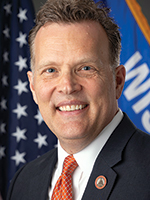
Photo of Andrew Hysell
D Wisconsin Assembly · District 48 On the 2026 ballot

Rep. Andrew Hysell

Compare
Total votes
245
all sessions
Attendance
100%
of floor votes
Near the chamber average
With party
97%
of cast votes
Near the chamber average
Bipartisan score
1%
crosses aisle rarely
Near the chamber average
Sponsored
163
bills & resolutions
Near the chamber average
Committees
3
assignments
163 bills and resolutions

Sponsored bills

Total
163
Primary
163
Co-sponsor
0
This page
163
matching current filters
Primary AB 607
Failed · Wisconsin Assembly · Lead sponsor
Relating to: housing and homelessness; emergency rental assistance program; indigent civil legal services; workforce development; community action agencies; poverty reports; mental health; economic security; reimbursement for nonemergency medical transportation services; urban mass transit aid; lead exposure and abatement services; lead service line replacement; providing an exemption from emergency rule procedures; granting rule-making authority; and making an appropriation. (FE)

Maddy summaryAB 607 creates new programs and modifies existing ones to address housing, homelessness, and related services in Wisconsin. It establishes a lead service line replacement program for water systems, creates an annual review process for homelessness services, and funds emergency rental assistance for households earning under 80% of county median income. The bill allocates $43 million for indigent civil legal services, $5 million for emergency rental assistance (2026-27), and $2.5 million for housing grants. These provisions directly affect low-income residents, homeless individuals, and service providers by expanding access to housing support, legal aid, and water infrastructure improvements.

Failed Mar 23, 2026 0 co-sponsors
Primary AB 97
Failed · Wisconsin Assembly · Lead sponsor
Relating to: extension of eligibility under the Medical Assistance program for postpartum women. (FE)

Maddy summaryAB 97 extends health coverage under Wisconsin's Medicaid program (Medical Assistance) for postpartum women from 60 days to 365 days after pregnancy, directly affecting pregnant and postpartum women who qualify for the program. The bill changes eligibility rules to ensure coverage continues without regard to income changes during this extended period. It also adds a provision allowing women with family incomes above 300% of the poverty line to qualify if their income is spent on medical care or health insurance premiums. This policy update aims to provide longer-term health coverage for new mothers during a critical postpartum period.

Failed Mar 23, 2026 0 co-sponsors
Primary AB 263
Failed · Wisconsin Assembly · Lead sponsor
Relating to: coverage of breast cancer screenings by the Medical Assistance program and health insurance policies and plans. (FE)

Maddy summaryAB 263 requires disability insurance policies and self-insured health plans to cover diagnostic breast examinations and supplemental screenings for individuals at increased breast cancer risk, as defined by National Comprehensive Cancer Network guidelines or breast density (per American College of Radiology standards). It mandates coverage without copays or deductibles for these specific screenings, including diagnostic exams for abnormalities and supplemental screenings for high-risk patients. The bill applies to all affected plans, ensuring coverage regardless of symptoms and prohibiting cost-sharing for these services. This directly impacts patients with dense breast tissue, family history, or other risk factors, as well as the insurers and employers offering these health plans.

Failed Mar 23, 2026 0 co-sponsors
Primary AB 686
Failed · Wisconsin Assembly · Lead sponsor
Relating to: reducing the eligibility threshold to claim the veterans and surviving spouses property tax credit. (FE)

Maddy summaryThis bill reduces the required disability rating for veterans to qualify for the property tax credit from 100% to 70% or higher. It allows veterans with service-connected disabilities rated at least 70% to claim a credit proportional to their disability percentage (e.g., a 70% rating would yield 70% of the full credit amount). Surviving spouses of eligible veterans also qualify under these updated terms. The change directly affects veterans and surviving spouses with service-connected disabilities below 100% but at or above 70%.

Failed Mar 23, 2026 0 co-sponsors
Primary AB 680
Failed · Wisconsin Assembly · Lead sponsor
Relating to: prohibiting individuals under age 21 from accessing intoxicating hemp products and providing a penalty. (FE)

Maddy summaryAB 680 prohibits the sale of intoxicating hemp products to individuals under age 21. It defines "intoxicating hemp products" as those containing specific cannabinoids (like delta-8 THC) above certain thresholds (e.g., over 0.3% concentration for solids, 1mg per 12oz beverage). Retailers must verify age, use child-resistant packaging, display age warnings, and provide QR codes linking to product testing certificates. This applies only to products that can cause intoxication, not all hemp products (which remain legal with under 0.3% THC).

Failed Mar 23, 2026 0 co-sponsors
Primary AB 462
Failed · Wisconsin Assembly · Lead sponsor
Relating to: employee misclassification; construction contractor registration; reporting state tax law violations committed by construction industry employers; and granting rule-making authority, making an appropriation, and providing a penalty. (FE)

Maddy summaryAB 462 requires construction contractors to register with the state and comply with worker classification laws, directly affecting employers in the construction industry. It creates a whistleblower program offering 15-30% of penalties collected (up to 10% for media-sourced tips) to employees who report misclassification or tax violations, while prohibiting retaliation against reporting workers. The bill also mandates multilingual outreach to educate employers and workers about misclassification rights and anonymous reporting options. These provisions aim to increase compliance with worker classification and tax laws in the construction sector.

Failed Mar 23, 2026 0 co-sponsors
Primary AB 578
Failed · Wisconsin Assembly · Lead sponsor
Relating to: funding for the supplemental food program for women, infants and children during the federal government shutdown and making an appropriation. (FE)

Maddy summaryAB 578 ensures Wisconsin continues providing WIC (Women, Infants, and Children) food benefits during federal government shutdowns. It requires the state to fund these benefits at pre-shutdown levels until federal funding is restored under federal law. The bill directly affects WIC participants - mothers, infants, and young children - who rely on these nutrition services. It creates a state funding mechanism to prevent benefit disruptions during federal funding lapses, such as the October 2025 shutdown referenced in the bill. The policy change takes effect immediately but includes a repeal provision for October 2026.

Failed Mar 23, 2026 0 co-sponsors
Primary AB 571
Failed · Wisconsin Assembly · Lead sponsor
Relating to: a statewide Parkinson’s disease registry. (FE)

Maddy summaryAB 571 creates a statewide Parkinson’s disease registry to collect and track health data on Parkinson’s disease and related conditions (like multiple system atrophy). Health care providers must report anonymized patient data - including diagnosis, treatment, outcomes, and demographics - to the University of Wisconsin-Madison for storage and analysis. The registry will generate annual public reports on disease incidence, prevalence, and trends via a dedicated website, with strict privacy safeguards (e.g., coded data, IRB-approved research access). This affects health care facilities, providers, and patients, but does not impose new costs or treatment requirements.

Failed Mar 23, 2026 0 co-sponsors
Primary AB 409
Signed into law · Wisconsin Assembly · Lead sponsor
Relating to: passing certain vehicles stopped on or near a highway and providing a penalty.

Maddy summaryAB 409 makes it illegal to pass a stopped vehicle on or near a highway without exercising caution, creating a new traffic violation. It directly affects drivers who pass stopped vehicles, such as those involved in accidents or breakdowns, particularly near emergency or maintenance crews. The key provision establishes a specific penalty (fines or citations) for violating this rule, aiming to improve safety in highway stoppages. This bill updates traffic regulations to address unsafe passing behavior near stationary vehicles.

Signed into law Dec 10, 2025 0 co-sponsors
Showing 151 to 160 of 163 bills