

Maddy summaryAB 529 requires school boards to provide eligible high school students with voter registration forms, eligibility information, and nonpartisan materials explaining voting importance and civic roles. It directly affects high school students who become eligible to register to vote (typically 16-18 year olds in most states). The bill mandates schools to distribute these resources as part of student enrollment or transition processes, ensuring access to nonpartisan voting information. It creates a new statute (6.31) specifying these requirements without altering voting eligibility rules. The measure aims to streamline voter registration access for young adults through educational institutions.
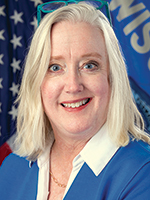
Rep. Ann Roe
Sponsored bills
Maddy summaryAB 536 requires election officials to complete one-hour accessibility training sessions focused on meeting voter accessibility requirements under sections 5.25(4) and 6.82. Specifically, chief inspectors must attend this training under new section 7.31(6), while municipal clerks, inspectors, special deputies, and registration officials must complete it under new section 7.315(5). All training must be provided before the 2027 spring election. The bill directly affects local election staff responsible for polling place operations and voter assistance.
Maddy summaryAB 535 requires all polling places to be accessible to voters with disabilities by mandating election workers to use a standardized accessibility checklist on election day to identify and immediately report barriers. It also requires the election commission to submit annual reports (by June 30 in odd years) on voting impediments faced by elderly and disabled voters, consulting with relevant advocacy groups. Additionally, the bill creates uniform signage guidelines to notify disabled voters about ballot assistance options at polling place entrances. These changes apply to all polling places and take effect before the 2027 spring election.
Maddy summaryAB 531 creates a $200,000 annual grant program for counties and law enforcement agencies to establish safe firearm disposal initiatives. Agencies must advertise the program, use law enforcement personnel (with grant funds covering overtime), securely store firearms until destruction, prevent fraud, and have firearms inspected by licensed dealers before payment. Participants receive gift cards (not cash) that cannot be redeemed for guns or ammo, and agencies must report firearm details and program outcomes to the state. The bill also funds staff positions to administer the program and requires annual reports on participation and improvements.
Maddy summaryAJR 98 is a symbolic resolution that would officially proclaim October 2025 as "Filipino American History Month" in Wisconsin. It directly affects Wisconsin residents by encouraging the state to recognize and celebrate Filipino American heritage, contributions, and history. The resolution cites historical milestones, including the first Filipino settlement in the U.S. and Wisconsin's Filipino population of over 22,000 people. It does not create new laws or policies, but rather serves as a ceremonial recognition of Filipino American contributions to Wisconsin and the U.S. The resolution was introduced by multiple legislators and refers to the established national observance of Filipino American History Month.
Maddy summaryAJR 111 is a symbolic resolution recognizing September 23, 2025, and September 23, 2026, as "Celebrate Bisexuality Day" in Wisconsin. It formally acknowledges the bisexual community's resilience and contributions without creating new laws, funding, or requirements. The resolution aims to increase visibility and respect for bisexual individuals within Wisconsin, aligning with an internationally observed day. It directly affects Wisconsin's bisexual community by affirming their inclusion through legislative recognition. The bill is procedural, focusing solely on symbolic support rather than policy changes.
Maddy summaryAB 434 creates a new $60 million annual state grant program to fund local traffic calming projects. It directly affects counties, cities, villages, towns, and federally recognized tribes by providing funding for infrastructure projects designed to reduce vehicle speeds. The program, administered by the Department of Transportation, will award grants for projects eligible under federal transportation alternatives programs. Grants require applications with specified details, and the department will set evaluation criteria for funding decisions. This is a concrete policy change establishing ongoing state funding for community safety improvements.
Maddy summaryAB 579 creates a new University of Wisconsin System tuition grant program to help cover the gap between other scholarships and full tuition and fees for eligible students. It directly affects Wisconsin residents enrolled in their first bachelor's degree program at a non-Madison UW campus with household income under $71,000 annually. The bill appropriates $11.86 million for 2025-26 and $28.11 million for 2026-27 to fund grants covering up to 8 consecutive semesters for freshmen or 4 for transfers (excluding summer terms). The program requires students to meet academic standards and excludes those with unmet selective service or child support obligations.
Maddy summaryAB 516 would allow local governments (counties, cities, towns, school districts) to adopt ranked-choice voting for nonpartisan local elections. Under this system, voters would rank candidates in order of preference instead of selecting just one. The bill provides funding for local governments to update election equipment and software to implement this system. It also modifies tie-breaking procedures for elections where candidates receive equal votes, requiring selection by lot if ranked-choice voting isn't used.
Maddy summaryAB 49 allows minors aged 14 or older who are unaccompanied youth (homeless youth without parental supervision) to consent to medically necessary health care without parental permission. To qualify, a minor must be verified as unaccompanied by specific professionals like school counselors, shelter staff, or social workers. The bill defines "medically necessary care" as treatment meeting established medical standards, including safety, effectiveness, and cost-efficiency. Healthcare providers following this law are protected from liability for providing such care, though the law does not override existing mandatory reporting requirements or other minor consent rights under Chapter 51.