

Maddy summaryAJR 75 is a commemorative resolution honoring the late Wisconsin Assembly Representative Thomas A. Hauke, who served from 1972 to 1992 and passed away in 2023. The resolution formally expresses the Wisconsin Legislature's condolences to his family and recognizes his public service, including his roles as majority leader and committee chair. As a procedural resolution (not a policy bill), it has no binding effect or direct impact on constituents or laws. It was introduced in 2025 by multiple legislators and referred to the Committee on Rules.
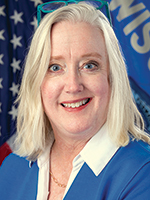
Rep. Ann Roe
Sponsored bills
Maddy summaryAJR 76 proposes removing a constitutional ban that currently defines marriage as only between one man and one woman. If passed, this change would eliminate the restriction preventing the state from recognizing same-sex marriages or creating equivalent legal status for unmarried couples. The bill directly affects all residents by removing a constitutional barrier to marriage equality, allowing the state to legally recognize same-sex marriages without requiring separate legal frameworks.
Maddy summaryAJR 74 is a ceremonial resolution honoring the late Wisconsin State Senator Bruce S. Peloquin (1936-2024). It formally recognizes his public service career, including his 1965-1979 tenure in the Wisconsin Assembly and Senate, and his legislative work on education and child welfare. The resolution has no policy impact - it simply expresses the Legislature's tribute to his life and service, extending condolences to his family. As a commemorative resolution, it does not create new laws or affect any individuals or programs.
Maddy summaryThis bill allocates $2 million annually for two years to fund LGBTQIA+ rights training for school counselors and social workers in Wisconsin public schools. It requires school boards to provide department-approved training on LGBTQIA+ rights, defined as including lesbian, gay, bisexual, transgender, queer, intersex, and other nonheterosexual or noncisgender identities. The training must be developed or approved by the state Department of Public Instruction. School counselors and social workers employed by participating school boards will directly receive this training through the grant program. The funding is tied to specific statutory provisions creating new grant categories under education budgets.
Maddy summaryAB 336 would allocate $11 million annually for the 2025-26 and 2026-27 fiscal years to fund additional mental and behavioral health services at the University of Wisconsin System. The bill specifically directs these funds toward improving student health services through enhanced staffing, training, prevention programs, and assessment tools. It directly affects all University of Wisconsin System campuses and their students by expanding access to mental health support. The funding mechanism is a direct state appropriation with no additional requirements for institutions.
Maddy summaryAB 335 creates a new $2 million annual appropriation to provide monthly stipends for school social worker interns. It directly affects interns enrolled in graduate programs leading to school social work licensure who are placed in public schools by school boards. The bill establishes that funds from the Public Instruction budget will cover these stipends starting in the 2026-27 school year. This is a concrete funding mechanism with no additional requirements or policy changes beyond the stipend payments.
Maddy summaryAB 341 creates a $5 million annual grant program to help prospective school social workers cover education costs for licensure. It specifically targets individuals who are members of racial minority groups (including Black Americans, American Indians, Hispanic individuals, Asian/Pacific Islanders, or multiracial people) and are either school employees or enrolled in relevant graduate programs. The Wisconsin Department of Public Instruction will administer the grants and establish rules to implement the program. The bill allocates funding for the 2025-26 and 2026-27 fiscal years, with implementation starting after the 2025 budget act is published.
Maddy summaryAB 342 creates a $5 million annual grant program for school districts to hire mental health professionals who are members of racial minority groups. The bill defines "racial minority group" to include Black Americans, American Indians/Alaska Natives, Hispanic individuals, Asian/Pacific Islanders, and multiracial people. School districts receiving grants must use funds specifically to hire qualified professionals from these groups. The Department of Public Instruction will administer the program and establish rules for implementation, with funding allocated for the 2025-26 and 2026-27 fiscal years.
Maddy summaryAB 359 prohibits licensed mental health professionals from providing conversion therapy to individuals under 18 years old. The bill defines conversion therapy as any attempt to change a person’s sexual orientation or gender identity, while explicitly excluding supportive counseling for gender transition, general acceptance, or safety-focused interventions. Violations could lead to disciplinary actions by licensing boards, including license suspension, revocation, or limitations on practice. This law directly affects minors under 18 and mental health professionals licensed under chapters 448, 455, or 457 of the statutes.
Maddy summaryAB 361 eliminates specific criminal defenses in cases where a defendant claims they acted due to the victim's gender identity or sexual orientation. The bill amends statutes to prevent defendants from using "adequate provocation," "self-defense," or "not guilty by reason of mental disease" as justifications if the claim relates to the victim's actual or perceived gender identity, expression, or sexual orientation. This specifically blocks defenses in situations like when the victim made a romantic advance without force or when the defendant and victim dated. The law applies to offenses committed on its effective date and directly affects defendants in criminal cases involving these specific circumstances.