

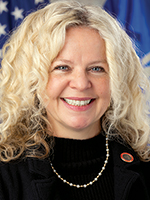
Photo of Brienne Brown
D Wisconsin House · District 43 On the 2026 ballot

Rep. Brienne Brown

Compare
Total votes
245
all sessions
Attendance
100%
of floor votes
Near the chamber average
With party
94%
of cast votes
Near the chamber average
Bipartisan score
3%
crosses aisle rarely
Near the chamber average
Sponsored
317
bills & resolutions
Near the chamber average
Committees
3
assignments
317 bills and resolutions

Sponsored bills

Total
317
Primary
317
Co-sponsor
0
This page
317
matching current filters
Primary AB 1162
Failed · Wisconsin House · Lead sponsor
Relating to: a very large customer class for electric utilities and granting rule-making authority. (FE)

Maddy summaryThis bill creates a new category called "very large customer" for electric utilities and gives the state commission authority to define who qualifies for this class. It requires electric utilities to file rate applications every other year for these customers and mandates that the commission review whether the rates charged are fair and not discriminatory. The commission will also develop specific rules to ensure utilities properly justify how rates cover the costs of serving these large customers. If rates are found to be unreasonable or unfairly discriminatory, the commission can adjust them or modify service terms accordingly.

Failed Apr 9, 2026 0 co-sponsors
Primary AB 1203
Failed · Wisconsin House · Lead sponsor
Relating to: net zero emissions, carbon-free and renewable energy standards, and creating an office of sustainability and clean energy, granting rule-making authority, making an appropriation, and providing a penalty. (FE)

Maddy summaryThis bill establishes a comprehensive clean energy framework requiring Wisconsin to achieve 100 percent clean electricity production and net-zero carbon emissions by 2050. It creates a new Office of Sustainability and Clean Energy within the Department of Administration to develop and update an economy-wide decarbonization roadmap using sector-based modeling. The legislation sets specific interim targets for carbon-free electricity, including 50 percent by 2030, 65 percent by 2035, 80 percent by 2040, 90 percent by 2045, and full carbon-free status by 2050. State agencies must consider purchasing renewable energy from providers with long-term contracts, though the requirements do not apply if generation is not technically feasible or cost-effective. The bill also provides funding for technology implementation and defines carbon-free resources to include hydroelectric power alongside other renewable sources.

Failed Apr 9, 2026 0 co-sponsors
Primary AB 1205
Failed · Wisconsin House · Lead sponsor
Relating to: a tax credit for local newspaper subscriptions. (FE)

Maddy summaryThis bill creates a state tax credit to help residents offset the cost of subscribing to local newspapers. It directly affects individuals who file state income tax returns and purchase subscriptions from newspapers that are legally qualified to print official notices. Under the bill, eligible taxpayers can claim a credit equal to 50 percent of their newspaper subscription costs, with a maximum credit of $250 per year or $125 for married individuals filing separately. The credit applies to taxable years beginning after December 31, 2024, and must be claimed within the standard tax filing period.

Failed Apr 9, 2026 0 co-sponsors
Primary AB 1129
Failed · Wisconsin House · Lead sponsor
Relating to: an assistance program for water infrastructure in 3rd class and 4th class cities, villages, and towns; granting rule-making authority; and making an appropriation. (FE)

Maddy summaryThis bill establishes a state assistance program to help smaller municipalities, specifically 3rd and 4th class cities, villages, and towns, upgrade their water infrastructure to meet federal water quality standards. The program would provide grants covering up to 50 percent of project costs, with the Department of Natural Resources responsible for administering applications, setting eligibility criteria, and prioritizing projects based on established rules. An appropriation of $10 million is included for the 2025-26 fiscal year to fund these assistance payments, and the department must approve all project plans and specifications before funds are released.

Failed Apr 9, 2026 0 co-sponsors
Primary AB 957
Signed into law · Wisconsin House · Lead sponsor
Relating to: Internet crimes against children law enforcement and making an appropriation. (FE)

Maddy summaryAB 957 increases funding by $400,000 for each of the 2025-26 and 2026-27 fiscal years to support internet crimes against children law enforcement within the Department of Justice. This is a budget adjustment that directly affects the Department of Justice's resources for investigating and prosecuting online crimes targeting minors. The bill does not create new laws or change existing legal standards - it solely allocates additional state funds for enforcement efforts.

Signed into law Apr 9, 2026 0 co-sponsors
Primary AB 958
Signed into law · Wisconsin House · Lead sponsor
Relating to: position authorizations for Internet crimes against children law enforcement. (FE)

Maddy summaryAB 958 authorizes the Department of Justice to add three new positions specifically for its Internet Crimes Against Children (ICAC) unit: two criminal analyst roles, one outreach specialist, and one digital evidence examiner. These positions are funded through existing appropriations under section 20.455(2)(a). The bill directly affects the ICAC unit’s staffing capacity to investigate and respond to online crimes involving children. It does not create new laws or policies but adjusts personnel authorizations to support existing law enforcement efforts. The bill was introduced in the 2026 Legislature and referred to the Criminal Justice and Public Safety Committee.

Signed into law Apr 9, 2026 0 co-sponsors
Primary AB 194
Signed into law · Wisconsin House · Lead sponsor
Relating to: modifications to housing programs under the Wisconsin Housing and Economic Development Authority. (FE)

Maddy summaryAB 194 modifies Wisconsin's housing programs under the Wisconsin Housing and Economic Development Authority. It redefines "developer" to include tribal housing authorities (Section 3) and clarifies "residential housing" to include tax-exempt reservation or trust lands (Section 4). The bill reduces maximum loan limits for housing projects from 33% to 20% of development costs (Section 10) and from 25% to 10% (Section 11). It also requires local governments to submit cost-reduction analyses showing how zoning or fee changes lowered housing costs (Section 7), directly affecting developers, tribal entities, and local governments administering housing programs.

Signed into law Apr 9, 2026 0 co-sponsors
Primary AB 1204
Failed · Wisconsin House · Lead sponsor
Relating to: residency requirements for certain employees of a local governmental unit. (FE)

Maddy summaryThis bill allows local governments to require that certain top administrative employees live within their jurisdiction. It specifically permits police and fire departments to set residency rules for their chiefs, cities and villages to apply them to administrators, counties without elected executives to apply them to county administrators, and school boards to apply them to school district administrators. Additionally, cities and villages that have or are electing a city manager may require that manager to live locally. The changes take effect only for individuals hired after the bill becomes law, meaning existing employees are not affected.

Failed Apr 8, 2026 0 co-sponsors
Primary AB 916
Failed · Wisconsin House · Lead sponsor
Relating to: a home repair program and making an appropriation. (FE)

Maddy summaryAB 916 creates a state-funded home repair program to address habitability issues and improve energy efficiency in affordable housing. It provides grants of up to $25,000 per unit to eligible homeowners (income ≤100% of area median income who own or occupy their homes) and interest-free loans of up to $25,000 to eligible landlords (owning ≤5 properties/15 units of affordable housing). The program prioritizes repairs for homes with health/safety hazards, energy efficiency upgrades, and accessibility improvements for individuals with disabilities or young children. Properties must be between 10 and 40 years old to qualify, and funds are administered by the state authority or contracted counties/nonprofits with strict reporting requirements.

Failed Apr 7, 2026 0 co-sponsors
Primary AB 785
Failed · Wisconsin House · Lead sponsor
Relating to: a percentage of income payment program for electricity and gas service, electricity and gas service disconnections, granting rule-making authority, and making an appropriation. (FE)

Maddy summaryAB 785 establishes a program to cap electricity and gas costs at 2% of a household's annual income for energy burdened households (spending 2-4% of income on utilities) and severely energy burdened households (spending 4% or more, or having no income with utility bills). It prohibits utility disconnections for residential customers with income up to 300% of the federal poverty level due to nonpayment and creates an "energy burden relief fund" to finance the program. The bill requires automatic enrollment for eligible households, an online application portal, and annual reporting by the Public Service Commission on program administration and barriers to participation.

Failed Apr 6, 2026 0 co-sponsors
Showing 11 to 20 of 317 bills