

Maddy summaryAB 346 modifies fleet registration requirements for certain motor vehicles, specifically targeting commercial or organizational vehicle fleets (like rental companies or corporate fleets). The bill's exact provisions - such as fee adjustments, registration process changes, or eligibility criteria - are not detailed in the provided context. It directly affects businesses and organizations operating multiple vehicles under a single registration. The bill passed all legislative stages on October 14-17, 2025, but the specific policy changes cannot be summarized without access to the bill's text.
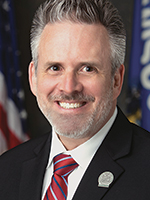
Rep. David Steffen
Sponsored bills
Maddy summaryAJR 92 is a ceremonial resolution recognizing the U.S. Marine Corps' 250th birthday on November 10, 2025. It formally celebrates the Marine Corps' history, beginning with its founding by the Continental Congress on November 10, 1775, and acknowledges its ongoing service, including active-duty personnel and training at Fort McCoy in Wisconsin. The resolution contains no new policies, funding, or legal requirements - it solely expresses the Wisconsin Legislature's symbolic appreciation for the Marine Corps' 250 years of service. As a procedural resolution, it does not directly affect any individuals or change existing laws.
Maddy summaryAB 271 allows commercial motor vehicles operating in Wisconsin (intrastate commerce) to use camera monitor systems instead of traditional mirrors, provided the systems meet federal safety standards. The bill specifically permits systems exempted under federal regulations (49 CFR 393.80) or approved as mirror alternatives in federal safety standards. This change directly affects commercial truck and bus operators by removing a requirement for physical mirrors when using federally compliant camera systems. The law aligns Wisconsin statute with existing federal approvals, without creating new safety standards.
Maddy summaryAB 74 requires Wisconsin public, private, and charter schools to notify parents or guardians within 24 hours if they receive a report alleging specific misconduct: sexual misconduct by a staff member, a convicted sex offender working with children, or a sex offender photographing a minor without consent. Schools must deliver notice by phone or in person, with deadlines of 5 p.m. the same day (if reported before school ends) or noon the next day. The law excludes reports involving the student’s parent or guardian and applies to all schools covered under Wisconsin education statutes. This is a direct notification requirement, not an investigation mandate.
Maddy summaryAB 265 strengthens Wisconsin's penalties for human trafficking by requiring minimum prison terms: 15 years for child trafficking and 10 years for general human trafficking convictions. It creates new felony charges for individuals who profit from trafficking (Class D C felony) or receive compensation from commercial sex acts or debt bondage (Class F E felony). The bill directly affects convicted traffickers, their financial beneficiaries, and those who facilitate trafficking through recruitment or harboring of children for commercial sex. These sentencing changes apply to offenses committed after the bill's effective date.
Maddy summaryAB 409 makes it illegal to pass a stopped vehicle on or near a highway without exercising caution, creating a new traffic violation. It directly affects drivers who pass stopped vehicles, such as those involved in accidents or breakdowns, particularly near emergency or maintenance crews. The key provision establishes a specific penalty (fines or citations) for violating this rule, aiming to improve safety in highway stoppages. This bill updates traffic regulations to address unsafe passing behavior near stationary vehicles.
Maddy summaryAB 201 modifies Wisconsin law to require sex offender registration for individuals convicted of sexual extortion or certain related offenses. It directs courts to mandate registration under Wisconsin Statute 301.45 if the underlying conduct was "sexually motivated" (as defined in Statute 980.01(5)), including violations of statutes related to sexual extortion (e.g., 942.09, 942.095). The bill affects offenders convicted of sexual extortion or sexually motivated crimes under Chapters 940, 942, 943, 944, or 948. Courts may later release individuals from registration if they meet conditions set by the court. This is a policy change to expand registration requirements for specific sexual offenses, not a new criminal penalty.
Maddy summaryAB 2 requires Wisconsin school boards to adopt policies banning student use of wireless communication devices (like cell phones, tablets, laptops, and gaming devices) during instructional time, effective July 1, 2026. The policy must define "wireless communication device," include specific exceptions for emergencies, health needs, individualized education programs, and teacher-approved educational use, and allow boards to add other learning-focused exceptions. It directly affects school boards, which must create and implement these policies, while students are the primary group subject to the restrictions. The bill does not mandate device confiscation but permits it as a consequence for violations.
Maddy summaryAB 35 requires candidates for most Wisconsin offices (excluding district attorney) to formally withdraw their candidacy by specific deadlines before elections. To withdraw, candidates must file a sworn statement with the election commission and pay a fee ($1,000 for statewide/national offices, $250 for local offices). The law also penalizes false withdrawal statements as a Class G felony, with the commission required to verify the authenticity of all sworn statements. This law directly affects candidates who wish to withdraw from races but does not apply to district attorney candidates.
Maddy summaryAJR 50 is a ceremonial resolution recognizing the U.S. Army's 250th anniversary on June 14, 2025. It formally celebrates the Army's history of service and sacrifice since its founding in 1775, highlighting its role in defending the nation. The resolution specifically acknowledges Wisconsin's connection to the Army, including over 10,000 soldiers and civilians stationed in the state and Fort McCoy's economic impact. As a symbolic gesture with no policy changes, it does not affect any laws or groups beyond expressing legislative appreciation.