

Maddy summaryAB 598 allows patient representatives to consent to health care facility admissions for incapacitated individuals without requiring a court-appointed guardian or protective placement petition. The bill creates a defined "patient representative" role, requiring two medical professionals (e.g., two physicians or one physician plus an advanced practice clinician) to certify incapacity based on medical need - not age, disability, or eccentricity. Patient representatives gain authority to make health care decisions, enroll individuals in Medical Assistance, and authorize health care expenses similar to a guardian, but only for non-developmental disability and non-mental illness cases. This change streamlines admissions for incapacitated patients while mandating 72-hour notifications to county agencies about the certification.
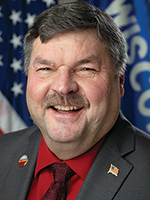
Rep. Rob Swearingen
Sponsored bills
Maddy summaryAssembly Joint Resolution 4 (AJR 4) is a commemorative resolution by the Wisconsin Legislature. It honors the life and public service of Justice David T. Prosser Jr., recognizing his over 40 years of service in all three branches of state government, including 18 years in the Wisconsin Legislature and 18 years on the Wisconsin Supreme Court. The resolution also extends condolences to his family and friends.
Maddy summaryThis bill modifies the Wisconsin married persons credit by increasing the maximum benefit amount for spouses with lower earned income. Specifically, it raises the credit limit from $480 to $870 for taxable years beginning after December 31, 2023. The change applies to married couples filing joint state tax returns where one spouse has earned income. The legislation was ultimately vetoed by the Governor and did not become law.
Maddy summaryThis Wisconsin bill proposes to lower individual income tax rates for residents in the third tax bracket while simultaneously expanding the retirement income subtraction available to retirees. The legislation would allow more retirees to exclude a larger portion of their pension and retirement account withdrawals from state taxable income, with specific provisions added for those who are permanently and totally disabled. Although the bill passed the legislature, it was vetoed by the Governor and ultimately failed to become law.
Maddy summaryThis Wisconsin bill expands the state tax deduction for retirement income, allowing more people to exclude certain pension and savings withdrawals from their taxable income. It specifically increases the annual deduction limit and adds new categories of eligible payments, including those from the U.S. Coast Guard, the National Oceanic and Atmospheric Administration, and the Public Health Service. The legislation also clarifies the definition of disability for individuals under 65 who receive disability payments from non-retirement plans. Although the bill passed the legislature, the Governor vetoed it, and the state legislature did not override that veto, meaning the proposed changes did not become law.
Maddy summaryThis bill, which was ultimately vetoed by the Governor, would have changed how deer hunting is regulated in Wisconsin's northern forest zone. It prohibited the state from allowing seasons where only antlerless deer could be hunted and banned the issuance of special permits to kill antlerless deer, with one specific exception for hunters under 16. The legislation also limited individuals to holding only one permit for killing antlered deer per season and allowed those who did not use their bow or crossbow permits to use them during the other type of season. Because the bill was vetoed, these regulatory changes were not enacted.
Maddy summaryThis Wisconsin bill proposes expanding the state's individual income tax brackets to apply to higher income levels. It would create two new tax tiers for single filers, heads of households, and married couples, taxing income between $14,320 and $112,500 at 4.40 percent and income above $315,310 at 7.65 percent. The legislation also includes provisions to adjust these tax brackets annually based on changes in the consumer price index to account for inflation. Although the bill passed the legislature, the Governor vetoed it, and the measure failed to override that veto.
Maddy summaryThis Wisconsin bill creates a revolving loan fund to help licensed child care providers finance renovations to their facilities. The program provides interest-free loans with no repayment fees, offering up to $30,000 for in-home care providers and up to $95,000 for center-based providers. To qualify, providers must submit a business plan and financial forecast, and they must maintain enrollment of children who are not relatives of the provider. The state retains the right to terminate the loan and demand immediate repayment if the facility fails to meet enrollment requirements or if the provider becomes unable to repay the debt. Although the bill passed the legislature, the Governor vetoed it, and the state legislature did not override the veto.