

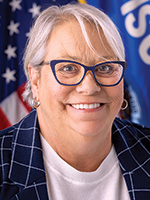
Photo of Christine Sinicki
D Wisconsin Assembly · District 20 On the 2026 ballot

Rep. Christine Sinicki

Compare
Total votes
788
all sessions
Attendance
99%
10 missed
Near the chamber average
With party
97%
of cast votes
Near the chamber average
Bipartisan score
1%
crosses aisle rarely
Near the chamber average
Sponsored
2,375
bills & resolutions
Near the chamber average
Committees
3
assignments
2,375 bills and resolutions

Sponsored bills

Total
2,375
Primary
2,375
Co-sponsor
0
This page
2,375
matching current filters
Primary AB 957
Signed into law · Wisconsin Assembly · Lead sponsor
Relating to: Internet crimes against children law enforcement and making an appropriation. (FE)

Maddy summaryAB 957 increases funding by $400,000 for each of the 2025-26 and 2026-27 fiscal years to support internet crimes against children law enforcement within the Department of Justice. This is a budget adjustment that directly affects the Department of Justice's resources for investigating and prosecuting online crimes targeting minors. The bill does not create new laws or change existing legal standards - it solely allocates additional state funds for enforcement efforts.

Signed into law Apr 9, 2026 0 co-sponsors
Primary AB 958
Signed into law · Wisconsin Assembly · Lead sponsor
Relating to: position authorizations for Internet crimes against children law enforcement. (FE)

Maddy summaryAB 958 authorizes the Department of Justice to add three new positions specifically for its Internet Crimes Against Children (ICAC) unit: two criminal analyst roles, one outreach specialist, and one digital evidence examiner. These positions are funded through existing appropriations under section 20.455(2)(a). The bill directly affects the ICAC unit’s staffing capacity to investigate and respond to online crimes involving children. It does not create new laws or policies but adjusts personnel authorizations to support existing law enforcement efforts. The bill was introduced in the 2026 Legislature and referred to the Criminal Justice and Public Safety Committee.

Signed into law Apr 9, 2026 0 co-sponsors
Primary AB 968
Signed into law · Wisconsin Assembly · Lead sponsor
Relating to: virtual currency kiosks.

Maddy summaryAB 968 would require virtual currency kiosks (machines exchanging cash for digital currency or vice versa) to obtain state licenses, display mandatory fraud warnings, and verify customer identities using government ID and photos. It sets a $500 daily transaction limit, caps fees at 3% or $5 per transaction, and mandates detailed receipts showing all transaction details. The bill directly affects kiosk operators and customers, aiming to prevent fraud through identity checks and clear transaction records. Currently under review in the Financial Institutions committee.

Signed into law Apr 9, 2026 0 co-sponsors
Primary AB 964
Signed into law · Wisconsin Assembly · Lead sponsor
Relating to: Internet crimes against children administrative subpoenas for the crime of sexual extortion when the crime victim is a child. (FE)

Maddy summaryAB 964 clarifies that online sexual extortion targeting children falls under existing law by specifying it as a violation of Section 942.095 when the victim is a child (as defined in Section 948.01). This bill directly affects law enforcement agencies investigating internet crimes against children, enabling them to issue administrative subpoenas to internet companies for relevant data without a court order. The key provision streamlines the process for obtaining evidence from online platforms in cases where children are victims of sexual extortion. It does not create new penalties but ensures these cases are explicitly covered under current statutes for investigative efficiency.

Signed into law Apr 9, 2026 0 co-sponsors
Primary AB 969
Signed into law · Wisconsin Assembly · Lead sponsor
Relating to: the drug repository program.

Maddy summaryAB 969 creates a formal drug donation program to redistribute unused medications to eligible patients. It defines key terms like "donor" (including pharmacies, hospitals, and individuals), "eligible patient" (indigent, uninsured, or underinsured individuals), and "recipient" (medical facilities or pharmacies that can receive donations). The bill allows donors to contribute drugs to participating facilities, with recipients permitted to charge a handling fee covering actual costs (e.g., storage, shipping), while prohibiting donations of certain FDA-regulated drugs requiring patient enrollment. This program aims to provide access to medications for underserved patients through a structured, safe, and cost-transparent system.

Signed into law Apr 9, 2026 0 co-sponsors
Primary AB 759
Signed into law · Wisconsin Assembly · Lead sponsor
Relating to: eligibility to receive occupational credentials for recipients of deferred action under the Deferred Action for Childhood Arrivals program. (FE)

Maddy summaryAB 759 allows individuals with deferred action under the federal DACA program to obtain state occupational licenses (like nursing or cosmetology credentials) if they have valid federal work permits. It requires state licensing agencies to verify DACA recipients' federal work authorization through official systems before issuing licenses. Licenses issued under this law expire when the federal work permit expires, and recipients must renew both simultaneously. The bill explicitly states it does not grant eligibility for public benefits beyond occupational credentials.

Signed into law Apr 9, 2026 0 co-sponsors
Primary AB 601
Signed into law · Wisconsin Assembly · Lead sponsor
Relating to: excluding certain event or sports wagers from the definition of “bet”.

Maddy summaryAB 601 amends the statute to exclude certain sports wagers from the legal definition of "bet." Specifically, it exempts wagers made by people physically in the state using mobile devices if the server is on tribal lands and the wager follows an Indian gaming compact entered before April 1, 1993. This directly affects tribal gaming operations that operate under pre-1993 compacts. The bill clarifies that such wagers - conducted via tribal servers under existing agreements - are not considered "bets" under state gambling laws. This is a technical definition change, not a new policy or tax.

Signed into law Apr 9, 2026 0 co-sponsors
Primary AB 604
Signed into law · Wisconsin Assembly · Lead sponsor
Relating to: coverage under the Medical Assistance program for incarcerated individuals. (FE)

Maddy summaryAB 604 would require Wisconsin's Department of Health Services to request a federal Medicaid waiver to provide pre-release medical coverage for incarcerated individuals eligible for Medicaid. It specifically covers case management, medication-assisted treatment for substance use disorders, and a 30-day supply of prescription medications for up to 90 days before release. This bill directly affects incarcerated people who qualify for Medicaid, aiming to improve continuity of care upon reentry. The waiver request must be submitted by January 1, 2027, to allow state and federal reimbursement for these services. The bill focuses on concrete policy changes to expand healthcare access during a critical transition period.

Signed into law Apr 9, 2026 0 co-sponsors
Primary AB 1168
Failed · Wisconsin Assembly · Lead sponsor
Relating to: medical debt abolition and making an appropriation. (FE)

Maddy summaryThis bill establishes a program to eliminate medical debt for eligible Wisconsin residents by creating a $10 million annual appropriation for the Department of Health Services to purchase and cancel outstanding medical bills. To qualify, residents must either have household income at or below 400 percent of the federal poverty line or owe medical debt equal to at least 5 percent of their annual household income. The department will identify eligible individuals, negotiate with healthcare providers and debt collectors to buy their outstanding balances, and then formally abolish the debt while minimizing tax consequences for recipients. The program prioritizes purchasing debt from providers serving low-income populations and those in areas disproportionately affected by medical debt, with annual reporting required to track the number of debts eliminated and demographic information of affected residents.

Failed Apr 8, 2026 0 co-sponsors
Primary AB 1204
Failed · Wisconsin Assembly · Lead sponsor
Relating to: residency requirements for certain employees of a local governmental unit. (FE)

Maddy summaryThis bill allows local governments to require that certain top administrative employees live within their jurisdiction. It specifically permits police and fire departments to set residency rules for their chiefs, cities and villages to apply them to administrators, counties without elected executives to apply them to county administrators, and school boards to apply them to school district administrators. Additionally, cities and villages that have or are electing a city manager may require that manager to live locally. The changes take effect only for individuals hired after the bill becomes law, meaning existing employees are not affected.

Failed Apr 8, 2026 0 co-sponsors
Showing 31 to 40 of 2,375 bills
Previous 1 … 3 4 5 … 238 Next