

Maddy summaryAJR 68 is a symbolic resolution honoring Anna Mae Robertson, a Milwaukee resident and member of the historic 6888th Central Postal Directory Battalion (Six Triple Eight) during World War II. It recognizes her service in clearing a 17-million-piece mail backlog overseas in 1945 and her later contributions as a nurse and community member. The resolution, introduced by multiple Wisconsin legislators, formally commends her legacy and extends condolences to her family. As a procedural resolution, it does not create new laws or affect policy - it solely serves to commemorate her service through legislative recognition.
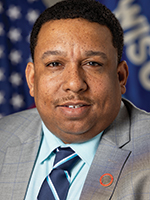
Rep. Russell Goodwin
Sponsored bills
Maddy summaryAB 343 increases state funding to help schools hire more mental health staff by reimbursing 50% of new spending on pupil services professionals (like counselors and social workers). It directly affects public school districts, charter schools, and participating private schools that increase their spending on these roles. The bill adds $16.5 million for fiscal year 2025-26 and $18 million for 2026-27 to the existing mental health aid appropriation. This creates a new reimbursement mechanism for schools that expand their mental health staffing beyond prior-year levels.
Maddy summaryAB 317 creates the Child Care Quality Improvement Program to provide monthly payments to certified child care providers, including licensed centers and school-based programs. It allocates $221 million for fiscal year 2025-26 and $220 million for 2026-27 from the Department of Children and Families budget. The program grants the department rule-making authority to set eligibility, payment amounts, and usage requirements for recipients. The bill repeals outdated sections of existing law and updates funding allocations for quality improvement activities.
Maddy summaryThis joint resolution (AJR 70) formally proclaims June 2025 as "Immigrant Heritage Month" in Wisconsin. It recognizes the historical and ongoing contributions of immigrants to Wisconsin's culture, economy, and communities, citing statistics such as 308,000 immigrants in the state and their $13.5 billion in annual household income. The resolution does not create new laws or policies; it is a ceremonial declaration urging Wisconsinites to celebrate immigrant contributions and reject prejudice. It directly affects the public by designating a month for community recognition, with no specific groups or programs being altered or funded.
Maddy summaryAB 338 requires most health insurance plans (including those offered by state/local governments) to cover at least 28 annual therapy visits for mental health or substance use disorders without prior authorization. It mandates that insurers provide this minimum coverage per policy year, based on the insured's treatment goals. The law includes a cost-check mechanism: if insurers' actuarial analysis shows coverage would increase plan costs by over 10%, enforcement may be paused. This directly affects health insurers, self-insured public employer plans, and individuals seeking mental health/substance use treatment. The bill takes effect for new policy years starting after its publication date.
Maddy summaryThis joint resolution (AJR 73) is a symbolic recognition by the Wisconsin Legislature that June 2025 will be observed as Black Music Month in Wisconsin. It directly affects Wisconsin residents by formally acknowledging the state's support for celebrating Black musical contributions. The resolution highlights the historical significance of Black music genres like jazz, soul, and hip-hop, and honors Black artists' global influence on music and culture. As a commemorative measure with no new laws or funding, it serves solely to affirm and celebrate this cultural legacy through official state recognition.
Maddy summaryAB 336 would allocate $11 million annually for the 2025-26 and 2026-27 fiscal years to fund additional mental and behavioral health services at the University of Wisconsin System. The bill specifically directs these funds toward improving student health services through enhanced staffing, training, prevention programs, and assessment tools. It directly affects all University of Wisconsin System campuses and their students by expanding access to mental health support. The funding mechanism is a direct state appropriation with no additional requirements for institutions.
Maddy summaryAB 335 creates a new $2 million annual appropriation to provide monthly stipends for school social worker interns. It directly affects interns enrolled in graduate programs leading to school social work licensure who are placed in public schools by school boards. The bill establishes that funds from the Public Instruction budget will cover these stipends starting in the 2026-27 school year. This is a concrete funding mechanism with no additional requirements or policy changes beyond the stipend payments.
Maddy summaryAB 341 creates a $5 million annual grant program to help prospective school social workers cover education costs for licensure. It specifically targets individuals who are members of racial minority groups (including Black Americans, American Indians, Hispanic individuals, Asian/Pacific Islanders, or multiracial people) and are either school employees or enrolled in relevant graduate programs. The Wisconsin Department of Public Instruction will administer the grants and establish rules to implement the program. The bill allocates funding for the 2025-26 and 2026-27 fiscal years, with implementation starting after the 2025 budget act is published.
Maddy summaryAB 342 creates a $5 million annual grant program for school districts to hire mental health professionals who are members of racial minority groups. The bill defines "racial minority group" to include Black Americans, American Indians/Alaska Natives, Hispanic individuals, Asian/Pacific Islanders, and multiracial people. School districts receiving grants must use funds specifically to hire qualified professionals from these groups. The Department of Public Instruction will administer the program and establish rules for implementation, with funding allocated for the 2025-26 and 2026-27 fiscal years.