

Maddy summaryAJR 5 is a symbolic joint resolution directing the Governor of Wisconsin to proclaim February 2025 as Black History Month. It does not create new laws or affect any individuals or programs; it is a ceremonial recognition of the significance of Black History Month. The resolution cites historical context and highlights contributions of Wisconsin residents of African descent, but its sole effect is to formally request the Governor issue the proclamation. This is a procedural resolution with no policy impact beyond the symbolic recognition.
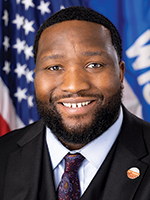
Rep. Darrin Madison
Sponsored bills
Maddy summaryThis bill establishes a violence prevention grant program funded by taxes on vapor products. The money would be distributed to local health departments and tribal health centers, which could then award grants to organizations for violence prevention initiatives. A key provision explicitly prohibits these health entities from giving the funds to law enforcement agencies or any groups working through them. The legislation also authorizes an additional $150,000 in state funding to support the administrative staff needed to manage this grant program.
Maddy summaryThis bill establishes a $25 million fund to provide financial assistance to businesses in Wisconsin that want to open new locations or expand into vacant commercial spaces. The program allows the Wisconsin Economic Development Corporation to award grants to eligible for-profit businesses, while explicitly excluding nonprofit organizations from receiving funding. Eligibility rules for the grants are designed to be similar to those used in a previous 2023 initiative, giving the corporation flexibility to set specific application procedures. Although the bill was introduced to support local commerce recovery, it ultimately failed to pass during the 2024 legislative session.
Maddy summaryThis bill directs the Department of Workforce Development to study the feasibility of creating a grant program that funds guaranteed jobs in the care economy, such as healthcare, education, and social services. The proposed program would provide grants to public and nonprofit entities to offer at least 100 days of work at $20 per hour, with priority given to specific groups including youth, people with disabilities, low-income households, long-term unemployed individuals, and formerly incarcerated people. The study must analyze the number of positions needed, associated costs, training strategies, and pathways to full-time employment, with results to be reported to state officials within 18 months. To support this research, the bill appropriates an additional $250,000 for the fiscal year 2023-24.
Maddy summaryAB 1225 eliminates the $6.25 fee for annual fishing licenses issued to resident senior citizens in Wisconsin. To fund this change, the bill requires the state to transfer an amount equal to the total fees that would have been collected from these licenses into the conservation fund each fiscal year. The legislation also updates related statutes to reflect the zero cost for these licenses and clarifies that no issuing fee applies to them.
Maddy summaryThis bill establishes a state program to provide loans and grants to housing cooperatives for infrastructure improvements. The funding, totaling $10 million, is intended for organizations that own residential properties used as homes by their members, including multi-family apartment complexes and manufactured or mobile home communities. Recipients can use the funds to repair or upgrade buildings, add energy-saving features, install storm shelters, or build community facilities to ensure properties remain safe and affordable. The Wisconsin Housing and Economic Development Authority will manage the program and set specific rules for how the money is awarded.
Maddy summaryThis bill creates a revolving loan fund and program administered by the Wisconsin Housing and Economic Development Authority to provide financing for housing cooperatives. The program is designed to help these cooperatives build or purchase resident-owned housing, with a specific focus on manufactured or mobile home communities and multi-family apartment complexes. Loans issued under the program must have interest rates at or below market levels or be interest-free, and they require that at least 50 percent of the units remain affordable to households earning up to 80 percent of the area median income. Additionally, the bill appropriates $25 million to establish the fund and includes a requirement that the loan amount becomes due if the housing is sold, unless the sale is to a current resident under a rent-to-own agreement approved by the authority.