

Maddy summaryAJR 90 is a ceremonial resolution recognizing August 2025 as Immunization Awareness Month in Wisconsin. It does not create new laws or policies but formally acknowledges the importance of vaccines through the state legislature's public recognition. The resolution cites Wisconsin's school immunization requirements and global vaccine impact statistics as context for this symbolic observance. It directly affects the Wisconsin Legislature by authorizing its members to publicly honor this awareness month. This is a procedural resolution with no binding policy changes or direct impact on residents.
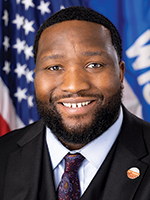
Rep. Darrin Madison
Sponsored bills
Maddy summaryAB 340 increases state reimbursement for school medical services in Wisconsin from 60% to 100% of the federal share for eligible school districts, cooperative agencies, and specialized programs like the Wisconsin Center for the Blind and Visually Impaired. It also raises reimbursement for administrative costs from 90% to 100% of the federal share, using time studies to calculate these costs. The bill explicitly includes common carrier transportation costs as part of reimbursable school medical services, unless federal policy changes prohibit it. School districts and agencies must still comply with federal health department requirements to receive these reimbursements.
Maddy summaryAB 92 creates a Spinal Cord Injury Council in Wisconsin's Department of Health Services to oversee research funding. It allocates $2.5 million biennially for grants supporting research into new treatments for spinal cord injuries, including pharmaceutical, medical device, and rehabilitative approaches. The council - composed of researchers, patients, veterans, and family members - sets grant criteria, reviews applications, and recommends awardees. Grant recipients must present findings at department-hosted symposia (held no more than once every two years) and report annual results to the legislature. This directly affects Wisconsin-based researchers and medical institutions conducting spinal cord injury research.
Maddy summaryAB 403 requires certain buildings (like public facilities and commercial properties) to install universal changing stations for diaper changes or other needs. It creates a tax credit to help offset the cost of installing these stations for building owners or operators. The bill also includes state funding (an appropriation) to support the implementation of this requirement. This directly affects property owners in covered buildings by mandating new infrastructure while providing financial assistance through the tax credit.
Maddy summaryAB 332 requires drivers to stop for pedestrians in crosswalks at intersections with traffic signals or when pedestrians have begun crossing on a green signal. It applies to all vehicles, including those turning, and affects pedestrians, bicyclists, and riders of e-scooters or mobility devices. The bill clarifies that drivers must yield and remain stopped until the pedestrian or device has safely crossed, whether at signaled intersections or unmarked crosswalks. It also specifies that pedestrians may not suddenly enter a vehicle's path, and drivers must yield to all crossing users during turns on red signals.
Maddy summaryAB 435 restructures funding and governance for Wisconsin's Warren Knowles-Gaylord Nelson Stewardship 2000 conservation program. It establishes a new Knowles-Nelson Stewardship Board with specific member appointments (including assembly/senate representatives, environmental groups, tribal representatives, and outdoor recreation stakeholders) and creates two new grant programs: one for nonprofit conservation organizations ($5 million annually) and a tribal co-management program ($3 million annually). The bill also adjusts debt limits for the program and modifies how funds are allocated from the capital improvement fund to support state parks, local recreation, and boating facilities. This directly affects conservation organizations, tribal governments, local municipalities, and outdoor recreation businesses receiving program funding.
Maddy summaryAB 431 creates a "special motion to strike" process to quickly dismiss lawsuits that target individuals or groups for speaking out on public issues, such as criticizing government actions or participating in public debates. If a plaintiff sues for speech protected under free speech or petition rights, the defendant can file this motion; the court will dismiss the case unless the plaintiff proves they are likely to win. If the motion succeeds, the winning defendant typically recovers attorney fees, unless the motion was frivolous or delayed the case. This bill directly affects people engaging in public discourse, including activists, journalists, and community members, by making it harder for opponents to use lawsuits to silence them.
Maddy summaryAB 444 prohibits state agencies, local governments, and county sheriffs from using public facilities (including jails) to detain people solely based on immigration status. It also bans state or local funding for immigrant detention facilities. The bill directly affects all state and local entities that operate facilities or manage public funds, preventing them from participating in immigration enforcement through detention or financial support. The law creates a clear legal barrier to state involvement in immigration detention systems, effective upon enactment.
Maddy summaryAB 378 requires all state agencies to mask or anonymize personally identifiable information (PII) before sharing it with the federal government, directly affecting state agencies handling sensitive data like health records or social services. The bill allows limited exceptions for sharing unmasked data when required by law, for legislative constituent services, or for court operations. It also creates a civil lawsuit option for individuals harmed by negligent violations, allowing recovery of actual damages, up to $1,000 in punitive damages, and attorney fees. The law aims to strengthen data privacy protections by limiting federal access to identifiable state records without explicit safeguards.
Maddy summaryAB 490 creates a statewide suicide prevention program funded by an annual $250,000 appropriation. The program requires the Department of Health Services to implement public awareness campaigns, coordinate with community groups, and provide training for law enforcement, healthcare providers, schools, and others who interact with people at risk of suicide. It specifically targets at-risk groups including youth, elderly individuals, Native Americans, and rural residents through county-level initiatives, crisis service enhancements, and a centralized resource website. The bill also mandates annual reports to the legislature on program activities starting in 2027.