

Maddy summaryAB 872 creates a new Energy Innovation Grant Program to fund projects advancing clean energy technologies. It allocates $10 million annually for the 2025-26 and 2026-27 fiscal years, directly supporting the Office of Energy Innovation within the Public Service Commission. The program allows the agency to distribute grants for innovative energy solutions, with no specific project types or recipient criteria detailed in the bill. This is a funding measure with no voting record yet, as the bill was introduced on January 16, 2026.
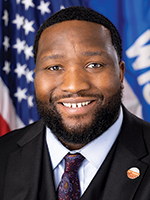
Rep. Darrin Madison
Sponsored bills
Maddy summaryAB 844 allows cities, counties, villages, and towns to adopt stricter energy efficiency standards for new buildings than the state's baseline code, provided they follow a state-developed "stretch energy code." Local governments can choose to implement either residential or commercial components of this code, which must exceed current state minimums. The state must create the stretch energy code by December 2026 through a working group including energy experts, climate nonprofits, and municipalities with climate plans. This directly affects local building regulations without changing the state's baseline requirements.
Maddy summaryAB 857 creates a climate change scholarship program funding $5 million annually for Wisconsin students enrolled in climate-related academic programs at eligible colleges and universities (including UW System, technical colleges, tribal colleges, or private nonprofits). It requires scholarships to be split equally between merit-based and need-based awards, with a $5,000 annual limit per student. The program is funded through a dedicated appropriation in the state budget, administered by the Higher Educational Aids Board. Students with unresolved child support liens may be excluded unless they provide approved payment plans.
Maddy summaryAB 867 creates a new program allowing public utilities to finance energy improvements (like solar panels or insulation) at residential properties. Utilities would cover the upfront costs and recover them over time by adding a small, regular charge to the homeowner's utility bill. The Public Service Commission must develop rules to govern this program. This directly affects homeowners seeking energy upgrades and the utilities offering this financing option.
Maddy summaryAB 858 requires Wisconsin's Public Service Commission to consider a minimum "social cost of carbon" of $185 per metric ton of CO2 emissions when reviewing energy certificates. It mandates that costs for expanding fossil fuel infrastructure can only be recovered from customers who directly benefit from that infrastructure, and prohibits passing transition costs to renewable energy onto ratepayers. The bill directly affects utilities seeking infrastructure investments and residential/commercial electricity customers paying rates. Key provisions ensure fossil fuel expansion costs are tied to specific beneficiaries while shielding customers from transition expenses during the shift to renewables.
Maddy summaryAB 853 allocates $200,000 annually for the 2025-26 and 2026-27 fiscal years to fund two full-time research positions at the University of Wisconsin-Madison focused on agriculture and climate change. The positions must be filled using existing vacant research roles (not creating new ones), assigned to the university's extension division, and contribute to increasing the total number of research positions at UW-Madison. The bill modifies the state budget to add this funding under existing appropriations for the University of Wisconsin System. It does not create new positions but directs existing resources toward climate science research in agriculture through UW-Madison's extension program.
Maddy summaryAB 860 requires state and county correctional facilities to provide written guides detailing inmates' and juveniles' rights, updated annually or after legal changes. These guides must account for individual circumstances like confinement status and location, and be posted throughout facilities, provided upon entry or transfer, and explained by staff to all affected individuals. The bill appropriates $200,000 for the Department of Administration to contract with legal organizations - including formerly incarcerated individuals - to develop these guides by June 2027. The law takes effect July 1, 2027, directly affecting all inmates in state prisons, county jails, and juveniles in youth facilities across Wisconsin.
Maddy summaryAB 851 authorizes $25 million from the capital improvement fund to purchase agricultural conservation easements, which are agreements that limit development on farmland to preserve agricultural use. The bill creates new funding mechanisms (20.115 (7) (br) and (tb)) to reimburse costs for these easements and specifies payment procedures for the Department of Agriculture, Trade and Consumer Protection. It directly affects landowners selling conservation easements and state agencies administering the program. The appropriation supports farmland conservation by enabling the state to acquire easements under Section 93.73. The bill repeals an outdated statute (23.197 (15)) and amends related sections to implement these funding changes.
Maddy summaryAB 852 establishes new grants for local governments to implement farmland preservation plans, including activities like updating zoning, creating farmland agreements, and monitoring compliance. It also requires the state to automatically adjust the farmland preservation tax credit for inflation annually using agricultural price data, ensuring the credit keeps pace with rising costs. These changes directly affect Wisconsin farmers who claim the tax credit and local governments (counties, cities, tribes) that receive implementation grants. The bill creates specific funding mechanisms through the working lands fund and sets eligibility criteria for grant recipients based on plan alignment and project effectiveness.
Maddy summaryAB 871 allows Milwaukee’s city government to install water, gas, sewer, and heat utility pipes (laterals/service pipes) on private property without the landowner’s permission under specific conditions. It applies only to absentee owners (non-residents) after the city makes at least three documented contact attempts, and with tenant consent for the property. Crucially, the city cannot charge property owners for these installations - the costs remain with the city. This change affects Milwaukee homeowners with vacant properties and tenants, streamlining utility upgrades while shifting financial responsibility from residents to the city.