

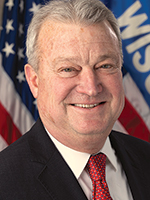
Photo of Joel Kitchens
R Wisconsin Assembly · District 1 On the 2026 ballot

Rep. Joel Kitchens

Compare
Total votes
810
all sessions
Attendance
99%
8 missed
Near the chamber average
With party
99%
of cast votes
Near the chamber average
Bipartisan score
0%
crosses aisle rarely
Near the chamber average
Sponsored
761
bills & resolutions
Near the chamber average
Committees
5
assignments
761 bills and resolutions

Sponsored bills

Total
761
Primary
761
Co-sponsor
0
This page
761
matching current filters
Primary AB 477
Failed · Wisconsin Assembly · Lead sponsor
Relating to: age for the issuance of a Missing Child Alert.

Maddy summaryAB 477 changes the age threshold for issuing a Missing Child Alert from under 10 years to under 12 years. It directly affects minors under 12 who are believed to be incapable of returning home without assistance due to a physical or mental condition, disability, or inability to navigate safely. The bill amends the statute to adjust the age requirement while maintaining the existing criteria for qualifying alerts. This is a technical adjustment to the alert system's eligibility rules, not a new program or policy. The change aims to expand the alert coverage to include older minors who may still require urgent assistance.

Failed Mar 23, 2026 0 co-sponsors
Primary AB 196
Failed · Wisconsin Assembly · Lead sponsor
Relating to: rehired annuitants in the Wisconsin Retirement System. (FE)

Maddy summaryThis bill changes Wisconsin's retirement system rules for state retirees who return to work. It allows retirees who rejoin state employment (after a 75-day separation) to choose whether to keep their retirement annuity for up to 60 months, instead of having it automatically suspended. If they elect to keep the annuity, their new employer must pay equivalent retirement contributions to the system. The policy directly affects state retirees returning to jobs where they work at least two-thirds full-time, while ensuring retirement fund contributions remain intact.

Failed Mar 23, 2026 0 co-sponsors
Primary AB 296
Failed · Wisconsin Assembly · Lead sponsor
Relating to: eliminating the 13-week limit on the garnishment of earnings of certain debtors.

Maddy summaryAB 296 removes a 13-week waiting period that previously required employers (garnishees) to verify if they would owe wages within 13 weeks before processing wage garnishments. It directly affects debtors with ongoing wage garnishment orders and the employers handling those garnishments. The bill eliminates this waiting period, allowing garnishments to begin immediately upon employer notification. It also maintains existing priority rules, ensuring child support and restitution garnishments take precedence over other wage garnishments, with specific limits on the percentage of disposable earnings that can be garnished.

Failed Mar 23, 2026 0 co-sponsors
Primary AB 315
Passed · Wisconsin Assembly · Lead sponsor
Relating to: the Warren Knowles-Gaylord Nelson stewardship 2000 program and a major land acquisitions program. (FE)

Maddy summaryAB 315 modifies grant rules for Wisconsin's Warren Knowles-Gaylord Nelson stewardship program and land conservation efforts. It creates new provisions requiring governmental units and nonprofits to apply for funding *before* purchasing land to qualify for up to 50% of acquisition costs (reduced to 40% if applying after purchase). The bill maintains a 30% cap on additional costs covered by grants or in-kind contributions. These changes directly affect local governments and conservation groups seeking state funds to acquire land for parks, recreation, or conservation. The bill does not create new funding but adjusts eligibility and percentage limits for existing programs.

Passed Mar 23, 2026 0 co-sponsors
Primary AB 197
Failed · Wisconsin Assembly · Lead sponsor
Relating to: a levy limit exemption for regional emergency medical systems and eligibility for the expenditure restraint incentive program. (FE)

Maddy summaryAB 197 creates a new exemption allowing local governments (like counties or municipalities) to count certain regional emergency medical services costs toward their budget limits without triggering spending restrictions. To qualify, the service must cover at least 232 square miles or include 8 municipalities, and annual cost increases must stay below the inflation rate plus 5%. The exemption requires confirmation of a regional service area and a designated coordination entity for EMS across the area. This specifically affects jurisdictions operating joint emergency medical services districts or intergovernmental agreements for EMS, including fire department-provided services.

Failed Mar 23, 2026 0 co-sponsors
Primary AB 644
Passed · Wisconsin Assembly · Lead sponsor
Relating to: state aid for consolidated school districts. (FE)

Maddy summaryAB 644 modifies state aid formulas for school districts that consolidate. It provides consolidated districts that merge in 2026, 2027, or 2028 with a higher initial payment of $2,000 per student in their first year, followed by $150 per student for the next four years. Districts consolidating outside this window receive $150 per student for five years (first year plus four subsequent years). The bill directly affects school districts undergoing consolidation, ensuring adjusted funding during transition periods. It passed the Assembly on November 19, 2025, with 53-44 support.

Passed Mar 23, 2026 0 co-sponsors
Primary AB 648
Passed · Wisconsin Assembly · Lead sponsor
Relating to: supplemental state aid for consolidated school districts. (FE)

Maddy summaryAB 648 provides supplemental state aid to school districts formed by consolidation after July 1, 2026. It directly affects these newly consolidated districts by determining eligibility based on property tax rates: if their projected tax rate after consolidation exceeds the lowest rate of the original districts, they qualify for aid. The aid amount is calculated as the difference between the projected tax rate and the lowest original rate, multiplied by the district's property valuation. Payments are phased over four years (100% in the first year, then 80%, 60%, and 40% in subsequent years) if state funds are sufficient.

Passed Mar 23, 2026 0 co-sponsors
Primary AB 647
Passed · Wisconsin Assembly · Lead sponsor
Relating to: whole grade sharing grants for school boards. (FE)

Maddy summaryAB 647 creates a 4-year grant program for school districts that enter into whole grade sharing agreements (where districts share entire grade levels, such as all 5th graders). Eligible school boards receive $500 per enrolled student in the shared grade level each school year, starting in 2026-27, with funds distributed annually. The program requires school districts to submit annual reports on grant usage, and the state department must report to the legislature on grant distribution and spending. This directly affects school districts participating in grade-sharing arrangements by providing ongoing funding for shared educational resources.

Passed Mar 23, 2026 0 co-sponsors
Primary AB 646
Passed · Wisconsin Assembly · Lead sponsor
Relating to: requiring a school district consolidation study. (FE)

Maddy summaryAB 646 requires the Department of Public Instruction to commission a study on school district consolidation by January 1, 2027. The study must examine school boundaries, facility conditions, population demographics, staffing, finances, and geographic feasibility across all school districts. The resulting report must include specific consolidation recommendations with details on projected enrollment, affected communities, school locations, and property values. This study aims to inform future decisions about district boundaries but does not mandate any immediate consolidation.

Passed Mar 23, 2026 0 co-sponsors
Primary AB 156
Passed · Wisconsin Assembly · Lead sponsor
Relating to: requiring child sexual abuse prevention education. (FE)

Maddy summaryAB 156 requires public school districts in the 2026-27 school year to provide age-appropriate child sexual abuse prevention education to all students from 4-year-old kindergarten through 12th grade. The curriculum must include specific topics like correct body part names, setting personal boundaries, identifying safe adults, distinguishing safe/unsafe touch, and reporting abuse, using research-based methods. Schools must notify parents about the program schedule and content annually, and parents can opt their child out with a written request. This law directly affects all K-12 students and their families in public schools across the state.

Passed Mar 23, 2026 0 co-sponsors
Showing 81 to 90 of 761 bills
Previous 1 … 8 9 10 … 77 Next