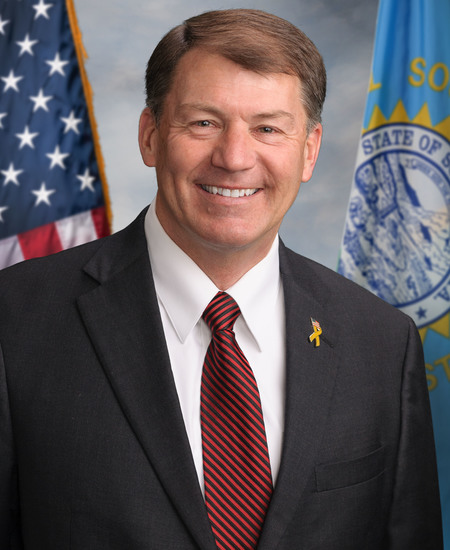
Photo of Mike Rounds
R United States Senate · South Dakota On the 2026 ballot

Sen. Mike Rounds

Compare
Total votes
1,037
all sessions
Attendance
93%
71 missed
Higher than 94% of chamber peers
With party
92%
of cast votes
Near the chamber average
Bipartisan score
5%
crosses aisle rarely
Near the chamber average
Sponsored
1,063
bills & resolutions
Near the chamber average
Committees
18
assignments
1,063 bills and resolutions

Sponsored bills

Total
1,063
Primary
148
Co-sponsor
915
This page
1,063
matching current filters
Co-sponsor S 3831
In committee · Wisconsin Senate · Co-sponsor
Enhancing Multi-Class Share Disclosures Act

Maddy summaryThis bill requires public companies with multi-class share structures (where different share classes have varying voting rights) to disclose specific ownership details. Companies must include in shareholder proxy materials or other filings the percentage of all voting shares owned and the voting power percentage held by each director, nominee, executive officer, and any beneficial owner with 5%+ of voting power. The disclosure focuses on translating share holdings into clear percentages of both total voting shares and total voting power. This aims to increase transparency about how voting control is distributed among shareholders.

In committee Feb 11, 2026 1 co-sponsor
Co-sponsor S 2904
In committee · Wisconsin Senate · Co-sponsor
SHADOW Fleet Sanctions Act of 2026

Maddy summaryThe SHADOW Fleet Sanctions Act of 2026 imposes sanctions on vessels and foreign entities supporting Russia's shadow fleet - vessels used to circumvent sanctions on Russian oil exports. It targets foreign vessels engaging in unsafe maritime behavior, lacking proper insurance, or evading the crude oil price cap, as well as foreign persons facilitating such activities through ship-to-ship transfers, insurance, or port services. The bill requires sanctions on port terminals in China or India accepting oil from sanctioned vessels and establishes a public database of vessels suspected of sabotage activities. It also creates reporting requirements and a strategy to counter China's role in evading sanctions on Russian energy products.

In committee Feb 10, 2026 1 co-sponsor
Co-sponsor S 2236
In committee · Wisconsin Senate · Co-sponsor
YALI Act of 2026

Maddy summaryThe YALI Act of 2026 formalizes and expands the Young African Leaders Initiative (YALI), directly affecting young African leaders aged 18-35 in sub-Saharan Africa who demonstrate leadership potential in business, civic engagement, or public administration. Key provisions include increasing Mandela Washington Fellowship participation beyond 700 annual fellows, establishing four regional leadership centers for in-person and online training, and creating an online network connecting participants with U.S. and African leaders. The bill mandates annual reporting to Congress on program progress, impacts on U.S.-Africa relations, and includes a 5-year sunset provision. It focuses on developing skills in governance, entrepreneurship, peacebuilding, and economic resilience through U.S.-Africa partnerships.

In committee Feb 10, 2026 1 co-sponsor
Co-sponsor S 3809
In committee · Wisconsin Senate · Co-sponsor
AI Grand Challenges Act of 2026

Maddy summaryThe AI Grand Challenges Act of 2026 directs the National Science Foundation (NSF) to establish prize competitions for U.S.-based researchers and companies to solve specific, measurable problems in critical areas like health, national security, energy, and cancer research. It requires the NSF to publish clear problem statements and success metrics for each challenge, including a mandatory $10 million prize competition focused on AI-driven cancer breakthroughs for detection, treatment, or diagnostics. Eligibility is limited to U.S. entities or citizens/permanent residents, with annual reporting to Congress on competition results and public accessibility via the Challenge.gov platform. The bill mandates public input on challenge selection and biennial reports detailing program activities and outcomes.

In committee Feb 9, 2026 1 co-sponsor
Co-sponsor SRES 601
Passed · Wisconsin Senate · Co-sponsor
A resolution designating the week beginning February 2, 2026, as "National Tribal Colleges and Universities Week".

Maddy summaryThis Senate resolution (SRES 601) designates the week beginning February 2, 2026, as "National Tribal Colleges and Universities Week" to recognize these institutions' role in serving Native communities and their economic contributions. It highlights that tribal colleges serve students from over 250 federally recognized tribes, offer culturally grounded education, and contribute $3.8 billion annually to the U.S. economy. As a symbolic resolution (not a law), it has no binding effect but calls for public observance through community activities. The resolution focuses on honoring tribal colleges' mission and achievements, citing their open enrollment and economic impact statistics.

Passed Feb 5, 2026 1 co-sponsor
Primary S 699
In committee · Wisconsin Senate · Lead sponsor
Purchased and Referred Care Improvement Act of 2025

Purchased and Referred Care Improvement Act of 2025 This bill specifies that the Indian Health Service (IHS) must reimburse patients for their out-of-pocket costs for authorized purchased/referred care services within 30 days. (The IHS provides medical and dental services directly to American Indian and Alaska Native patients whenever possible. However, when services are not available, IHS beneficiaries may be referred to private providers. This is called purchased/referred care.) Specifically, the bill requires the Department of Health and Human Services (HHS) to establish and implement procedures to allow a patient who paid out of pocket for purchased/referred care services authorized by the IHS to be reimbursed by the IHS for that payment no later than 30 days after the patient submits required documentation.  Additionally, the bill requires HHS to update applicable provisions of and exhibits to the Indian Health Manual, contracts with providers, and other relevant documents and administrative authorities to incorporate the provisions of the bill. The bill also replaces statutory references to contract health service with purchased/referred care .

In committee Feb 4, 2026 0 co-sponsors
Co-sponsor S 3767
In committee · Wisconsin Senate · Co-sponsor
Stronger Engagement for Indian Health Needs Act of 2026

Maddy summaryS 3767, the Stronger Engagement for Indian Health Needs Act of 2026, reorganizes administrative leadership within the Indian Health Service. It changes the title of the position from "Director of the Indian Health Service" to "Assistant Secretary for Indian Health" throughout federal law, including the Indian Health Care Improvement Act and related statutes. The bill updates all references to this role in existing laws, executive orders, and documents, and specifies that the Assistant Secretary's salary will be paid from the Indian Health Services account. This is an administrative reorganization bill with no new funding or policy changes for tribal health programs. It directly affects the structure of the Indian Health Service within the Department of Health and Human Services.

In committee Feb 3, 2026 1 co-sponsor
Co-sponsor SRES 592
Passed · Wisconsin Senate · Co-sponsor
A resolution supporting the designation of 2026 as the "International Year of the Woman Farmer" to recognize and honor the critical role of women in agriculture.

This resolution supports the designation of 2026 as the International Year of the Woman Farmer and recognizes the critical role of women in agriculture. The resolution also encourages citizens to celebrate the impact these women have on the food systems and agricultural workforce of the United States by encouraging and empowering women to pursue careers in agriculture and cultivate leadership opportunities.

Passed Jan 29, 2026 1 co-sponsor
Co-sponsor S 3752
In committee · Wisconsin Senate · Co-sponsor
SAVE America Act

Safeguard American Voter Eligibility Act or the SAVE America Act This bill requires individuals to provide documentary proof of U.S. citizenship when registering to vote, and requires photo identification to vote, in federal elections. Specifically, the bill prohibits states from accepting and processing an application to register to vote in a federal election unless the applicant presents documentary proof of U.S. citizenship. The bill specifies what documents are considered acceptable proof of U.S. citizenship, such as identification that complies with the REAL ID Act of 2005 that indicates U.S. citizenship. Further, the bill (1) prohibits states from registering an individual to vote in a federal election unless, at the time the individual applies to register to vote, the individual provides documentary proof of U.S. citizenship; and (2) requires states to establish an alternative process to demonstrate U.S. citizenship. Each state must take affirmative steps on an ongoing basis to ensure that only U.S. citizens are registered to vote, which shall include establishing a program to identify individuals who are not U.S. citizens using information supplied by certain sources. Additionally, states must remove noncitizens from their official lists of eligible voters. The bill (1) provides for a private right of action for certain violations, and (2) establishes criminal penalties for certain offenses. Individuals voting in federal elections must present an eligible photo identification document. An individual who votes by absentee ballot must submit a copy of their identification document with both the request for, and the submission of, the absentee ballot.


In committee Jan 29, 2026 1 co-sponsor
Co-sponsor S 3697
In committee · Wisconsin Senate · Co-sponsor
SAVE Moms and Babies Act of 2026

Maddy summaryThe SAVE Moms and Babies Act of 2026 prohibits the FDA from approving new abortion drugs or granting investigational exemptions for them. It requires existing approved abortion drugs to be dispensed only in-person by certified healthcare providers in clinics or hospitals (not pharmacies), mandates providers to verify pregnancy duration and handle complications, and enforces strict adverse event reporting to the FDA. The bill directly affects healthcare providers prescribing abortion drugs, patients seeking these medications, and the FDA’s regulatory authority over such drugs. Key provisions include banning use after 70 days gestation, requiring provider certification for specific medical capabilities, and mandating documentation of risks to patients.

In committee Jan 27, 2026 1 co-sponsor
Showing 91 to 100 of 1,063 bills
Previous 1 9 10 11 107 Next