

Maddy summaryHB 1806 redirects 50% of commercial fishing landing tax revenue to the cities or counties where fish are first landed, primarily benefiting rural coastal communities in southwest Washington that rely heavily on the fishing industry. The bill amends tax collection rules to ensure this portion - previously going to the state general fund - directly supports local public safety and infrastructure needs in these communities. Key provisions specify that 50% of the "landing tax" paid by commercial fishers on certain species (like salmon) must be distributed locally, while smaller percentages fund state conservation accounts and the general fund. This policy change takes effect January 1, 2027, aiming to align tax revenue with community needs.
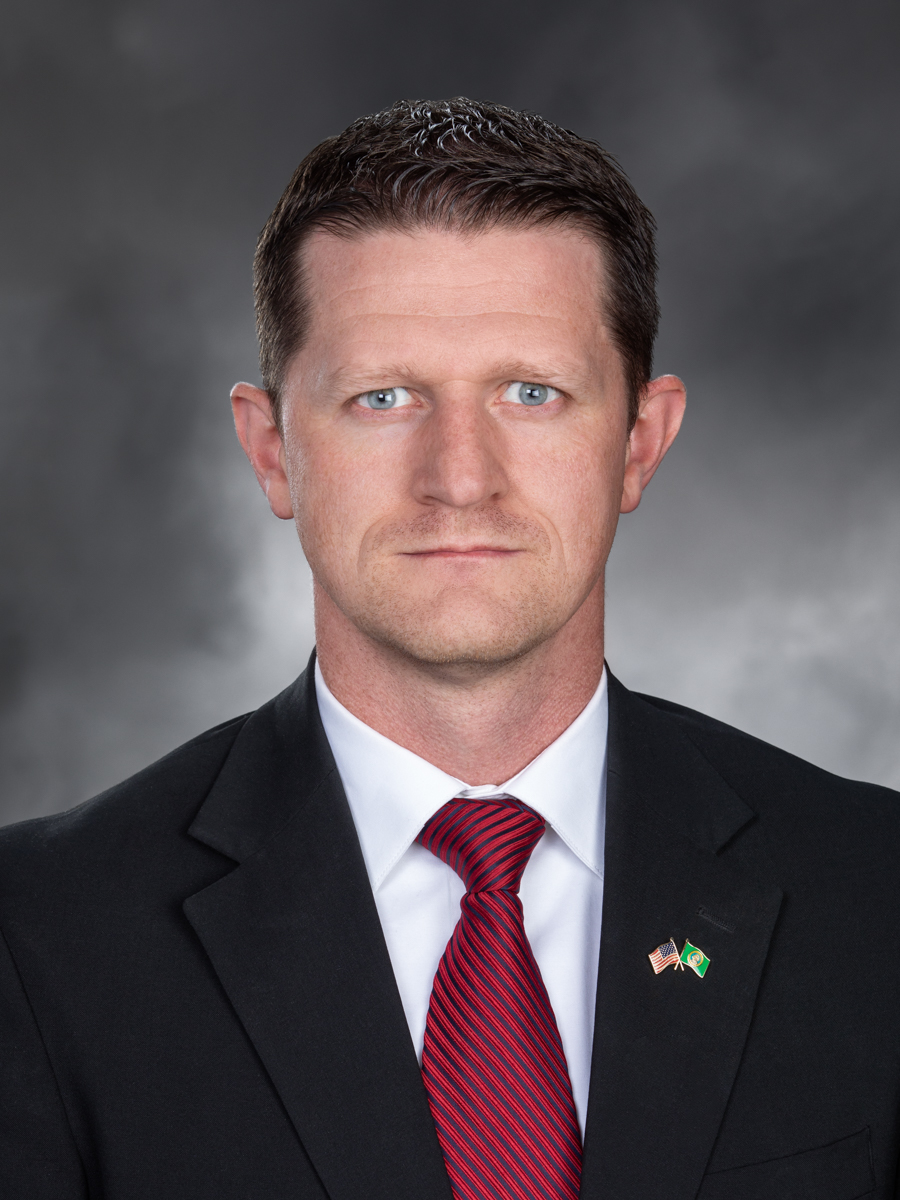
Rep. Joel McEntire
Sponsored bills
Maddy summaryHB 1134 establishes a voluntary "Washington state green schools program" within the Office of the Superintendent of Public Instruction to promote student-led resource conservation in public schools. The program provides limited stipend funding ($600 max per school annually) for school-based advisors to support student education and leadership in waste reduction, energy conservation, water efficiency, and urban forestry initiatives. Schools with over 50% of students eligible for free/reduced-price meals receive priority for funding, and the program aligns with state science curriculum standards on climate and sustainability. It is funded using revenues from the Climate Commitment Act and complements existing district conservation efforts.
Maddy summaryHouse Bill 2080 aims to prevent the Washington state legislature from enacting taxes that specifically target a single individual, business, or entity. The bill prohibits the assessment of any new excise tax if it is intended to, or has the effect of, applying only to one specific individual, business, or a group of individuals affiliated with a singular business. This measure would ensure that state tax policy provides for common welfare rather than being used to target particular entities. It affects the state's ability to levy highly specific taxes and protects individual businesses from such targeted taxation.
Maddy summaryHB 1118 changes Washington's process for restoring firearm rights to individuals previously banned from owning guns. It allows people with certain past convictions (like nonviolent misdemeanors or specific felonies) to petition a court for restored rights after meeting strict requirements, including 3-5 years of clean records and completing all court-ordered obligations. The bill adds procedural steps, such as requiring courts to verify eligibility with law enforcement, notifying victims of the petition, and using standardized court forms starting in 2024. It does not apply to those convicted of violent felonies, sex offenses, or crimes with 20+ year sentences.
Maddy summaryHB 1433 would establish a regulated system in Washington for adults 21+ to access psychedelic substances for therapeutic use under licensed professionals. It directs the Department of Health to license facilitators and service centers, and the Liquor & Cannabis Board to oversee manufacturers and testing, requiring sessions in controlled environments with trained guides. The bill emphasizes reducing costs to improve equity, particularly for historically disadvantaged communities, while explicitly stating it does not require insurance coverage or override federal law. This would create a legal framework for safe, supervised use and research, pending legislative approval.
Maddy summaryHB 1721 allows qualified zero-emission vehicle (ZEV) manufacturers - those with no existing dealership agreements - to sell directly to consumers in Washington, provided they establish at least two service centers and offer mobile repair services in the state. It supports traditional auto dealers by creating a grant program for EV technician training and charging infrastructure, with dealers selling at least 50% of their vehicles as ZEVs qualifying for additional funding. The bill requires ZEV manufacturers to honor warranties at designated service centers and mandates annual reports starting in 2026 to evaluate the program’s effectiveness, with a final review scheduled for 2034. These changes aim to expand ZEV access while balancing dealer transitions and consumer protections.
Maddy summaryHB 1538 creates a new grant program to help small, financially struggling school districts (with 1,000 students or fewer) modernize or rebuild aging school buildings. It requires projects to address critical safety issues like seismic risks, outdated infrastructure, and accessibility barriers in buildings over 30 years old and rated "poor" by the state. Districts must first secure a planning grant to assess needs before applying for construction grants, with funding prioritized based on financial need and building conditions. Grants cover project planning, design, and construction costs (excluding district administration), but cannot exceed 110% of the statewide average cost per square foot.
Maddy summaryHB 2036 prohibits individuals convicted of violent offenses involving a firearm from earning early release credits under Washington's sentencing laws. It directly affects people serving sentences for violent crimes where a firearm was used or involved, as defined by existing law. The bill amends RCW 9.94A.729 to explicitly deny all "good time credits or earned release time" for sentences tied to such offenses. This change modifies current early release eligibility rules, ensuring offenders convicted of firearm-related violent crimes cannot reduce their sentences through earned credits. The policy focuses on restricting sentence reductions for specific high-risk offenses, not altering general sentencing guidelines.
Maddy summaryHB 1751 exempts required course materials (like textbooks and digital resources) from Washington state sales and use taxes for students enrolled at public colleges and universities. It requires students to show valid enrollment proof at approved vendors (campus bookstores or institution-designated online sellers) to qualify for the exemption. Public institutions must inform students about this tax break via their websites and course syllabi. The bill directly affects all students at Washington’s public higher education institutions by reducing out-of-pocket costs for essential learning materials, which the legislature notes are increasingly unaffordable (65% of students skip buying textbooks due to cost).
Maddy summaryHB 1585 requires Washington counties to verify that registered voters have proof of U.S. citizenship by July 1, 2025. It directs county election offices to check if voters have submitted acceptable documentation (like a passport, naturalization certificate, or specific certified U.S. birth certificate) and to send notices if they lack it. Voters without proof face registration cancellation 14 days before the 2025 general election unless they provide documentation. The law expires January 1, 2027, and explicitly rejects birth certificates from Puerto Rico issued before July 2010 and Washington wallet-sized birth registrations as valid proof.