

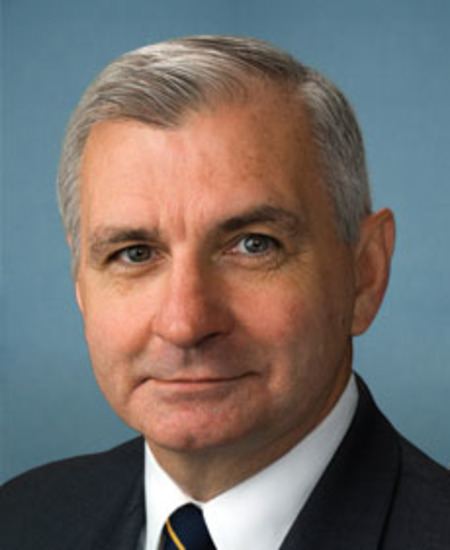
Photo of Jack Reed
D United States Senate · Rhode Island On the 2026 ballot

Sen. Jack Reed

Compare
Total votes
1,037
all sessions
Attendance
100%
of floor votes
Higher than 94% of chamber peers
With party
99%
of cast votes
Higher than 94% of chamber peers
Bipartisan score
1%
crosses aisle rarely
Lower than 98% of chamber peers
Sponsored
1,075
bills & resolutions
Near the chamber average
Committees
20
assignments
1,075 bills and resolutions

Sponsored bills

Total
1,075
Primary
137
Co-sponsor
938
This page
1,075
matching current filters
Primary S 3907
In committee · Washington Senate · Lead sponsor
Foreign Stablecoin Transparency Act

Maddy summaryThis bill requires large foreign stablecoin issuers (with over $50 billion in outstanding value) that aren’t already subject to SEC reporting to prepare annual financial statements disclosing related party transactions and undergo independent audits. The audits must follow Public Company Accounting Oversight Board (PCAOB) standards for auditor independence, internal controls, and related transactions. It directly affects major foreign digital currency platforms currently operating without U.S. financial disclosure obligations. The law aims to increase transparency for these issuers by mandating standardized financial reporting and verification.

In committee Feb 24, 2026 0 co-sponsors
Co-sponsor SCONRES 25
Passed · Washington Senate · Co-sponsor
A concurrent resolution recognizing the 15th anniversary of the January 8, 2011, Tucson, Arizona, shooting and honoring the survivors and victims, including former Congresswoman Gabby Giffords, a gun violence survivor and one of the most influential voices of courage in the United States in the fight to end gun violence.

Maddy summaryThis concurrent resolution (SCONRES 25) commemorates the 15th anniversary of the January 8, 2011, Tucson shooting that killed six people and injured 13, including former Congresswoman Gabby Giffords. It honors the victims (such as Judge John Roll, Gabriel Zimmerman, and 9-year-old Christina-Taylor Green), survivors like Giffords and Ron Barber (who later became a U.S. Representative), and the community's response. The resolution expresses support for survivors, recognizes Giffords’ advocacy against gun violence, and reaffirms commitment to respectful dialogue and opposing political violence. As a symbolic gesture, it does not enact new laws or policy changes.

Passed Feb 13, 2026 1 co-sponsor
Co-sponsor S 3869
In committee · Washington Senate · Co-sponsor
Healthy Families Act

Maddy summaryThe Healthy Families Act would require most private employers and certain government entities to provide employees with earned paid sick time, allowing workers to take up to 56 hours per year for their own health needs, caring for family members, or addressing domestic violence, sexual assault, or stalking. Employees would earn 1 hour of paid sick time for every 30 hours worked, with the ability to use it for medical appointments, caring for family members with health needs, or seeking safety from violence. The bill prohibits employers from retaliating against workers who use this time and requires employers to post clear notices about the policy. It applies to most private employers, with specific provisions for government entities like the Library of Congress and Government Accountability Office.

In committee Feb 12, 2026 1 co-sponsor
Co-sponsor S 3875
In committee · Washington Senate · Co-sponsor
Responsible Firearms Marketing Act

Maddy summaryThis bill requires the Federal Trade Commission (FTC) to study firearm advertising and marketing for unfair or deceptive practices, such as ads targeting people under 18, implying illegal use, or promoting semiautomatic assault weapons. Within two years, the FTC must report findings to Congress and then create regulations to ban these practices within 18 months of the report. These regulations would apply to firearm manufacturers, dealers, and importers, prohibiting specific deceptive marketing tactics. Violations would be enforced under existing FTC authority, with penalties matching current unfair business practice violations.

In committee Feb 12, 2026 1 co-sponsor
Co-sponsor S 3847
In committee · Washington Senate · Co-sponsor
Stop Corporate Inversions Act of 2026

Maddy summaryThis bill amends U.S. tax law to prevent corporations from avoiding U.S. taxes through "inversions," where a foreign company acquires a U.S. business and moves its tax residence abroad. It treats certain foreign corporations as domestic for tax purposes if they acquire a U.S. entity after May 8, 2014, and either have over 50% of their stock held by former U.S. shareholders or maintain significant U.S. operations (at least 25% of employees, compensation, assets, or income in the U.S.). Exceptions apply if the corporation has substantial business activities in its original foreign country. The changes apply to taxable years ending after May 8, 2014, targeting tax avoidance strategies rather than affecting most standard multinational businesses.

In committee Feb 11, 2026 1 co-sponsor
Co-sponsor S 3811
In committee · Washington Senate · Co-sponsor
American Business for American Companies Act of 2026

Maddy summaryThis bill prohibits U.S. federal agencies from awarding contracts to "inverted domestic corporations" - foreign companies that have acquired U.S. businesses and now have significant foreign ownership. It applies to civilian and defense contracts exceeding $10 million, requiring contractors to avoid subcontracting with these entities for more than 10% of a contract's value. The bill defines an "inverted domestic corporation" as a foreign entity that acquired a U.S. business and now has more than 50% of its stock held by former U.S. shareholders, or has significant U.S. business operations (at least 25% of employees, compensation, assets, or income in the U.S.). Agencies can waive this rule for national security or health programs but must report such waivers to Congress within 14 days.

In committee Feb 9, 2026 1 co-sponsor
Co-sponsor SRES 600
Passed · Washington Senate · Co-sponsor
A resolution recognizing January 2026 as "National Mentoring Month".

Maddy summaryThis resolution designates January 2026 as "National Mentoring Month" to raise public awareness about mentoring programs. It recognizes the benefits of mentoring for youth - including improved academic performance, mental health, career development, and reduced risk of delinquency - and highlights that 40% of U.S. youth lack a mentor. The Senate encourages community, school, and workplace efforts to expand existing mentoring programs and recruit volunteers to support young people. It does not create new laws or funding but aims to promote existing mentoring initiatives across the country.

Passed Feb 5, 2026 1 co-sponsor
Primary S 3793
In committee · Washington Senate · Lead sponsor
Predatory Lending Elimination Act

Maddy summaryThe Predatory Lending Elimination Act applies military lending protections to all consumers, not just military members, by setting strict interest rate limits on personal loans and credit cards. It prohibits lenders from charging excessive rates on most consumer credit (except residential mortgages, auto loans for vehicle purchases, and federal credit union loans) and bans exemptions that would weaken these caps. The law preserves stronger state consumer protections and allows state attorneys general to enforce violations within three years. It requires the Consumer Financial Protection Bureau to issue rules within one year to implement these rate limits and ensure consistency with existing military lending standards.

In committee Feb 5, 2026 0 co-sponsors
Primary S 3777
In committee · Washington Senate · Lead sponsor
Rebuild America’s Schools Act of 2026

Maddy summaryThe Rebuild America's Schools Act of 2026 would provide $20 billion annually (2027-2031) to improve public school facilities across the United States. The bill directs funds to states based on previous Title I funding allocations, requiring states to contribute 10% of the funds (with some exceptions) and develop plans for equitable distribution to school districts. Local educational agencies must prioritize schools with high numbers of students eligible for free or reduced-price lunch, and funds can be used for construction, renovation, energy efficiency upgrades, removal of toxic substances, and making facilities accessible. The bill also establishes school infrastructure bonds to leverage private investment and includes specific provisions to repair foundations damaged by pyrrhotite.

In committee Feb 4, 2026 0 co-sponsors
Co-sponsor S 3761
In committee · Washington Senate · Co-sponsor
Student Loan Bond Expansion Act of 2026

Maddy summaryS 3761, the Student Loan Bond Expansion Act of 2026, modifies federal tax rules to make it easier for states and local governments to issue bonds that fund student loans. The bill exempts "qualified student loan bonds" from two key restrictions: the annual limit on tax-exempt bond issuance (volume cap) and the alternative minimum tax calculation. This change allows more such bonds to be issued without triggering these tax rules, directly benefiting state or local entities that issue these bonds to support student loan programs. The law applies to bonds issued after the bill's enactment date.

In committee Feb 3, 2026 1 co-sponsor
Showing 101 to 110 of 1,075 bills
Previous 1 10 11 12 108 Next