

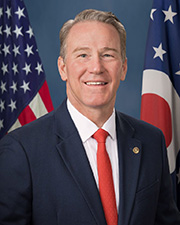
Photo of Jon Husted
R United States Senate · Ohio On the 2026 ballot

Sen. Jon Husted

Compare
Total votes
433
all sessions
Attendance
98%
7 missed
Near the chamber average
With party
97%
of cast votes
Near the chamber average
Bipartisan score
1%
crosses aisle rarely
Near the chamber average
Sponsored
210
bills & resolutions
Lower than 91% of chamber peers
Committees
17
assignments
210 bills and resolutions

Sponsored bills

Total
210
Primary
52
Co-sponsor
158
This page
210
matching current filters
Co-sponsor S 237
In committee · Washington Senate · Co-sponsor
Honoring Our Fallen Heroes Act of 2025

Maddy summaryThis bill expands benefits for public safety officers (like police and firefighters) who develop certain cancers linked to their work. It creates a presumption that specific cancers - such as lung, bladder, or mesothelioma - were caused by job-related exposure to carcinogens, if the officer served at least 5 years, was diagnosed within 15 years of leaving active duty, and the cancer caused death or permanent disability. The list of covered cancers will be updated every 3 years based on medical evidence from agencies like the National Institute for Occupational Safety and Health. Claims must be filed within 3 years of the bill’s enactment, applying to cases involving deaths or disabilities occurring after January 1, 2020.

In committee May 20, 2025 1 co-sponsor
Co-sponsor S 1793
In committee · Washington Senate · Co-sponsor
COUNTER Act

Maddy summaryThe COUNTER Act (S 1793) amends U.S. military law to clarify and expand authorities for responding to drone threats. It allows the Secretary of Defense to delegate drone mitigation actions to combatant commanders and exempts related technology and protocols from public disclosure under federal and state laws. The bill specifies that certain federal laws (like those covering cybercrime and aviation) do not apply to military drone mitigation efforts conducted outside the United States. It also updates reporting deadlines and adds new definitions for military commands involved in drone threat response, with key provisions extending until 2030. This bill directly affects Department of Defense and Coast Guard operations related to unmanned aircraft system threats.

In committee May 15, 2025 1 co-sponsor
Co-sponsor SRES 220
Passed · Washington Senate · Co-sponsor
A resolution designating the week of May 11 through May 17, 2025, as "National Police Week".

Maddy summarySRES 220 designates the week of May 11-17, 2025, as "National Police Week" to honor law enforcement officers across the United States. The resolution recognizes officers who have been killed, disabled, or injured in the line of duty, including 234 officers honored for 2024 fatalities and 18 officers killed in 2025. It expresses the Senate’s support for law enforcement, acknowledges the need for adequate resources for officer safety, and encourages public observance to celebrate their service and sacrifices. This is a ceremonial resolution with no new policy or funding changes.

Passed May 13, 2025 1 co-sponsor
Co-sponsor S 1707
In committee · Washington Senate · Co-sponsor
Helping Young Americans Save for Retirement Act

Maddy summaryThe Helping Young Americans Save for Retirement Act (S 1707) lowers the minimum age for joining employer retirement plans, such as 401(k)s, from 21 to 18. Young workers aged 18 or older can now participate if they work at least 500 hours in two consecutive 12-month periods. The bill amends federal retirement laws (ERISA) and tax code provisions to implement this change, directly affecting new workers entering the workforce. These provisions will apply to retirement plan years starting one year after the bill becomes law.

In committee May 12, 2025 1 co-sponsor
Co-sponsor S 1639
In committee · Washington Senate · Co-sponsor
American Innovation and Jobs Act

Maddy summaryThis bill allows businesses to immediately deduct research and development (R&D) costs instead of spreading them over 60 months, directly benefiting companies investing in innovation. It increases the refundable R&D credit cap for small businesses from $250,000 to $750,000 over time, with specific phase-in amounts starting in 2025. Additionally, it expands access for startups by raising the gross receipts threshold for eligibility from $5 million to $15 million and increasing credit rates for qualified small businesses. These changes aim to make R&D tax incentives more accessible and valuable for smaller companies and new ventures.

In committee May 7, 2025 1 co-sponsor
Co-sponsor SRES 201
Passed · Washington Senate · Co-sponsor
A resolution expressing support for the designation of the week of May 4, 2025, through May 10, 2025, as "National Small Business Week" to celebrate the contributions of small businesses and entrepreneurs in every community in the United States.

Maddy summarySRES 201 is a non-binding Senate resolution designating the week of May 4-10, 2025, as "National Small Business Week." It honors small businesses and entrepreneurs across all U.S. communities for their economic contributions, citing that small businesses support over 59 million jobs. The resolution recognizes their resilience and celebrates their role in strengthening local economies. This symbolic gesture, consistent with annual presidential proclamations since 1963, does not create new laws or affect any specific group through policy changes.

Passed May 5, 2025 1 co-sponsor
Co-sponsor S 1532
In committee · Washington Senate · Co-sponsor
A bill to amend the Internal Revenue Code of 1986 to modify the railroad track maintenance credit.

This bill increases the annual limit on the tax credit for qualified railroad track maintenance expenses (also referred to as the short line railroad tax credit) and expands eligibility for claiming the credit. Under current law, the tax credit is limited each tax year to $3,500 multiplied by the sum of the number of miles of railroad track owned or leased by the taxpayer (miles owned or leased) and the number of railroad track miles assigned to the taxpayer by a Class II or III railroad (miles assigned). This bill increases the annual limit to $6,100 multiplied by the sum of miles owned or leased and miles assigned. The $6,100 amount used in the calculation of the tax credit limit is adjusted for inflation for tax years beginning after 2025. The bill also expands eligibility for the tax credit to include gross expenses for maintaining railroad tracks owned or leased as of January 1, 2024. Under current law, the tax credit is limited to gross expenses for maintaining railroad tracks owned or leased as of January 1, 2015.

In committee Apr 30, 2025 1 co-sponsor
Co-sponsor S 1541
In committee · Washington Senate · Co-sponsor
SHIPS for America Act of 2025

Maddy summary# Summary of the SHIPS for America Act of 2025 This comprehensive maritime legislation establishes a wide-ranging framework to strengthen the U.S. maritime industry, workforce, and infrastructure. Key components include: ## Shipbuilding and Maritime Infrastructure - Establishes a **Shipbuilding Financial Incentives Program** (Section 501) to support commercial vessel construction - Creates a **National Shipbuilding Research Program** (Section 522) to advance shipbuilding technology - Mandates an **Anticipated Commercial Vessel Construction Survey** (Section 506) to inform industry planning - Establishes a **United States Center for Maritime Innovation** (Section 521) to accelerate technology adoption - Requires a **Maritime Infrastructure Readiness Assessment** (Section 523) ## Workforce Development - Creates a **Merchant Marine Career Retention Program** (Section 606) with an 8-3-1 schedule to maintain mariner qualifications - Provides **Public Service Loan Forgiveness** for Merchant Marines (Section 601) - Establishes **Eligibility for Educational Assistance** (Section 602) for Merchant Mariners - Creates **Reimbursement for Spouse Relicensing Costs** (Section 604) - Implements **Noncompetitive Federal Employment** for Merchant Mariners (Section 605) ## Education and Training - Establishes **Centers of Excellence for Domestic Maritime Workforce Training** (Section 612) - Creates a **Maritime Career and Technical Education Advisory Committee** (Section 613) - Develops a **Military to Maritime Transition Program** (Section 616) - Establishes **International Exchange Programs** for mariners and naval architects (Section 618) - Mandates **Maritime Worker Data Collection** (Section 615) to track industry needs ## Additional Provisions - Requires **Reports on National Defense Reserve Fleet** (Section 509) - Mandates an **Assessment of Commercial Best Practices for Navy Shipbuilding** (Section 511) - Establishes **Military Sealift Command** improvements (Section 513) - Creates a **Maritime Workforce Data Collection System** (Section 615) The legislation is funded through the **Maritime Security Trust Fund** (established under Section 50301(b)) and represents a comprehensive strategy to strengthen U.S. maritime capabilities for national security, economic competitiveness, and workforce development.

In committee Apr 30, 2025 1 co-sponsor
Co-sponsor S 1504
In committee · Washington Senate · Co-sponsor
Claiming Age Clarity Act

Maddy summaryS 1504, the Claiming Age Clarity Act, changes Social Security Administration terminology by 2027 to replace terms like "early eligibility age" and "full retirement age" with clearer phrases such as "minimum monthly benefit age" and "standard monthly benefit age." It also eliminates the term "delayed retirement credit" and refers to age 70 as the "maximum monthly benefit age" instead. These changes apply to all Social Security Administration materials, including online resources and printed guides, directly affecting how beneficiaries and the public understand retirement benefit options.

In committee Apr 29, 2025 1 co-sponsor
Co-sponsor S 1515
In committee · Washington Senate · Co-sponsor
Affordable Housing Credit Improvement Act of 2025

Maddy summaryThe Affordable Housing Credit Improvement Act of 2025 updates the Low-Income Housing Tax Credit program to increase affordability and accessibility for low-income households. It raises state allocation amounts through revised per capita calculations, modifies income eligibility rules to better serve extremely low-income households, and adds protections for domestic violence victims in housing. The bill expands "difficult development areas" to include rural areas and Indian lands, and changes the program's name from "Low-Income Housing Credit" to "Affordable Housing Credit" to better reflect its purpose. These changes aim to make affordable housing more accessible while improving transparency and accountability in the program's implementation.

In committee Apr 29, 2025 1 co-sponsor
Showing 151 to 160 of 210 bills
Previous 1 15 16 17 21 Next