

John R. Lewis Voting Rights Advancement Act of 2021 This bill establishes new criteria for determining which states and political subdivisions must obtain preclearance before changes to voting practices may take effect. Preclearance is the process of receiving preapproval from the Department of Justice (DOJ) or the U.S. District Court for the District of Columbia before making legal changes that would affect voting rights. The bill also includes provisions related to federally protected activities at polling places and voting access on tribal lands. A state and all of its political subdivisions shall be subject to preclearance of voting practice changes for a 10-year period if 15 or more voting rights violations occurred in the state during the previous 25 years; or 10 or more violations occurred during the previous 25 years, at least 1 of which was committed by the state itself. A political subdivision as a separate unit shall also be subject to preclearance for a 10-year period if three or more voting rights violations occurred there during the previous 25 years. States and political subdivisions that meet certain thresholds regarding minority groups must preclear covered practices before implementation, such as changes to methods of election and redistricting. Further, states and political subdivisions must notify the public of changes to voting practices. Next, the bill authorizes DOJ to require states or political subdivisions to provide certain documents or answers to questions for enforcing voting rights. The bill also outlines factors courts must consider when hearing challenges to voting practices, such as the history of official voting discrimination in the state or political subdivision. In addition, the bill (1) includes certain protections for election workers, polling places, and election infrastructure; and (2) expands voting access on tribal lands.
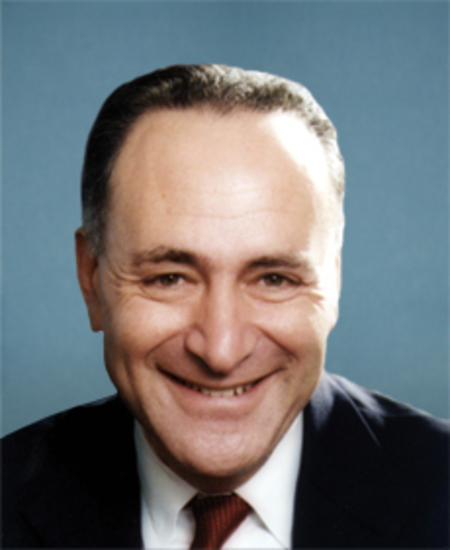
Sen. Charles E. Schumer
Sponsored bills
Designates the facility of the United States Postal Service located at 66 Meserole Avenue in Brooklyn, New York, as the "Joseph R. Lentol Post Office."
Freedom to Vote Act This bill addresses voter registration and voting access, election integrity and security, redistricting, and campaign finance. Specifically, the bill expands voter registration (e.g., automatic and same-day registration) and voting access (e.g., vote-by-mail and early voting). It also limits removing voters from voter rolls. Next, the bill establishes Election Day as a federal holiday. The bill declares that the right of a U.S. citizen to vote in any election for federal office shall not be denied or abridged because that individual has been convicted of a criminal offense unless, at the time of the election, such individual is serving a felony sentence. The bill establishes certain federal criminal offenses related to voting. In particular, the bill establishes a new criminal offense for conduct (or attempted conduct) to corruptly hinder, interfere with, or prevent another person from registering to vote or helping someone register to vote. Additionally, the bill sets forth provisions related to election security, including by requiring states to conduct post-election audits for federal elections. The bill outlines criteria for congressional redistricting and generally prohibits mid-decade redistricting. The bill addresses campaign finance, including by expanding the prohibition on campaign spending by foreign nationals, requiring additional disclosure of campaign-related fundraising and spending, requiring additional disclaimers regarding certain political advertising, and establishing an alternative campaign funding system for certain federal offices.
This resolution recognizes (1) the celebration of Hispanic Heritage Month from September 15 - October 15, 2021; and (2) the integral role of Latinos and their manifold heritage in the economy, culture, and identity of the United States.
Champlain Valley National Heritage Partnership Reauthorization Act This bill extends through FY2036 the authority of the Department of the Interior to provide any assistance to the Champlain Valley National Heritage Area Partnership in Vermont and New York. The bill eliminates the ceiling on the total amount that may be appropriated for the partnership. Finally, the bill decreases to 25% the amount of the nonfederal share of partnership activities carried out using federal funds.
This resolution authorizes Senate Legal Counsel to represent the Select Committee on Intelligence and Senator Warner in the case of Shawn Musgrave v. Mark Warner and the U.S. Senate Select Committee on Intelligence .
This resolution authorizes Senate Legal Counsel to represent Secretary of the Senate Sonceria Ann Berry and the Office of the Secretary of the Senate in the case of Shawn Musgrave v. J. Thomas Manger, et al .
Pregnant Workers Fairness Act This bill prohibits employment practices that discriminate against making reasonable accommodations for qualified employees affected by pregnancy, childbirth, or related medical conditions. A qualified employee is an employee or applicant who, with or without reasonable accommodation, can perform the essential functions of the position, with specified exceptions. Specifically, the bill declares that it is an unlawful employment practice to fail to make reasonable accommodations to known limitations of such employees unless the accommodation would impose an undue hardship on an entity's business operation; require a qualified employee affected by such condition to accept an accommodation other than any reasonable accommodation arrived at through an interactive process; deny employment opportunities based on the need of the entity to make such reasonable accommodations to a qualified employee; require such employees to take paid or unpaid leave if another reasonable accommodation can be provided; or take adverse action in terms, conditions, or privileges of employment against a qualified employee requesting or using such reasonable accommodations. The bill sets forth enforcement procedures and remedies that cover different types of employees in relation to such unlawful employment practices. The Equal Employment Opportunity Commission must provide examples of reasonable accommodations that shall be provided to affected employees unless the employer can demonstrate that doing so would impose an undue hardship. The bill prohibits state immunity under the Eleventh Amendment to the Constitution from an action for a violation of this bill.
This bill suspends the public debt limit through December 16, 2022. The bill also requires the limit to be adjusted on December 17, 2022, to accommodate obligations issued during the suspension period.
This resolution honors the life of Robert Dove, Parliamentarian Emeritus of the Senate, and offers the condolences of the Senate regarding his death.