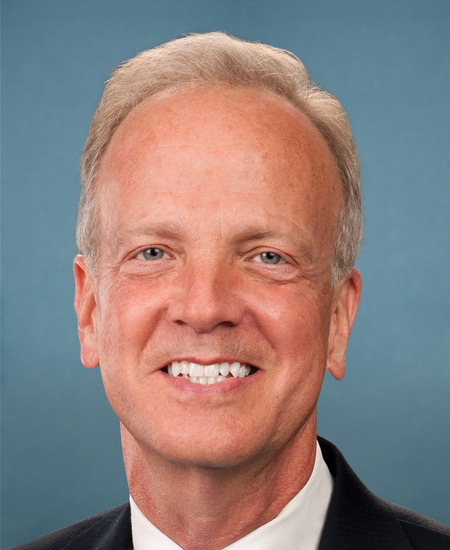
Photo of Jerry Moran
R United States Senate · Kansas

Sen. Jerry Moran

Compare
Total votes
1,037
all sessions
Attendance
96%
41 missed
Lower than 79% of chamber peers
With party
91%
of cast votes
Near the chamber average
Bipartisan score
5%
crosses aisle rarely
Near the chamber average
Sponsored
1,050
bills & resolutions
Near the chamber average
Committees
17
assignments
1,050 bills and resolutions

Sponsored bills

Total
1,050
Primary
193
Co-sponsor
857
This page
1,050
matching current filters
Co-sponsor S 2421
In committee · Washington Senate · Co-sponsor
CLEAR Waters Act

Maddy summaryThe CLEAR Waters Act (S 2421) clarifies the definition of "navigable waters" under the Clean Water Act by explicitly excluding certain water features from federal regulation. It directly affects wastewater treatment facilities (like lagoons and ponds), seasonal streams that flow only after rain, and groundwater by removing them from the Clean Water Act's jurisdiction. Key provisions add specific exclusions to the definition, including waste treatment systems, ephemeral features, groundwater, and future exclusions determined by the EPA and Army Corps. This changes which water bodies require federal permits for pollution control, shifting oversight away from these excluded features.

In committee Jul 23, 2025 1 co-sponsor
Primary S 2423
In committee · Washington Senate · Lead sponsor
Streamlining Rural Housing Act of 2025

Maddy summaryS 2423, the Streamlining Rural Housing Act of 2025, aims to simplify the approval process for rural housing projects funded by the Department of Housing and Urban Development (HUD) or the Department of Agriculture (USDA). It requires HUD and USDA to create a shared process within 180 days to streamline environmental reviews, designate a lead agency for projects, and establish an advisory group with housing stakeholders (including nonprofits, developers, residents, and public housing agencies). The bill mandates a report within one year with recommendations to speed up project approvals while maintaining safety, resident costs, and environmental standards. This directly affects rural housing developers, public housing agencies, and residents of HUD/USDA-funded housing projects by reducing bureaucratic delays in construction.

In committee Jul 23, 2025 0 co-sponsors
Primary S 2354
In committee · Washington Senate · Lead sponsor
Commerce, Justice, Science, and Related Agencies Appropriations Act, 2026

Commerce, Justice, Science, and Related Agencies Appropriations Act, 2026 This bill provides FY2026 appropriations to the Department of Commerce, the Department of Justice (DOJ), the science agencies, and several related agencies. The bill provides appropriations to the Department of Commerce for the International Trade Administration, the Bureau of Industry and Security, the Economic Development Administration, the Minority Business Development Agency, Economic and Statistical Analysis, the Bureau of the Census, the National Telecommunications and Information Administration, the U.S. Patent and Trademark Office, the National Institute of Standards and Technology, the National Oceanic and Atmospheric Administration, and Departmental Management. The bill provides appropriations to DOJ for Justice Operations, Management, and Accountability; the Executive Office for Immigration Review; the Office of Inspector General; the U.S. Parole Commission; Legal Activities; the U.S. Marshals Service; the National Security Division; Interagency Law Enforcement; the Federal Bureau of Investigation; the Drug Enforcement Administration; the Bureau of Alcohol, Tobacco, Firearms and Explosives; and the Federal Prison System. The bill also provides appropriations to DOJ for state and local law enforcement activities, including the Office on Violence Against Women, the Office of Justice Programs, and Community Oriented Policing Services (COPS). The bill provides appropriations for science agencies, including the Office of Science and Technology Policy, the National Space Council, National Aeronautics and Space Administration (NASA), and the National Science Foundation. The bill provides appropriations to related agencies, including the Commission on Civil Rights, the Equal Employment Opportunity Commission, the U.S. International Trade Commission, the Legal Services Corporation, the Marine Mammal Commission, the Office of the U.S. Trade Representative, and the State Justice Institute. The bill also sets forth requirements and restrictions for using funds provided by this and other appropriations acts.


In committee Jul 17, 2025 0 co-sponsors
Co-sponsor S 2282
In committee · Washington Senate · Co-sponsor
Farmers First Act of 2025

Farmers First Act of 2025 This bill extends through FY2030 and revises the Farm and Ranch Stress Assistance Network (FRSAN). This Department of Agriculture program provides competitive grants to states, Indian tribes, and qualified nonprofit organizations to provide stress assistance programs (i.e., professional agricultural behavioral health counseling, helplines, and resources) to individuals engaged in farming, ranching, and agriculture-related occupations. The bill specifies that the grant funding for farm telephone helplines and websites may also be used for crisis lines. Further, FRSAN grant recipients may establish referral relationships with providers, including Certified Community Behavioral Health Clinics, health centers, rural health clinics, and critical access hospitals.

In committee Jul 15, 2025 1 co-sponsor
Primary S 2240
In committee · Washington Senate · Lead sponsor
Expanding Defense Community Partnerships Act

Maddy summaryThis bill expands how military bases can partner with local communities. It allows the Department of Defense to collaborate with other federal agencies when making agreements with state, local, or tribal governments to provide installation-support services like facility maintenance or operations. The bill also broadens funding options for these agreements, permitting use of existing operation/maintenance funds and non-military funds, and extends the deadline for such agreements from 2025 to 2030. This directly affects military installations, local governments, and tribal entities entering these partnerships.

In committee Jul 10, 2025 0 co-sponsors
Co-sponsor S 2211
In committee · Washington Senate · Co-sponsor
Special Diabetes Program Reauthorization Act of 2025

Maddy summaryThis bill reauthorizes two existing federal diabetes programs through 2027. It provides $160 million annually for fiscal years 2026 and 2027 for the Special Diabetes Program for Type I Diabetes (serving people with Type I diabetes) and the Special Diabetes Program for Indians (serving Native American communities through Indian Health Services). A final $40 million is allocated for October-December 2027 for both programs, with all funds remaining available until expended. The bill extends current funding levels without changing program eligibility or structure.

In committee Jul 8, 2025 1 co-sponsor
Co-sponsor S 2195
In committee · Washington Senate · Co-sponsor
WWII Nurses Congressional Gold Medal Act

Maddy summaryS 2195, the WWII Nurses Congressional Gold Medal Act, authorizes a Congressional Gold Medal to honor Army and Navy nurses who served during World War II, recognizing their critical military service and devotion to duty. The medal, to be designed and struck by the Secretary of the Treasury, will be displayed at the Smithsonian Institution and specific locations like the Women in Military Service for America Memorial and the National World War II Museum. The bill also permits the sale of bronze duplicates to cover production costs. This legislation provides formal recognition for nurses who provided medical care under combat conditions, including in field hospitals, prisoner-of-war camps, and evacuation efforts across multiple continents.

In committee Jun 26, 2025 1 co-sponsor
Co-sponsor SRES 296
In committee · Washington Senate · Co-sponsor
A resolution condemning antisemitism and recent antisemitic attacks in the United States.

Maddy summarySRES 296 is a Senate resolution condemning antisemitism and recent antisemitic attacks, specifically referencing the May 21, 2025, murders of Sarah Milgrim and Yaron Lischinsky at a Washington, DC, event and the June 1, 2025, Boulder, Colorado, Molotov cocktail attack. It cites data showing a record 9,354 antisemitic incidents in 2024 (a 63% rise in hate crimes since 2022) and notes Jewish Americans face disproportionate harm, including 68% of religious hate crimes despite being 2.4% of the U.S. population. The resolution does not create new laws but formally expresses the Senate’s condemnation, mourns the victims, and encourages society to combat antisemitism and support Jewish communities. It also recognizes the importance of existing federal resources, like the Nonprofit Security Grant Program, for community safety.

In committee Jun 24, 2025 1 co-sponsor
Co-sponsor S 2141
In committee · Washington Senate · Co-sponsor
Intelligence Community Workforce Agility Protection Act of 2025

Maddy summaryThis bill changes tax rules to help intelligence community employees who relocate for work. It allows these employees (excluding military members) to deduct moving expenses and exclude relocation reimbursements from taxable income when moving due to a required assignment change. The key change modifies two sections of the tax code to treat intelligence community relocations similarly to other federal employee moves. This directly affects current or new intelligence community staff who must move for mission-critical assignments. The policy aims to reduce tax burdens when these employees relocate for work.

In committee Jun 23, 2025 1 co-sponsor
Primary S 2140
In committee · Washington Senate · Lead sponsor
Haskell Indian Nations University Improvement Act

Maddy summaryThe Haskell Indian Nations University Improvement Act would transform Haskell Indian Nations University from a Bureau of Indian Education institution into a federally chartered corporation with its own independent board of trustees. This change would allow the university to operate independently from the Bureau of Indian Education, accept private donations as a tax-exempt organization, and develop its own policies to better serve its students. The bill aims to address longstanding challenges with facility maintenance, program management, and funding dependency that have affected the university's ability to provide quality education to its approximately 900 enrolled students representing 140 tribes. The new board would be composed of 15 voting members (all enrolled in Indian Tribes) and 1 student member, with the goal of improving the university's educational mission and campus environment.

In committee Jun 23, 2025 0 co-sponsors
Showing 151 to 160 of 1,050 bills
Previous 1 15 16 17 105 Next