

Ghost Army Congressional Gold Medal Act This bill directs the Speaker of the House of Representatives and the President pro tempore of the Senate to award a Congressional Gold Medal to the 23rd Headquarters Special Troops and the 3133d Signal Service Company, known as the Ghost Army , collectively, in recognition of its service during World War II.
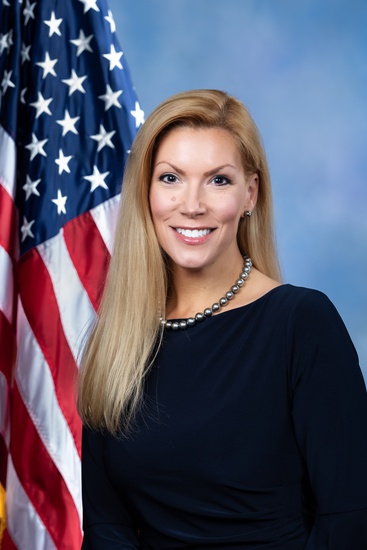
Rep. Beth Van Duyne
Sponsored bills
Regulations from the Executive in Need of Scrutiny Act of 20 21 This bill revises provisions relating to congressional review of agency rulemaking. Specifically, the bill establishes a congressional approval process for a major rule. A major rule may only take effect if Congress approves of the rule. A major rule is a rule that results in (1) an annual effect on the economy of $100 million or more; (2) a major increase in costs or prices for consumers, individual industries, government agencies, or geographic regions; or (3) significant adverse effects on competition, employment, investment, productivity, innovation, or the ability of U.S.-based enterprises to compete with foreign-based enterprises. In addition, the bill establishes a congressional disapproval process for a nonmajor rule. A nonmajor rule may only take effect if Congress does not disapprove of the rule.
Border Visibility and Security Act This bill directs the Department of Homeland Security (DHS) to install surveillance technology and take other actions with respect to the U.S.-Mexico border. DHS shall deploy the most practical and effective technology available to achieve situational awareness and operational control of the border. Such technology may include radar surveillance systems, tunnel detection technology, and unmanned aerial vehicles. DHS is authorized to waive legal requirements as necessary in order to implement the necessary surveillance technology along the border. DHS shall also (1) construct a navigable road along at least 700 miles of the southwest border, (2) permanently eradicate certain foliage that grows along the Rio Grande river, and (3) report to Congress a comprehensive strategy about the barriers and technologies needed to secure operational control along the border. Drug cartel funds that have been criminally forfeited to the U.S. government shall be reserved for security measures along the U.S.-Mexico border.
State Border Security Reimbursement Act of 2021 This bill requires the federal government to reimburse eligible states for their border security expenses. To be eligible, a state must have expended more than $2.5 billion on border security and enforcement in the 10 years before this bill's enactment. If such a state provides an accounting of all of its nonfederally funded border security expenses any time up to 180 days after this bill's enactment, the federal government shall reimburse the full amount.
Combatting COVID Unemployment Fraud Act of 2021 This bill requires additional documentation for individuals seeking pandemic unemployment assistance, requires state unemployment agencies to use designated fraud prevention tools, and otherwise addresses pandemic-related unemployment benefits.
This bill eliminates federal pandemic unemployment compensation on May 31, 2021. Under current law, this supplementary compensation is available to claimants in participating states until September 6, 2021.
Metastatic Breast Cancer Access to Care Act This bill expedites payment of Social Security Disability Insurance (SSDI) benefits and eligibility for Medicare coverage for those with metastatic breast cancer (i.e., breast cancer that has spread to other sites in the body). Specifically, the bill eliminates the 5-month waiting period for SSDI benefits and the subsequent 24-month waiting period for Medicare coverage for individuals with metastatic breast cancer. Under current law, individuals generally must wait five months after the onset of disability to begin receiving SSDI benefits and an additional 24 months to become eligible for Medicare.
EIDL Oversight Act of 2021 This bill establishes oversight requirements for economic injury disaster loans and advances made on those loans. Such requirements include directing the Small Business Administration (SBA) to (1) ensure that loan and advance proceeds are deposited in a legitimate account of a borrower, (2) ensure that any modification of a request for a loan or an advance is reviewed by an SBA employee, and (3) verify the legitimacy of loan or advance applicants through tax returns or other documentation.
Stop CRT Act This bill grants Executive Order 13950 the force and effect of law. That order prohibits federal agencies and contractors from advancing specified policies or training related to race or sex.
Motor Carrier Safety Selection Standard Act This bill establishes a standard of care for the selection of brokers and other entities that contract with motor carriers for the shipment of goods or household goods. A broker is a person, other than a motor carrier or an employee or agent of a motor carrier, that as a principal or agent sells, offers for sale, negotiates for, or holds itself out by solicitation, advertisement, or otherwise as selling, providing, or arranging for, transportation by motor carrier for compensation. Specifically, the bill requires such entities to verify that a transporting motor carrier (1) is properly registered with the Department of Transportation (DOT); (2) has obtained the minimum required insurance coverage; and (3) is not determined unfit to safely operate commercial motor vehicles, or otherwise ordered to discontinue operations by the Federal Motor Carrier Safety Administration or a state. DOT must prescribe by regulation a process for revoking the registration of an owner or operator determined unfit to safely operate a commercial motor vehicle.