

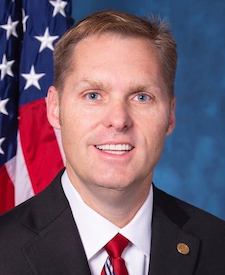
Photo of Michael Guest
R United States House · District 3 · Mississippi On the 2026 ballot

Rep. Michael Guest

Compare
Total votes
2,818
all sessions
Attendance
96%
115 missed
Near the chamber average
With party
95%
of cast votes
Near the chamber average
Bipartisan score
3%
crosses aisle rarely
Near the chamber average
Sponsored
1,015
bills & resolutions
Near the chamber average
Committees
7
assignments
1,015 bills and resolutions

Sponsored bills

Total
1,015
Primary
48
Co-sponsor
967
This page
1,015
matching current filters
Co-sponsor HR 976
In committee · Washington House · Co-sponsor
1071 Repeal to Protect Small Business Lending Act

Maddy summaryHR 976, the "1071 Repeal to Protect Small Business Lending Act," would repeal data collection and reporting requirements for small business loans under Section 704B of the Equal Credit Opportunity Act. This specifically removes the mandate for financial institutions - especially community banks and credit unions - to track and submit loan data by business characteristics like race or gender. The bill aims to reduce compliance costs for lenders, which its findings argue limit small business access to credit. The repeal would eliminate these reporting obligations and remove references to the requirement from related federal laws.

In committee May 6, 2025 1 co-sponsor
Co-sponsor HR 3151
In committee · Washington House · Co-sponsor
SHIPS for America Act of 2025

Maddy summary# Summary of the SHIPS for America Act This comprehensive legislation focuses on strengthening the U.S. maritime industry, shipbuilding capacity, and maritime workforce to enhance national security and economic competitiveness. ## Key Areas of Focus 1. **Shipbuilding & Maritime Infrastructure** - Establishes a United States Center for Maritime Innovation to accelerate adoption of commercial technologies - Creates a National Shipbuilding Research Program - Requires an annual survey of anticipated commercial vessel construction - Includes provisions for streamlined environmental reviews of maritime infrastructure 2. **Workforce Development** - Establishes the United States Merchant Marine Career Retention Program to maintain mariner qualifications - Creates Centers of Excellence for Domestic Maritime Workforce Training and Education - Implements military-to-maritime transition programs - Establishes a Maritime Career and Technical Education Advisory Committee 3. **Education & Training** - Expands educational assistance for merchant mariners - Creates eligibility for Naval Postgraduate School for merchant mariners - Establishes maritime education programs from K-12 through higher education - Provides for international exchanges for mariners and naval architects 4. **National Security & Strategic Readiness** - Requires reports on National Defense Reserve Fleet utilization - Includes measures to de-risk the maritime sector from Chinese influence - Enhances shipbuilding capacity for national security needs - Establishes programs to ensure sufficient mariner workforce for national defense 5. **Funding Mechanisms** - Authorizes appropriations from the Maritime Security Trust Fund - Includes funding for workforce programs, education, and shipbuilding initiatives - Establishes specific funding levels for various programs over multiple fiscal years The legislation aims to create a sustainable domestic maritime industrial base that supports both commercial shipping and national defense requirements, with a particular emphasis on developing and retaining a skilled U.S. maritime workforce.

In committee May 1, 2025 1 co-sponsor
Primary HR 3102
In committee · Washington House · Lead sponsor
To direct the Secretary of Health and Human Services to establish an Office of Rural Health, and for other purposes.

Maddy summaryThis bill creates a new Office of Rural Health within the Centers for Disease Control and Prevention (CDC) to address healthcare needs in rural communities. The office will coordinate CDC research, develop policies, and award grants focused on improving rural health access - particularly through telehealth - while identifying healthcare gaps and disparities. It directly affects rural populations by targeting challenges like chronic disease prevention, injury prevention, and limited care access. The office will work across CDC programs and coordinate with other federal health agencies to avoid duplicating efforts on rural health initiatives.

In committee Apr 30, 2025 0 co-sponsors
Co-sponsor HR 3057
In committee · Washington House · Co-sponsor
National POW/MIA Memorial and Museum Act

Maddy summaryThis bill designates the POW/MIA Memorial and Museum under construction in Jacksonville, Florida, as the official "National POW/MIA Memorial and Museum." It requires the museum to submit a detailed report to Congress within 90 days, including a five-year budget, organizational structure, bylaws, and accreditation details. The designation may be withdrawn if the museum is not operational within five years of the bill's enactment or if the required report is late. The museum honors prisoners of war and those missing in action since World War II through educational exhibits and reflective spaces for the public.

In committee Apr 29, 2025 1 co-sponsor
Co-sponsor HR 3044
In committee · Washington House · Co-sponsor
No Vaccine Mandates in Higher Education Act

Maddy summaryHR 3044, the "No Vaccine Mandates in Higher Education Act," prohibits federal funding from being provided to colleges and universities that require students or staff to receive a COVID-19 vaccine for enrollment, employment, or access to services. This directly affects institutions of higher education receiving federal funds, such as those participating in student aid programs. The bill's key mechanism is withholding federal funds from any institution enforcing such vaccine mandates, as defined under the Higher Education Act of 1965. The law focuses solely on vaccine requirements, not other health or safety policies.

In committee Apr 28, 2025 1 co-sponsor
Co-sponsor HR 633
In committee · Washington House · Co-sponsor
TAKE IT DOWN Act

Maddy summaryThe TAKE IT DOWN Act makes it a crime to intentionally share intimate images or digital forgeries of people without their consent, with penalties of up to 2 years in prison for adults and 3 years for minors. It requires major online platforms to establish a 48-hour process for victims to request removal of such content, with platforms protected from liability when acting in good faith. The bill defines "digital forgery" as AI-generated content that appears authentic and applies to websites and apps primarily hosting user-generated content, excluding email services and broadband providers. The Federal Trade Commission will enforce these notice and takedown requirements. This legislation directly affects victims of nonconsensual intimate content, the platforms hosting such material, and individuals who distribute it.

In committee Apr 28, 2025 1 co-sponsor
Co-sponsor HRES 337
In committee · Washington House · Co-sponsor
Recognizing linemen, the profession of linemen, the contributions of these brave men and women who protect public safety, and expressing support for the designation of April 18, 2025, as "National Lineman Appreciation Day".

Maddy summaryHRES 337 is a symbolic House resolution honoring linemen for their critical role in maintaining power infrastructure and responding to emergencies. It recognizes them as first responders who work in dangerous conditions 24/7 to keep electricity flowing, supporting schools and businesses during storms. The resolution formally supports designating April 18, 2025, as "National Lineman Appreciation Day" to publicly acknowledge their contributions. As a non-binding resolution, it has no direct policy impact or effect on affected individuals.

In committee Apr 17, 2025 1 co-sponsor
Co-sponsor HR 2854
In committee · Washington House · Co-sponsor
Neighborhood Homes Investment Act

Maddy summaryThe Neighborhood Homes Investment Act creates a new tax credit for developers who build or rehabilitate affordable homes in distressed communities. The credit is calculated as the lesser of (1) the difference between development costs and sale price, (2) 40% of development costs, or (3) 32% of the national median home price. It applies only to homes sold to qualified homeowners with income up to 140% of area median income in designated "qualified census tracts" (areas with high poverty rates, low median home values, and low median family income). Developers must meet quality standards and repay the credit if the home is sold within 5 years of the affordable sale. This credit aims to address the "value gap" that prevents housing development in distressed communities by incentivizing affordable home construction and rehabilitation.

In committee Apr 10, 2025 1 co-sponsor
Co-sponsor HR 2158
In committee · Washington House · Co-sponsor
Countering Transnational Repression Act of 2025

Maddy summaryThe Countering Transnational Repression Act of 2025 establishes a new Transnational Repression Working Group within the Department of Homeland Security to monitor and address threats where foreign governments or their agents target individuals in the U.S. through coercion, harassment, surveillance, or threats. The bill requires the Working Group to produce annual assessments of such incidents - including data on perpetrators, countries involved, and government responses - and share information with law enforcement partners. It mandates privacy and civil liberties safeguards, prohibits infringing on free speech, and includes a 7-year sunset provision. The law directly affects DHS operations, federal-state-local law enforcement coordination, and individuals targeted by foreign government repression tactics.

In committee Apr 9, 2025 1 co-sponsor
Co-sponsor HR 2705
In committee · Washington House · Co-sponsor
Nuclear Family Priority Act

Nuclear Family Priority Act This bill imposes limits on various types of family-sponsored immigration visas. The non-U.S. national ( alien  under federal law) parents of U.S. citizens shall not qualify for visas for immediate relatives, which are not subject to any direct numerical limits. Currently, the spouses, unmarried children under 21, and parents of citizens are considered immediate relatives. The bill also creates a nonimmigrant visa for such parents of citizens. Such non-U.S. nationals shall not be eligible for employment or any public benefits. The bill also reduces the baseline annual cap for family-sponsored visas from 480,000 to 88,000, and revises the methods for calculating the cap. Currently, the 480,000 cap may be adjusted depending on various factors but shall not be less than 226,000. The bill eliminates preference allocations (visa categories subject to various annual caps) for various family-sponsored visas, including those for the siblings and married children of citizens. The bill provides for a preference allocation for the unmarried children under 21 and spouses of permanent residents, subject to the 88,000 annual cap.

In committee Apr 8, 2025 1 co-sponsor
Showing 161 to 170 of 1,015 bills
Previous 1 16 17 18 102 Next