This resolution expresses the sense of the House of Representatives that the Department of Homeland Security (DHS) provides essential protection for our country from foreign and domestic threats and that defunding DHS would be detrimental to our national security.
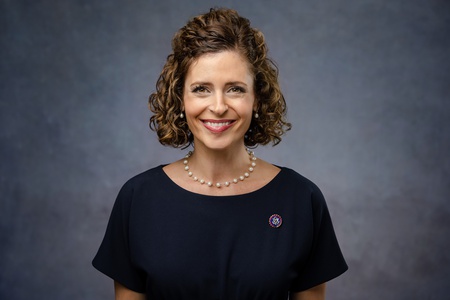
Rep. Julia Letlow
Sponsored bills
Broadband for Rural America Act This bill modifies and consolidates Department of Agriculture (USDA) programs for expanding broadband internet in rural areas. Specifically, the bill modifies a program that provides grants, loans, and loan guarantees to support broadband expansion in rural areas. Modifications include revising the criteria used to prioritize applications and projects and changing the name of the program to the ReConnect Rural Broadband Program. Additionally, the bill terminates on June 30, 2022, a Department of Agriculture (USDA) COVID-19 response program that supports broadband expansion in rural areas for distance learning and telemedicine. Any remaining program funds available after the termination date shall be used for the ReConnect Rural Broadband Program. The bill also expands coordination requirements that apply to the Department of Commerce, USDA, the Federal Communications Commission (FCC), and the National Telecommunications and Information Administration. This includes requiring the use of specified FCC maps when assessing a community's access to broadband.
Supporting Working Mothers Act This bill extends protections for a working mother who expresses breast milk for the employee's nursing child to cover salaried employees and other types of workers not covered under existing law. Further, time spent to express breast milk must be considered hours worked if the nursing mother is also working. The Government Accountability Office must report on the implementation and expansion of the workplace accommodations under this bill.
USA Workforce Tax Credit Act This bill allows tax credits for charitable contributions to certain nonprofit organizations with the exclusive purpose of providing (1) workforce development and apprenticeship training, or (2) scholarships for elementary and secondary education expenses of students from households with income that does not exceed 200% of the median gross income. The bill limits the credits to specified amounts for individuals and corporations. It also (1) imposes a tax on workforce development, apprenticeship training, and scholarship granting organizations that fail to distribute a specified portion of their receipts; and (2) establishes a $2 billion annual volume cap for the tax credits allowed under this bill.
Rebuilding Communities After Disasters Act This bill requires the Small Business Administration (SBA) to increase the loan limits for the disaster loan program and to communicate certain information about the program following disasters. Specifically, the bill raises from $40,000 to $75,000 the loan amount for repair or replacement of household and personal effects and from $200,000 to $400,000 the loan amount for repair or replacement of a primary residence. Further, the bill requires the SBA to communicate through radio, television, print, and web-based outlets all relevant information needed by disaster loan applicants if a disaster is declared or the SBA declares eligibility for additional disaster assistance. (Currently, the SBA is only required to endeavor to communicate such information.) The SBA must submit a report on the disaster loan program that includes information such as the number and dollar value of program loans and the average estimated dollar value of damage sustained by borrowers.
Restore the Rights of Property Owners under the Eviction Moratorium Issued by the CDC Act of 2021 This bill nullifies beginning on July 1, 2021, the emergency order (and any extensions of the order) issued by the Centers for Disease Control and Prevention on September 4, 2020, that restricted residential evictions during the COVID-19 emergency. It also prohibits the order from being reissued unless specifically authorized by law.
Disaster Reforestation Act This bill sets forth a special rule for the tax deduction for casualty losses of uncut timber (including pre-merchantable timber). It provides that in losses of any uncut timber from fire, storm, insects, invasive species, drought, or other casualty, or from theft, the basis for determining the amount of the deduction for such loss shall not be less than the excess of the value of such timber determined immediately before such loss was sustained, over the salvage value of such timber. To be eligible for the casualty loss deduction, the uncut timber subject to the loss must be reforested not later than the close of the five-year period beginning on the date of the loss.
Pandemic Unemployment Assistance Fraud Protection Act This bill creates several requirements for states to address fraudulent claims for Pandemic Unemployment Assistance (PUA), temporarily increases penalties for fraud related to PUA, and requires each state to establish a hotline for victims of unemployment fraud. Specifically, the bill requires states to cross reference PUA claims with federal and state prison records and E-Verify to ensure that claimants are eligible for PUA, submit to the Department of Labor plans to recover fraudulently obtained PUA, develop an anti-fraud task force to investigate and recover fraudulently obtained PUA, make restitution to Labor for the amount of any overpayment of PUA made by the state, and establish a hotline designed to encourage individuals who are victims of unemployment fraud and have received an incorrect statement of unemployment compensation to report that fraud. The bill also temporarily enhances the maximum penalty for fraud related to PUA through December 31, 2021, so that the offense is classified as fraud in relation to a presidentially declared major disaster or emergency and punishable by up to 30 years imprisonment, a fine of up to $1,000,000, or both.

Foreign Gain-of-Function Research Prevention Act of 2021 This bill prohibits the use of federal funds to conduct or support gain-of-function research involving potential pandemic pathogens by China, Russia, Iran, North Korea, or other foreign adversaries. Gain-of-function research is any research that is anticipated to confer an attribute on a pathogen to enhance its pathogenicity or transmissibility in mammals. If the Department of State finds that an entity has used funds for prohibited research, the entity may not receive any federal funding for a period of five years.
Campus Free Speech Restoration Act This bill addresses expressive activities (e.g., peacefully assembling, distributing literature, or carrying signs) on college campuses. First, the bill generally prohibits a public institution of higher education (IHE) that participates in federal student-aid programs from restricting noncommercial expressive activities on campus. Further, the bill prohibits a public IHE from receiving federal funds if the Department of Education determines that the public IHE (1) maintains a policy that infringes upon the expressive rights of students; or (2) maintains or enforces time, place, or manner restrictions on expressive activities, except in limited circumstances. In addition, the bill prohibits retaliation against an individual because the individual reported or complained about restrictions on expressive activities or participated in an investigation or hearing. The bill also requires a private IHE that receives federal funds to provide students with its policies related to expressive rights. The bill also establishes a framework for investigating complaints and for IHEs to regain eligibility for federal funds.