

Constitutional amendment (first reference);qualifications of voters; right to vote; persons not entitled tovote. Provides that every person who meets the qualificationsof voters set forth in the Constitution of Virginia shall have thefundamental right to vote in the Commonwealth and that such rightshall not be abridged by law, except for persons who have been convictedof a felony and persons who have been adjudicated to lack the capacityto understand the act of voting. A person who has been convictedof a felony shall not be entitled to vote during any period of incarcerationfor such felony conviction, but upon release from incarceration forthat felony conviction and without further action required of him,such person shall be invested with all political rights, includingthe right to vote. Currently, in order to be qualified to vote a personconvicted of a felony must have his civil rights restored by theGovernor or other appropriate authority. The amendment also providesthat a person adjudicated by a court of competent jurisdiction aslacking the capacity to understand the act of voting shall not be entitled to vote during this period of incapacity until his capacityhas been reestablished as prescribed by law. Currently, the Constitutionof Virginia provides that a person who has been adjudicated to bementally incompetent is not qualified to vote until his competencyis reestablished.
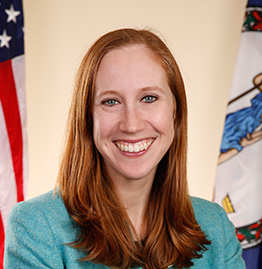
Sen. Elizabeth Bennett-Parker
Sponsored bills
Constitutional amendment (first reference); marriage between two individuals; repeal of same-sex marriage prohibition; affirmative right to marry. Repeals the constitutional provision defining marriage as only a union between one man and one woman as well as the related provisions that are no longer valid as a result of the United States Supreme Court decision in Obergefell v. Hodges, 576 U.S. 644 (2015). The amendment provides that the right to marry is a fundamental right inherent in the liberty of persons and prohibits the Commonwealth and its political subdivisions from denying the issuance of a marriage license to two parties contemplating a lawful marriage on the basis of the sex, gender, or race of such parties. The Commonwealth and its political subdivisions are required to recognize any lawful marriage between two parties and to treat such marriages equally under the law, regardless of the sex, gender, or race of such parties. The amendment provides that religious organizations and clergy acting in their religious capacity have the right to refuse to perform any marriage.
Affordable dwelling unit ordinances; accessibleunits. Provides that any locality that has adopted an affordabledwelling unit ordinance may require under such ordinance that a set percentage of the units built by a developer are compliant withthe appropriate requirements of the American National Standards forBuilding and Facilities for Type A units or with any other standards adopted as part of regulations promulgated by the U.S. Departmentof Housing and Urban Development providing accessibility and usabilityfor persons with a physical disability.
Imposition of income tax. Establishes anew income tax bracket beginning on and after January 1, 2024, that taxes income in excess of $1 million at a rate of 10 percent. Thebill provides that 50 percent of revenues generated by the new taxbracket will be dedicated to providing additional basic aid fundingfor public schools, 30 percent of such revenues will be dedicatedto the Child Care Subsidy Program, and 20 percent of such revenueswill be dedicated to the Virginia Housing Trust Fund.
Public school staffing ratios; specializedstudent support positions. Increases the number of specialized student support positions required to be employed by each local schoolboard from at least three to at least four such positions per 1,000students in the local school division. Such specialized student supportpositions include school social workers, school psychologists, schoolnurses, licensed behavior analysts, licensed assistant behavior analysts,and other licensed health and behavioral positions.
Reinstatement of the estate tax. Reinstatesthe estate tax for persons dying on and after July 1, 2024. The billprovides that no estate tax shall be imposed on a gross estate ifthe majority of the assets of the estate are an interest in a closelyheld business or a working farm. The bill designates revenues fromthe estate tax to be used for early childhood care and educationpurposes.
Child tax credit. Creates a tax credit for taxable years 2024 through 2028 for individuals whose households include dependents younger than the age of 18. The bill provides that the amount of the credit will be equal to $500 for each such dependent for an individual or married persons filing a joint return whose family Virginia adjusted gross income, as defined by Virginia code, does not exceed $100,000. The bill provides that if the taxpayer is a resident of the Commonwealth for the full taxable year, and the amount of such credit exceeds the taxpayer's liability for the taxable year, the excess shall be refunded by the Tax Commissioner.
Workers' compensation; post-traumatic stressdisorder incurred by dispatchers. Allows dispatchers, as definedin the bill, to claim workers' compensation benefits relating topost-traumatic stress disorder under the Virginia Workers' CompensationAct. Currently, only law-enforcement officers and firefighters mayclaim such benefits.
Faith in Housing for the Commonwealth Act.Permits a religious organization, defined in the bill, to constructaffordable housing on real estate owned by such religious organization(i) on or before January 1, 2024, or for a period of not less than five years, and (ii) for which the religious organization retainsa majority ownership interest.
Celebrating the life of Janet Marie Brooking.