

Purchase, possession, sale, transfer, etc.,of assault firearms and certain ammunition feeding devices prohibited;penalty. Creates a Class 1 misdemeanor for any person who imports,sells, manufactures, purchases, possesses, transports, or transfersan assault firearm, as that term is defined in the bill, and prohibitsa person who has been convicted of such violation from purchasing,possessing, or transporting a firearm for a period of three yearsfrom the date of conviction. The bill provides that an assault firearmdoes not include any firearm that is an antique firearm, has been rendered permanently inoperable, is manually operated by bolt, pump,lever, or slide action, or was manufactured before July 1, 2024.The bill also prohibits the sale of a large capacity ammunition feedingdevice, as that term is defined in the bill. The bill provides thatany person who willfully and intentionally (i) sells an assault firearmto another person or (ii) purchases an assault firearm from anotherperson is guilty of a Class 1 misdemeanor and that any person whoimports, sells, barters, or transfers a large capacity ammunition feeding device is guilty of a Class 1 misdemeanor. The bill alsomakes it a Class 1 misdemeanor for any person younger than 21 yearsof age to import, sell, manufacture, purchase, possess, transport,or transfer an assault firearm regardless of the date of manufactureof such assault firearm.
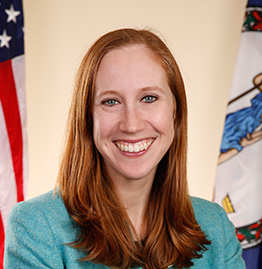
Sen. Elizabeth Bennett-Parker
Sponsored bills
Health insurance; coverage for contraceptivedrugs and devices. Requires health insurance carriers to providecoverage, under any health insurance contract, policy, or plan thatincludes coverage for prescription drugs on an outpatient basis,for contraceptive drugs and contraceptive devices, as defined inthe bill, approved for use as prescribed products or for over-the-counteruse. The bill prohibits a health insurance carrier from imposingupon any person receiving contraceptive benefits pursuant to theprovisions of the bill any copayment, coinsurance payment, or fee, except in certain circumstances. The provisions of the bill applyto health insurance contracts, policies, or plans delivered, issuedfor delivery, or renewed on and after January 1, 2025.
Firearm transfers to another person from a prohibited person. Provides that a person who is prohibited from possessing a firearm because such person is subject to a protective order or has been convicted of an assault and battery of a family or household member may transfer a firearm owned by such prohibited person to any person who is not otherwise prohibited by law from possessing such firearm, provided that such person who is not otherwise prohibited by law from possessing such firearm is 21 years of age or older and does not reside with the person who is subject to the protective order. Under current law, there is no requirement that such transferee cannot be younger than 21 years of age and cannot reside with such prohibited person. The bill also provides that such prohibited person who transfers, sells, or surrenders a firearm pursuant to the provisions of the bill shall inform the clerk of the court of the name and address of the transferee, the federally licensed firearms dealer, or the law-enforcement agency in possession of the firearm and shall provide a copy of such form to the transferee. The bill also provides that a person who is prohibited from possessing a firearm because such person is subject to a protective order or has been convicted of an assault and battery of a family or household member shall be advised that a law-enforcement officer may obtain a search warrant to search for any firearms from such person if such law-enforcement officer has reason to believe that such person has not relinquished all firearms in his possession. This bill is identical to SB 47.
Equity in public school funding; student need; English language learner, special education, and at-risk students. Places several parameters on Standards of Quality funding calculations performed by the Department of Education, including (i) requiring the Department, when calculating the cost of salaries under the Standards of Quality funding formula, to include facilities staff and transportation staff salaries in the calculation of any cost of competing adjustment to salaries for instructional and support positions that is provided as part of the state share of basic aid pursuant to the general appropriation act; (ii) requiring the Department, when estimating the cost of any compensation supplement for instructional and support positions under the Standards of Quality funding formula, to include and estimate the cost of such a compensation supplement for facilities staff; (iii) prohibiting the Department from applying any cap on inflation rate adjustments to non-personal cost categories during the biennial process of rebenchmarking the direct aid to public education budget; and (iv) requiring the Department to utilize a three-year average of the most recently available data to calculate the composite index of local ability-to-pay for each school division. The bill also amends Standard of Quality 2 by (a) including in the definition of "support services position" any central office clerical position that is not otherwise set forth in such definition, (b) requiring a per-pupil Standards of Quality funding add-on to be provided for English language learner and special education students, (c) requiring, in addition to the positions supported by basic aid, state funding, pursuant to the general appropriation act, to be provided to cover the actual average school division cost to educate children with disabilities, and (d) establishing the At-Risk Program, defined in the bill as any state funding provided for programs of prevention, intervention, or remediation or pursuant to the at-risk add-on for the purpose of supporting programs for students who are educationally at risk. The bill requires (1) the determination of the amount of state funding for which a school division is eligible pursuant to such At-Risk Program to be based on the school division's identified student percentage, defined in the bill as the fraction, expressed as a percentage, that results from dividing the number of identified students enrolled in a school division by the total number of students enrolled in such school division, weighted by the factor of 1.5, and then adjusted by the addition of a percentage that corrects for undercounting English language learner students as identified students and (2) such funding to be distributed as follows: 60 percent on a flat per-student rate and 40 percent on a variable rate set out in the general appropriation act based on the concentration of poverty in the school division. The bill is a recommendation of the Joint Legislative Audit and Review Commission.
Affordable housing; assisted living facilities. Allows localities that have adopted an affordable housing program to require that in an application for a special exception or special use permit affordable rental units be included for any proposed development of an assisted living facility. Such ordinance shall apply to newly licensed assisted living facilities and permit applications approved on or after January 1, 2025.
Minimum wage; farm laborers or farm employees;temporary foreign workers. Eliminates the exemptions from Virginia'sminimum wage requirements for (i) persons employed as farm laborers or farm employees and (ii) certain temporary foreign workers. This bill incorporates HB 866.
Uniform Statewide Building Code; bus shelters.Exempts plans and specifications for bus shelters that do not exceed256 square feet that are to be constructed for transit agencies receivingstate money and that will be constructed on state-owned propertyfrom the Department of General Services' review process requiredby the Uniform Statewide Building Code. The bill authorizes the localbuilding official of the locality in which the state-owned propertyis located to conduct the review process within 60 days of the applicant'sinitial submission of the plans and specifications for such bus shelter.
Children's advocacy centers; definitions; investigationsby local departments of social services. Replaces the term "childadvocacy center" with "children's advocacy center" and defines suchterm. The bill provides that if during the course of an investigationof child abuse by a local department of social services a local multidisciplinaryteam determines that an interview of the child by a children's advocacycenter is needed and such interview cannot be completed within thejurisdiction within 14 days, the local department of social services may facilitate the interview with another trained child forensicinterviewer. The bill also provides that if it is determined duringa human trafficking assessment that a forensic interview of the childis needed, such interview may be conducted by a children's advocacycenter within the jurisdiction; however, if the interview cannotbe completed within 14 days, the forensic interview may be conductedby a children's advocacy center located in another jurisdiction or another trained child forensic interviewer.
Public elementary and secondary schools; programs of instruction; mental health education; curriculum guidelines; instruction required. Requires each public elementary, middle, and high school to provide at each grade level, in addition to health instruction, an additional age-appropriate course of instruction on mental health. The bill directs the Board of Education to develop mental health curriculum guidelines for an age-appropriate, sequential mental health curriculum for each grade level and requires such curriculum guidelines to include instruction on (i) general themes of social and emotional learning, including self-awareness, self-management, responsible decision making, relationship skills, and social awareness; (ii) the signs and symptoms of common mental health challenges; (iii) mental health wellness and healthy strategies for coping with stress and negative feelings, including conflict resolution skills; (iv) the importance of and guidance on seeking assistance from an adult or mental health professional, including information on services offered within the school or the local school division; (v) the prevalence of mental health challenges and the importance of overcoming common stigmas surrounding such mental health challenges; (vi) the importance of mental health to a student's overall well-being, including physical health and academic success; and (vii) at such grade levels as the Board deems appropriate, the connection between mental health and substance use disorders and the safe use of and risks of abuse of prescription drugs. The bill permits the Board to consult with the Department of Behavioral Health and Developmental Services and other mental health experts in developing such curriculum guidelines and requires the Board to submit such guidelines to the State Board of Health for approval. The bill requires the Board to review and update by the beginning of the 2025–2026 school year the health Standards of Learning for each grade level to include such instruction on the mental health curriculum guidelines.
Contract actions; medical debt. Provides that in any action, including those brought by the Commonwealth, upon any contract to collect medical debt, as defined in the bill, such an action is barred if not commenced within three years from the due date applicable to the first invoice for a health care service unless the contract with a hospital or health care provider is for a payment plan that allows for a longer period of time for the collection of debt by the hospital or health care provider. The bill specifies that such limitation shall not apply to medical debt arising from services provided by programs administered by the Department of Medical Assistance Services.