Sickle cell disease education and screening program; cancer risk. Requires the sickle cell screening and treatment program to include the offering of educational resources to health care providers on the increased risks for certain cancers among individuals with sickle cell disease or the sickle cell trait.
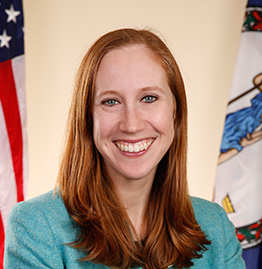
Sen. Elizabeth Bennett-Parker
Sponsored bills
Official emblems and designations; song emeritus; repeal. Repeals the designation of "Carry Me Back to Old Virginny," by James A. Bland, as set out in House Joint Resolution 10, adopted by the General Assembly of Virginia during the Session of 1940, as the official state song emeritus.
Alcoholic beverage control; food-to-beverage ratio; report. Reduces the current 45 percent food-to-beverage ratio for certain mixed beverage licensees. The bill requires that a mixed beverage restaurant, caterer's, or limited caterer's licensee meet or exceed the following: (i) for such licensees with monthly food sales averaging at least $48,000, the food-to-beverage ratio shall not apply; (ii) for such licensees with monthly food sales averaging at least $25,000 but less than $48,000, the food-to-beverage ratio shall meet or exceed 30 percent; and (iii) for such licensees with monthly food sales averaging at least $4,000, but less than $25,000, the food-to-beverage ratio shall meet or exceed 45 percent, except that for any licensee with monthly food sales averaging less than $25,000 with a seating capacity of less than 30 seats and an occupancy permit for less than 60 people total, the food-to-beverage ratio shall meet or exceed 30 percent. The bill also requires that restaurants have at least as many seats at tables as at counters. The bill requires the Virginia Alcoholic Beverage Control Authority to collect data regarding the compliance of mixed beverage licensees with the provisions of the bill and the impact of the change to the food-to-beverage ratio on the gross amount of food consumed on a licensee's premises. The bill requires the Authority to report such data to the Chairs of the House Committee on General Laws and the Senate Committee on Rehabilitation and Social Services by November 1, 2027.

Unemployment benefits; increase weekly benefit amount. Provides that, for unemployment compensation claims effective on or after July 1, 2026, an eligible individual's weekly benefit amount shall be $48 higher than the current weekly benefit amount, as denoted in the table in the printed bill. This bill is identical to SB 759.
Health insurance; coverage for maternal mental health screenings. Requires health insurance carriers to provide coverage for maternal mental health screenings. The bill requires such coverage to include at least one maternal mental health screening to be conducted during pregnancy, at least one additional screening to be conducted during the first six weeks of the postpartum period, and additional medically necessary postpartum screenings. Additionally, the bill provides that coverage for a prescription drug for the treatment of a maternal mental health condition shall not be subject to prior authorization requirements unless there are clinically significant safety or efficacy concerns.
School nurses; sickle cell disease training. Directs local school divisions to require school nurses to complete, within six months of employment and at least every three years thereafter, an online or in-person course of instruction approved by the Board in collaboration with the Department of Health regarding recognition and management of sickle cell disease. This bill is identical to SB 822.
Presidential electors; National Popular Vote Compact. Enters Virginia into an interstate compact known as the Agreement Among the States to Elect the President by National Popular Vote. Article II of the Constitution of the United States gives the states exclusive and plenary authority to decide the manner of awarding their electoral votes. Under the compact, Virginia agrees to award its electoral votes to the presidential ticket that receives the most popular votes in all 50 states and the District of Columbia. The compact goes into effect when states cumulatively possessing a majority of the electoral votes have joined the compact. A state may withdraw from the compact; however, a withdrawal occurring within six months of the end of a President's term shall not become effective until a President or Vice President has qualified to serve the next term. The bill also provides for the manner of appointing electors when such agreement does and does not govern the appointment of electors. This bill is identical to SB 322.
Collective bargaining by public employees; individual home care providers; Virginia Home Care Council established; Public Employee Relations Board established; exclusive bargaining representatives. Repeals the existing prohibition on collective bargaining by public employees. The bill creates the Public Employee Relations Board, which shall determine appropriate bargaining units and provide for certification and decertification elections for exclusive bargaining representatives of state employees and local government employees. The bill requires public employers and employee organizations that are exclusive bargaining representatives to meet at reasonable times to negotiate in good faith with respect to wages, hours, and other terms and conditions of employment. The bill establishes the Virginia Home Care Council within the Department of Medical Assistance Services to promote the stability of the individual provider workforce in the Commonwealth and tasks the Council with serving as the public employer of individual providers, as defined in the bill, for purposes of collective bargaining pursuant to the bill's provisions. The bill repeals a provision that declares that in any procedure providing for the designation, selection, or authorization of a labor organization to represent employees the right of an individual employee to vote by secret ballot is a fundamental right that shall be guaranteed from infringement. The bill directs the Department of Labor and Industry to promulgate any regulations necessary to effectuate the bill's provisions by July 1, 2028, and provides that upon the establishment of the Public Employee Relations Board, such regulations shall be transferred to the Board. The bill provides that until such regulations are adopted, no petitions or elections shall take place pursuant to the bill's provisions except pursuant to an ordinance or resolution adopted under current law. This bill is identical to SB 378.
Minimum energy and water conservation standards; heating, ventilation, and air conditioning facilities and home appliances; Department of Energy; prohibited practices; penalty. Provides that if any product or product categories under the federal Energy Policy and Conservation Act of 1975 (the EPCA) are removed by the U.S. Secretary of Energy or the federal government, the Department of Energy shall adopt energy or water conservation standards that shall be equivalent to the last applicable federal standards with a product compliance date of on or before December 31, 2025. The bill prohibits any such new products from being sold, offered for sale, leased, or rented in the Commonwealth unless such products meet or exceed such standards. The bill excludes any energy or water conservation standards set aside by a court or any product if federal law preempts the application of the minimum energy and water conservation standards to such a product, including any product or product categories where there is a requirement to develop a standard under the EPCA.
Elections; absentee and provisional ballots; cure process. Requires that, if the electoral board determines that any person having submitted a provisional vote was not entitled to vote as a result of a material error or omission on the provisional ballot form, the registrar is required to promptly notify the voter by telephone or email of the error or omission and to provide information to the voter on how to correct the issue so his ballot may be counted. The voter is entitled to make such necessary corrections before noon on the Monday after the election. The bill moves the deadline for curing errors or omissions in absentee ballot applications from noon on the third day after the election to noon on the Monday after the election. The bill also requries the Department of Elections to issue guidance to local election officials on the uniform processing and counting of provisional ballots, including any provisional ballot cast by a person submitting a registration application on the same day as the election.