

In committee Nov 22, 2022
0 co-sponsors
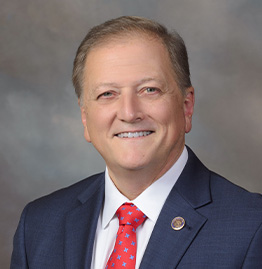
Total votes
21,252
all sessions
Attendance
76%
5,397 missed
Lower than 90% of chamber peers
With party
97%
of cast votes
Among the lowest in the chamber
Bipartisan score
2%
crosses aisle rarely
Higher than 97% of chamber peers
Sponsored
668
bills & resolutions
Near the chamber average
Committees
3
assignments
668 bills and resolutions
Sponsored bills
Total
668
Primary
211
Co-sponsor
457
This page
668
matching current filters
Income tax, state; military benefits subtraction.
Income tax; military benefits subtraction; emergency. Establishes an income tax subtraction for up to $20,000 of military benefits in taxable year 2022, up to $30,000 in taxable year 2023, and up to $40,000 in taxable year 2024 and each year thereafter. The bill defines military benefits to include military retirement income and benefits paid to the surviving spouse of a veteran. The bill contains an emergency clause.
Signed into law Aug 4, 2022
1 co-sponsor
RS&UT; exemption for food purchased for human consumption & essential personal hygiene products.
Sales tax; exemption for food purchased for human consumption and essential personal hygiene products. Exempts food purchased for human consumption and essential personal hygiene products (the grocery tax) from all state, regional, and local sales taxes. The bill dedicates an amount equal to a 0.182 percent sales and use tax to cities and counties as a supplemental school payment. Such payment shall, from July 1, 2022, until July 1, 2024, be distributed based on each city and county's estimated average share of monthly distributions attributable to the tax on such food and hygiene products between February 2020 and December 2021. Beginning July 1, 2024, such payment shall be based upon each city and county's pro rata share of total local sales and use taxes.
Signed into law Aug 4, 2022
1 co-sponsor
School principals; incident reports, written threats against school personnel, etc.
School principals; incident reports. Requires that school principals report to law enforcement certain enumerated acts that may constitute a misdemeanor offense and report to the parents of any minor student who is the specific object of such act that the incident has been reported to law enforcement. Under current law, principals are required to make such reports only for such acts that may constitute a felony offense. The bill provides, as an exception to the requirement to report any written threats against school personnel while on a school bus, on school property, or at a school-sponsored activity, that a principal is not required but may report to the local law-enforcement agency any such incident committed by a student who has an individualized education plan. This bill is identical to SB 36.
Signed into law May 27, 2022
1 co-sponsor
Nonpayment of wages; defense of contractor.
Nonpayment of wages; defense of contractor. Provides that a general contractor or subcontractor, regardless of tier, may submit as evidence in defending against a claim for nonpayment a written certification, under oath, from any lower-tier subcontractor stating that (i) the subcontractor and each of his sub-subcontractors has paid all employees all wages due for the period during which the wages are claimed for the work performed on the project and (ii) to the subcontractor's knowledge, all sub-subcontractors below the subcontractor, regardless of tier, have similarly paid their employees all such wages. This bill is identical to SB 538.
Signed into law Apr 27, 2022
1 co-sponsor
Adult protective services investigations; financial institutions to furnish records and information.
Adult protective services investigations; financial institutions; furnishing of records and information. Requires financial institutions to cooperate in any investigation of alleged adult abuse, neglect, or exploitation conducted by a local department of social services and to make any financial records or information relevant to such investigation available to the local department of social services upon request. Financial institutions may also voluntarily report information relevant to an adult protective services investigation to the local department of social services or to a court-appointed guardian ad litem for the adult under investigation. The bill provides that, absent gross negligence or willful misconduct, a financial institution is immune from civil or criminal liability for providing such information to a local department of social services or a court-appointed guardian ad litem.
Signed into law Apr 27, 2022
0 co-sponsors
Public elementary and secondary schools, etc.; student instruction.
Public elementary and secondary schools and public school-based early childhood care and education programs; student instruction; masks. Requires, except in the case of the 10 unscheduled remote learning days otherwise permitted by law or in certain cases of student discipline, each school board to offer in-person instruction, as defined in the bill, to each student enrolled in the local school division in a public elementary or secondary school for at least the minimum number of required annual instructional hours and to each student enrolled in the local school division in a public school-based early childhood care and education program for the entirety of the instructional time provided pursuant to such program. The bill permits, notwithstanding any other provision of law or any regulation, rule, or policy implemented by a school board, school division, school official, or other state or local authority, the parent of any child enrolled in a public elementary or secondary school, or in any school-based early childhood care and education program, to elect for such child to not wear a mask while on school property. The bill provides that no parent making such an election shall be required to provide a reason or any certification of the child's health or education status and no student shall suffer any adverse disciplinary or academic consequences as a result of this parental election. The bill clarifies that none of the foregoing provisions shall be construed to affect the authority granted to the Governor to achieve the purposes of relevant emergency services and disaster law with regard to a communicable disease of public health threat.
Signed into law Apr 27, 2022
1 co-sponsor
Public health emergency; out-of-state licenses, deemed licensure.
Public health emergency; out-of-state licenses; deemed licensure. Provides that when the Board of Health has entered an emergency order for the purpose of suppressing nuisances dangerous to the public health or communicable, contagious, or infectious diseases or other dangers to the public life and health, a practitioner of a profession regulated by the Board of Medicine who is licensed in another state, the District of Columbia, or a United States territory or possession and who is in good standing with the applicable regulatory agency in that state, the District of Columbia, or that United States territory or possession shall not be prevented or prohibited from engaging in the practice of that profession in the Commonwealth with a patient located in the Commonwealth when (i) such practice is for the purpose of providing continuity of care through the use of telemedicine services and (ii) the patient is a current patient of the practitioner with whom the practitioner has previously established a practitioner-patient relationship.The bill also provides that when the Board of Health has entered an emergency order for the purpose of suppressing nuisances dangerous to the public health or communicable, contagious, or infectious diseases or other dangers to the public life and health, individuals licensed or certified to practice medicine, osteopathic medicine, or podiatry or as a physician assistant, respiratory therapist, advanced practice registered nurse, registered nurse, licensed practical nurse, or nurse aide by another state, the District of Columbia, or a United States territory or possession shall be deemed to be licensed or certified to practice in the Commonwealth for a period of 30 days when certain criteria are met.
Signed into law Apr 27, 2022
0 co-sponsors
Banks; virtual currency custody services.
Banks; virtual currency custody services. Permits banks in the Commonwealth to provide virtual currency custody services so long as the bank has adequate protocols in place to effectively manage the associated risks. The bill defines "virtual currency" and provides that a bank may choose to offer such custody services in a nonfiduciary capacity or a fiduciary capacity. If it chooses to provide such custody services in a fiduciary capacity, it must possess trust powers and have a trust department approved by the State Corporation Commission.
Signed into law Apr 11, 2022
0 co-sponsors
Political subdivisions; group self-insurance pools.
Local government self-insurance pools. Expands provisions related to local government self-insurance pools by providing that a local government group self-insurance pool may provide all authorized insurance coverages to (i) any separate corporation established by one or more counties, cities, towns, or school boards, as permitted by law, that is supported wholly or principally by local public funds or utilize federal funds for local community housing projects and (ii) other corporations recognized under § 501(c)(3) or 501(c)(4) of the Internal Revenue Code that are supported wholly or principally by local public funds or utilizes federal funds for local community housing projects and that are recognized by a political subdivision and authorized by law to perform a government function.
Signed into law Apr 11, 2022
0 co-sponsors
Ask Maddy
·
AI policy assistant
Ask Maddy about Chris Head
Scope: virginia
Hi! I can help you understand Chris Head's legislative record. What would you like to know?
Try one of these
i
Maddy answers using official bill text and legislative records. Always verify before sharing.
Sources cited inline