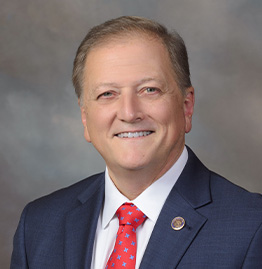
Photo of Chris Head
R Virginia Senate · District 3

Sen. Chris Head

Compare
Total votes
18,133
all sessions
Attendance
84%
2,750 missed
Lower than 90% of chamber peers
With party
98%
of cast votes
Among the lowest in the chamber
Bipartisan score
1%
crosses aisle rarely
Higher than 97% of chamber peers
Sponsored
668
bills & resolutions
Near the chamber average
Committees
3
assignments
668 bills and resolutions

Sponsored bills

Total
668
Primary
211
Co-sponsor
457
This page
668
matching current filters
Primary SB 136
In committee · Virginia Senate · Lead sponsor
Local government; prohibition on certain appointments.

Prohibition on certain local government appointments. Prohibits a local governing body from appointing a spouse, child, stepchild, parent, stepparent, or grandparent of a governing body member as a member of any local government board, committee, or commission or as a member of a board of directors of a not-for-profit organization that receives funding from the locality.

In committee Nov 19, 2024 0 co-sponsors
Co-sponsor HB 1078
In committee · Virginia House of Delegates · Co-sponsor
Family caregiver; creates a nonrefundable income tax credit for taxable years 2024 through 2028.

Family caregiver tax credit. Creates a nonrefundable income tax credit for taxable years 2024 through 2028 for expenses incurred by an individual in caring for an eligible family member, defined in the bill, who requires assistance with one or more activities of daily living, also defined in the bill. The credit equals 50 percent of eligible expenditures incurred by the caregiver up to $1,000. In order to qualify for the credit, the family caregiver must (i) not receive any compensation or reimbursement for the eligible expenditures and (ii) have federal adjusted gross income that is no greater than $100,000 for an individual or $200,000 for married persons. The bill requires the Tax Commissioner to establish guidelines for claiming the credit and provides that any unused credit may be carried forward by the taxpayer for five taxable years following the taxable year for which the credit was issued.

In committee Nov 18, 2024 1 co-sponsor
Co-sponsor SB 35
Passed · Virginia Senate · Co-sponsor
Unconscious bias and cultural competency; Bd. of Medicine shall require continuing education, etc.

Board of Medicine; Board of Nursing; continuingeducation; continuing competency; unconscious bias and cultural competency.Directs the Board of Medicine and the Board of Nursing to requireunconscious bias and cultural competency training as part of thecontinuing education and continuing competency requirements for renewalof licensure. The bill specifies requirements for the training andrequires the Board of Medicine and Board of Nursing to report onthe training to the Department of Health and the Neonatal PerinatalCollaborative.

Passed Apr 17, 2024 1 co-sponsor
Primary SB 155
Signed into law · Virginia Senate · Lead sponsor
Virginia Health Workforce Development Authority; powers and duties, definition.

Virginia Health Workforce Development Authority; Virginia Health Care Career and Technical Training and Education Fund created; psychological practitioner defined; educational requirements for nursing faculty. Modifies the enabling legislation for the Virginia Health Workforce Development Authority by adding four additional ex officio members to the Authority's Board of Directors, adding setting priorities for and managing graduate medical education programs to the duties of the Authority, specifying additional recipients of the Board's biennial report, and authorizing the Authority to partner with other agencies and institutions to obtain and manage health workforce data. The bill establishes the Virginia Health Care Career and Technical Training and Education Fund. The bill directs the Board of Nursing to add or remove certain educational requirements for members of the nursing faculty in specified nursing education programs and establishes a licensing procedure by the Board of Psychology for a psychological practitioner, as defined by the bill. The bill directs the Board of Nursing and the Board of Psychology to adopt regulations to implement relevant provisions of the bill to be effective no later than January 1, 2025. This bill is identical to HB 1499.

Signed into law Apr 8, 2024 0 co-sponsors
Co-sponsor SB 39
Signed into law · Virginia Senate · Co-sponsor
Kinship foster care; placement of child with foster parent.

Kinship as Foster Care Prevention Program established.Establishes the Kinship as Foster Care Prevention Program to promote and support placements of children with relatives by local boardsof social services in order to avoid foster care. The bill providesthat a child is eligible to participate in the Program if the localboard determines that (i) the child is at imminent risk of beingremoved from his home and a preliminary protective order is insufficientto address the child's immediate safety concerns and (ii) the child'sparent or guardian consents to the placement of the child with arelative pursuant to an agreement with the local board developedin accordance with the provisions of the bill.

Signed into law Apr 8, 2024 1 co-sponsor
Co-sponsor SB 339
Signed into law · Virginia Senate · Co-sponsor
Blockchain technology, digital asset mining, etc.; Jt. Commission on Technology & Science to study.

Digital asset mining; holding, use, and transfer of digital assets; securities exemption; tax exemption. Exempts any person engaging in home digital asset mining, digital asset mining, or digital asset mining business activities, as those terms are defined in the bill, from the requirement to obtain a money transmitter license. The bill exempts issuers and sellers of digital assets from securities registration requirements if certain conditions are met. Under the bill, no locality's industrial zone may prohibit the use of such area for digital asset mining or digital asset mining business activities and no local sound ordinance may be more restrictive for digital asset mining or digital asset mining business activities than the current industrial zone noise ordinance of the locality. Additionally, the bill provides that, for taxable years beginning on and after January 1, 2024, up to $200 per transaction of any net capital gain from exchanges made after January 1, 2024, for one legal tender to another legal tender shall be subtracted from taxable income computations. The bill provides that any person in the Commonwealth may use or transfer digital assets to purchase legal goods or services or transfer or exchange digital assets using a blockchain protocol and that no person engaging in digital asset mining, digital asset mining business activities, or providing digital asset mining or staking services for another person or operating a node or series of nodes on a blockchain network shall be subject to liability for merely validating a transaction. The bill also directs to the Bureau of Financial Institutions of the State Corporation Commission to convene a work group for the purpose of studying and making recommendations related to blockchain technology, digital asset mining, and cryptocurrency activity in the Commonwealth.

Signed into law Apr 8, 2024 1 co-sponsor
Primary SB 679
Signed into law · Virginia Senate · Lead sponsor
Enterprise zones; extension.

Enterprise zones; extension. Provides that any enterprise zone in existence as of June 30, 2024, shall be extended for a period of four years in addition to any renewal periods currently authorized by law and authorizes the Governor, upon the recommendation of the Director of the Department of Housing and Community Development, to renew enterprise zones for up to four five-year renewal periods for zones designated on or after July 1, 2005, and for up to two five-year renewal periods for zones designated before July 1, 2005. This bill incorporates SB 722.

Signed into law Apr 8, 2024 0 co-sponsors
Co-sponsor SB 367
Signed into law · Virginia Senate · Co-sponsor
Fentanyl and Heroin Enforcement, Task Force on; established, report.

Manufacturing, selling, giving, distributing, etc., of fentanyl, heroin, or related controlled substances; Task Force on Fentanyl and Heroin Enforcement established; penalties. Provides that a person is guilty of felony homicide, which constitutes second degree murder and is punishable by confinement of not less than five nor more than 40 years, if the underlying felonious act that resulted in the killing of another involved the manufacture, sale, gift, or distribution of a Schedule I or II controlled substance to another and (i) such other person's death results from his use of the controlled substance and (ii) the controlled substance is the proximate cause of his death. The bill provides that venue for a prosecution of this crime shall lie in the locality where the underlying felony occurred, where the use of the controlled substance occurred, or where death occurred. The bill also provides that if a person gave or distributed a Schedule I or II controlled substance only as an accommodation to another individual who is not an inmate in a community correctional facility, local correctional facility, or state correctional facility, or in the custody of an employee thereof, and not with intent to profit thereby from any consideration received or expected nor to induce the recipient of the controlled substance to use or become addicted to or dependent upon such controlled substance, he is guilty of a Class 5 felony. The bill also requires the Office of the Chief Medical Examiner to investigate the cause and manner of a death in any case where the attorney for the Commonwealth or the investigating law-enforcement agency has probable cause to believe that the death resulted from such felony homicide. The bill also adds mandatory minimum fines for manufacturing, selling, giving, distributing, or possessing with the intent to manufacture, sell, give, or distribute a mixture or substance containing a detectable amount of fentanyl, heroin, or carfentanil based on the weight of such mixtures or substances. Additionally, the bill creates the Task Force on Fentanyl and Heroin Enforcement whose purpose is to study ways to enhance the ability of law-enforcement officers throughout the Commonwealth to combat the illegal manufacturing, importation, and distribution of fentanyl, heroin, and other similar controlled substances. The bill requires the Task Force to meet at least annually and to report to the Governor and General Assembly by December 1 of each year regarding its activities and any recommendations.


Signed into law Apr 8, 2024 1 co-sponsor
Primary SB 145
Signed into law · Virginia Senate · Lead sponsor
Special conservators of peace; armed security officer registration.

Criminal Justice Services Board; special conservatorsof the peace and private security services business personnel; patrolrifle training. Requires the compulsory minimum, entry-level,and in-service training standards for armed special conservatorsof the peace established by the Criminal Justice Services Board toinclude patrol rifle classroom training. The bill also requires theregulations adopted by the Board establishing training standardsfor persons employed by private security services businesses to allowa special conservator of the peace who (i) has completed entry-levelhandgun training for special conservators of the peace, (ii) is employedby an institution of higher education that has a memorandum of understandingwith the local law-enforcement agency, and (iii) has the approvalof the attorney for the Commonwealth responsible for the jurisdictionwhere he is employed to complete the entry-level patrol rifle classroomtraining required as part of the firearm training for private securityservices business personnel who carry or have immediate access toa firearm while on duty regardless of whether such individual hassuccessfully completed security officer handgun training.

Signed into law Apr 5, 2024 0 co-sponsors
Co-sponsor SB 469
Signed into law · Virginia Senate · Co-sponsor
Controlled substances; manufacturing, selling, giving, distributing misbranded drugs, etc.

Controlled substances; manufacturing, selling, giving, distributing, etc.; adulterated or misbranded drugs; penalties. Makes it a Class 6 felony for any person, except for permitted manufacturers, to possess, purchase, sell, give, distribute, or possess with intent to sell, give, or distribute an encapsulating machine or a tableting machine that manufactures, compounds, converts, produces, processes, prepares, or otherwise introduces into the human body a controlled substance. The bill makes it a Class 5 felony if such person knows, intends, or has reasonable cause to believe that such action will result in the unlawful manufacture of a controlled substance or counterfeit controlled substance that contains (i) a controlled substance classified in Schedule I or Schedule II of the Drug Control Act; (ii) cocaine, coca leaves, or any salt, compound, derivative, or preparation thereof as described in Schedule II of the Drug Control Act; or (iii) a controlled substance analog as defined in relevant law.The bill also makes it a felony punishable by imprisonment for not less than 10 nor more than 40 years for any person 18 years of age or older to knowingly allow a minor or a mentally incapacitated or physically helpless person of any age to be present during the manufacture or attempted manufacture of any substance containing a detectable amount of fentanyl.The bill also increases from a Class 2 misdemeanor to a Class 6 felony the penalty for violations related to adulterated or misbranded drugs and cosmetics.

Signed into law Apr 4, 2024 1 co-sponsor
Showing 201 to 210 of 668 bills
Previous 1 … 20 21 22 … 67 Next