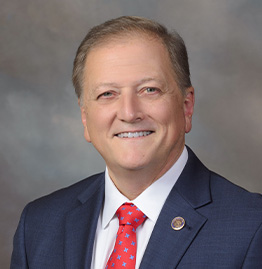
Fire Programs Fund; work group; report. Directs the Department of Fire Programs to establish a work group to evaluate the funding formula for the distribution of aid to localities through the Fire Programs Fund.
Sponsored bills
Certificate of public need; expedited review of certain projects; duties of the State Health Services Plan Task Force. Directs the State Health Services Plan Task Force to develop recommendations for designating areas of the state with an identifiable need for additional projects, taking into account numerous barriers of access to health care. The bill also directs the Board of Health to promulgate updated regulations for expedited application and review processes for certain projects. This bill is identical to HB 1337.
Professions and occupations; adjustment of fees by regulatory boards; recovery of disciplinary and monitoring costs. Repeals the provision of law that requires, following the close of any biennium, when the account for any regulatory board within the Department of Professional and Occupational Regulation (DPOR) shows revenue to be a certain percentage greater than expenses, such regulatory board to distribute excess revenue to current regulants and reduce its licensure or certification fees so that fees are sufficient but not excessive to cover expenses. The bill also repeals the provision with respect to the Department of Health Professions (DHP) that requires, following the close of any biennium, when the account for any regulatory board shows expenses allocated to it for the past biennium to be a certain percentage greater than moneys collected by the board, the board to revise its fees so that such fees are sufficient but not excessive to cover expenses. The bill makes it permissive for the regulatory boards within DPOR and DHP to annually revise the fees levied by it for certification, licensure, registration, or permit and renewal so that the fees are sufficient but not excessive to cover expenses. The bill specifies that each regulatory board must report such revisions to DPOR or DHP and requires each agency to report such revisions to the Chairs of the House Committee on Appropriations and the Senate Committee on Finance and Appropriations by November 1, 2026, and annually thereafter. Regulatory boards are also permitted to recover reasonable administrative costs associated with investigation, disciplinary proceedings, monitoring, and confirming compliance with any terms and conditions imposed from any person who is (i) licensed, registered, certified, or issued a multistate or compact licensure privilege by any regulatory or health regulatory board and (ii) issued a finding of a violation of law or regulation from such regulatory or health regulatory board. Such administrative costs shall not exceed $500 for regulatory boards within DPOR and $1,500 for health regulatory boards within DHP.

Retail franchise agreements; governing law; competition restrictions. Provides that retail franchise agreements shall be governed by the laws of the Commonwealth and prohibits any person from offering or entering into a franchise agreement that includes competition restrictions that extend beyond termination or expiration of the franchise agreement, except as a term of sale in the event that a franchisee sells a franchise to a third party or back to the franchisor. This bill is identical to HB 69.
High school graduation requirements; application. Provides that, in the event that the Board of Education establishes or modifies any graduation requirements or diploma pathways, the Board shall only apply such new or modified graduation requirements or diploma pathways to students who enter ninth grade at the beginning of or after the first school year of implementation of such new or modified graduation requirements or diploma pathways. The bill is applicable beginning with students who enter the ninth grade on or after the beginning of the 2027-2028 school year. This bill is identical to HB 1283.
Department of Health; State Health Commissioner; nursing homes; periodic medical visits and resident assessments; oversight and accountability. Requires all nursing homes to notify the resident of a nursing home, the resident's family, and the Department of Health if a federally required physician visit does not take place. The bill also requires each nursing home to conduct a comprehensive assessment on an annual basis to determine each resident's needs and describe each resident's capability to perform daily life functions. Such assessments must be reviewed at least once every 92 days, and more frequently in the event of a significant change in the resident's physical or mental condition. The bill directs the Department of Health and State Health Commissioner to take steps to improve care quality, protect residents, and strengthen oversight and accountability of nursing homes in the Commonwealth. The bill directs the Department to enhance recruitment efforts and expand workforce capacity in the Office of Licensure and Certification, accelerate training and onboarding initiatives, and explore measures to reduce administrative burdens. The bill requires the Commissioner to submit an annual report with recommendations for continuing improvement of nursing home quality and oversight. This bill incorporates SB 555.
Maddy summaryHJ 165 is a ceremonial resolution honoring Lieutenant Colonel Richard Thomas Bulova of the U.S. Army Reserve (USAR). It formally recognizes his service and life through a legislative expression of respect. This resolution directly affects no individuals or policies, as it has no legal effect beyond the symbolic act of commemoration. The bill passed both the House and Senate in early March 2026 as a non-binding gesture of tribute.
Maddy summaryHJ 157 is a ceremonial resolution commending the Taubman Museum of Art for its contributions to the community. It formally honors the museum's cultural impact and community engagement efforts. This resolution does not create new laws or affect any policies; it is a symbolic gesture of recognition. The bill passed both chambers unanimously via voice vote in early March 2026.
Maddy summaryHJ 156 is a symbolic resolution commending RADAR Transit for its service to the community. It does not create new laws, allocate funding, or change any policies - it is purely a formal expression of appreciation from the legislature. The bill directly affects RADAR Transit as the recipient of this recognition. It passed both chambers with voice votes in March 2026 but has no practical impact beyond the ceremonial acknowledgment.
Maddy summaryHJ 159 is a joint resolution commending the Virginia Community College System for its contributions to education and workforce development. It does not create new policies, alter funding, or directly affect any specific individuals or groups through legislative action. The resolution serves as a ceremonial expression of support with no implementation mechanisms or concrete policy changes. This type of resolution is purely symbolic and does not require further legislative action beyond its passage.