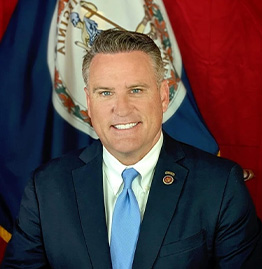
Photo of Bryce Reeves
R Virginia Senate · District 28

Sen. Bryce Reeves

Compare
Total votes
27,511
all sessions
Attendance
98%
465 missed
Lower than 83% of chamber peers
With party
97%
of cast votes
Near the chamber average
Bipartisan score
1%
crosses aisle rarely
Lower than 77% of chamber peers
Sponsored
1,077
bills & resolutions
Near the chamber average
Committees
4
assignments
1,077 bills and resolutions

Sponsored bills

Total
1,077
Primary
386
Co-sponsor
691
This page
1,077
matching current filters
Primary SB 446
In committee · Virginia Senate · Lead sponsor
Constitutional amendment; personal property tax exemption for motor vehicle of a disabled veteran.

Constitutional amendment (voter referendum); personal property tax exemption; motor vehicle owned by a veteran who is disabled. Provides for a referendum at the November 3, 2020, election to approve or reject a personal property tax exemption for a motor vehicle that is owned and used primarily by or for a veteran of the Armed Forces of the United States or the Virginia National Guard who has a 100 percent service-connected, permanent, and total disability.

In committee Dec 4, 2020 0 co-sponsors
Primary SB 464
In committee · Virginia Senate · Lead sponsor
Higher educational institutions; intercollegiate athletics, student-athletes, compensation.

Institutions of higher education; intercollegiateathletics; student-athletes; compensation, representation, and injury.Prohibits any private institution of higher education, baccalaureate publicinstitution of higher education, athletic association, athletic conference, orother organization with authority over intercollegiate athletics from (i)providing a prospective student-athlete with compensation that results from theuse of the student's name, image, or likeness; (ii) prohibiting or preventing astudent-athlete from earning from another individual or entity compensationthat results from the use of the student's name, image, or likeness, except incertain limited circumstances; (iii) prohibiting or preventing astudent-athlete from obtaining professional representation by an athlete agentor legal representation by an attorney licensed to practice law in theCommonwealth; or (iv) declaring ineligible for or revoking a scholarship providedto a student-athlete who earns compensation that results from the use of thestudent's name, image, or likeness. The bill prohibits any athleticassociation, athletic conference, or other organization with authority overintercollegiate athletics from prohibiting or preventing a private institutionof higher education or baccalaureate public institution of higher educationfrom becoming a member of or participating in intercollegiate athleticssponsored by such association, conference, or organization as a consequence ofthe compensation of a student-athlete at such institution that results from theuse of the student-athlete's name, image, or likeness. The bill requires eachprivate institution of higher education and each baccalaureate public institutionof higher education to establish (i) a sports injury compensation fund intowhich the institution shall deposit 7.5 percent of the revenue earned from itsintercollegiate athletics programs and from which any student-athlete whosuffers a serious or career-ending injury during a practice or competition mayapply for compensation upon his graduation and (ii) a wage fund into which theinstitution shall deposit 7.5 percent of the revenue earned from itsintercollegiate athletics programs and from which each student-athlete shallreceive an equal amount of compensation at the end of each academic year. Theforegoing provisions of the bill have a delayed effective date of July 1, 2024.The bill also requires the Chancellor of the Virginia Community College Systemto convene a work group consisting of such members as the Chancellor deemsappropriate to consider and make recommendations to the Governor and theGeneral Assembly no later July 1, 2022, relating to the compensation andrepresentation of student-athletes enrolled at comprehensive community collegesin the Commonwealth.

In committee Dec 4, 2020 0 co-sponsors
Co-sponsor SJ 58
In committee · Virginia Senate · Co-sponsor
Constitutional amendment; personal property tax exemption for motor vehicle of a disabled veteran.

Constitutional amendment (second resolution);personal property tax exemption; motor vehicle owned by a veteranwho is disabled. Provides that one motor vehicle of a veteranwho has a 100 percent service-connected, permanent, and total disabilityshall be exempt from state and local taxes. The amendment provides that only automobiles and pickup trucks qualify for the exemption. Additionally, the exemption is only applicable on the date the motorvehicle is acquired or the effective date of the amendment, whicheveris later, and is not applicable for any period of time prior to theeffective date of the amendment.

In committee Dec 4, 2020 1 co-sponsor
Primary SB 461
In committee · Virginia Senate · Lead sponsor
Veterans and active duty members of the Armed Forces; teachers, credit for service.

Veterans and active duty members of the ArmedForces; teachers; credit for service. Requires each local schoolboard to give any veteran or active duty member of any of the ArmedForces of the United States or the Commonwealth who it employs asa teacher in the local school division credit for any time servedin any such forces in determining such teacher's step on the localschool division's teacher salary scale.

In committee Dec 4, 2020 0 co-sponsors
Co-sponsor SB 235
Vetoed · Virginia Senate · Co-sponsor
Health insurance; association health plans.

Health insurance; association health plans. Provides that for policies of group accident and sickness insurance issued to an association, members of such an association may include (i) a self-employed individual and (ii) an employer member (a) with at least one employee that is domiciled in the Commonwealth or (b) that has a principal place of business that does not exceed the boundaries of a metropolitan area that is at least partially in the Commonwealth. The bill provides that for such policies issued to an association that covers at least 51 members and employees of employer members of such association on the first day of the plan year the policies shall be considered a large group market plan and are required to meet various provisions in the bill. The bill provides that to determine the size of an association all of the members and employees of employer members are aggregated and treated as employed by a single employer.The bill requires an insurer issuing a policy to an association to (1) treat all of the members and employees of employer members who are enrolled in coverage under the policy as a single risk pool; (2) set premiums based on the collective group experience of the members and employees of employer members who are enrolled in coverage under the policy; (3) vary premiums by age, except that the rate shall not vary by more than 5 to 1 for adults; (4) not vary premiums based on gender; (5) not establish discriminatory rules based on the health status of an employer member, an individual employee of an employer member, or a self-employed individual for eligibility or contribution.The bill requires the Commissioner of Insurance to, within 90 days of the enactment of the bill, apply to the U.S. Secretary of Health and Human Services for a state innovation waiver under the federal Patient Protection and Affordable Care Act, P.L. 111-148, to implement the provisions of the bill. The provisions of the bill regarding association health plans will become effective 30 days following the date the Commissioner of Insurance notifies the Governor and the Chairs of the House and Senate Committees on Commerce and Labor of federal approval of such waiver.

Vetoed May 21, 2020 1 co-sponsor
Co-sponsor SB 561
Signed into law · Virginia Senate · Co-sponsor
Workers' compensation; post-traumatic stress disorder, law-enforcement officers and firefighters.

Workers' compensation; post-traumatic stress disorder; law-enforcement officers and firefighters. Provides that post-traumatic stress disorder incurred by a law-enforcement officer or firefighter is compensable under the Virginia Workers' Compensation Act if a mental health professional examines a law-enforcement officer or firefighter and diagnoses the individual as suffering from post-traumatic stress disorder as a result of the individual's undergoing a qualifying event, which includes an event occurring in the line of duty on or after July 1, 2020, in which a law-enforcement officer or firefighter views a deceased minor, witnesses the death of a person or an incident involving the death of a person, witnesses an injury to a person who subsequently dies, has physical contact with and treats an injured person who subsequently dies, transports an injured person who subsequently dies, or witnesses a traumatic physical injury that results in the loss of a vital body part or a vital body function that results in permanent disfigurement of the victim. Other conditions for compensability include (i) if the post-traumatic stress disorder resulted from the law-enforcement officer or firefighter acting in the line of duty and, in the case of a firefighter, such firefighter complied with certain federal Occupational Safety and Health Act standards; (ii) if the law-enforcement officer's or firefighter's undergoing a qualifying event was a substantial factor in causing his post-traumatic stress disorder; (iii) if such qualifying event, and not another event or source of stress, was the primary cause of the post-traumatic stress disorder; and (iv) if the post-traumatic stress disorder did not result from any disciplinary action, work evaluation, job transfer, layoff, demotion, promotion, termination, retirement, or similar action of the officer or firefighter. The measure establishes procedural requirements on employers that contest a claim for such benefits. The measure also establishes requirements for resilience and self-care technique training.

Signed into law Apr 22, 2020 1 co-sponsor
Co-sponsor SB 316
Signed into law · Virginia Senate · Co-sponsor
Elections; date of June primary election.

Elections; date of June primary election. Changes the date of the primary election held in June from the second Tuesday in June to the third Tuesday in June. The bill also changes candidate filing deadlines to reflect the change of date. The provisions of the bill do not become effective unless reenacted by the 2021 Session of the General Assembly.

Signed into law Apr 22, 2020 1 co-sponsor
Co-sponsor SB 389
Signed into law · Virginia Senate · Co-sponsor
Alcoholic beverage control; definitions, license and fee reform.

Alcoholic beverage control; license and fee reform. Reorganizes all alcoholic beverage control licenses pursuant to the three-tier structure and license privileges, consolidates many licenses with common privileges, aligns license fee amounts with enforcement demands, and standardizes quantity limits on alcohol samples. The bill has a delayed effective date of July 1, 2021. This bill incorporates SB 447 and is identical to HB 390.

Signed into law Apr 10, 2020 1 co-sponsor
Co-sponsor SB 172
Signed into law · Virginia Senate · Co-sponsor
Health insurance; definitions, payment to out-of-network providers, emergency services.

Health insurance; payment to out-of-network providers. Provides that when an enrollee receives emergency services from an out-of-network health care provider or receives out-of-network surgical or ancillary services at an in-network facility, the enrollee is not required to pay the out-of-network provider any amount other than the applicable cost-sharing requirement and such cost-sharing requirement cannot exceed the cost-sharing requirement that would apply if the services were provided in-network. The measure also provides that the health carrier's required payment to the out-of-network provider of the services is a commercially reasonable amount based on payments for the same or similar services provided in a similar geographic area. If such provider disputes the amount to be paid by the health carrier, the measure requires the provider and the health carrier to make a good faith effort to reach a resolution on the amount of the reimbursement. If the health carrier and the provider do not agree to a commercially reasonable payment and either party wants to take further action to resolve the dispute, then the measure requires the dispute will be resolved by arbitration. The measure establishes a framework for arbitration of such disputes which includes (i) a timeline for the proceedings, (ii) a method for choosing an arbitrator, (iii) required and optional factors for the arbitrator to consider, (iv) non-disclosure agreements, (v) reporting requirements, and (vi) an appeals process for appeals on certain procedural grounds. The measure requires the State Corporation Commission to contract with Virginia Health Information (VHI) to establish a data set and business protocols to provide health carriers, providers, and arbitrators with data to assist in determining commercially reasonable payments and resolving disputes. The measure requires the Commission, in consultation health carriers, providers, and consumers, to develop standard language for a notice of consumer rights regarding balance billing. The measure authorizes the Commission, the Board of Medicine, and the Commissioner of Health to levy fines and take action against a health carrier, health care practitioner, or medical care facility, respectively, for a pattern of violations of the prohibition against balance billing. Additionally, the measure prohibits a carrier or provider from initiating arbitration with such frequency as to indicate a general business practice. The measure provides that such provisions do not apply to an entity that provides or administers self-insured or self-funded plans; however, such entities may elect to be subject to such provisions. The measure authorizes the Commission to adopt rules and regulations governing the arbitration process. The measure has a delayed effective date of January 1, 2021. This bill incorporates SB 522 and is identical to HB 1251.


Signed into law Apr 10, 2020 1 co-sponsor
Co-sponsor SB 817
Signed into law · Virginia Senate · Co-sponsor
Nuclear energy; considered a clean energy source.

Nuclear energy; considered a clean energy source. Provides that for the purposes of the Commonwealth Energy Policy, in any clean energy initiative or carbon-free energy initiative undertaken, overseen, regulated, or permitted by the Department of Mines, Minerals and Energy, nuclear energy shall be considered to be a clean energy source.

Signed into law Apr 9, 2020 1 co-sponsor
Showing 581 to 590 of 1,077 bills
Previous 1 … 58 59 60 … 108 Next