Firearm safety device tax credit; definition of firearm safety device. Expands the definition of "firearm safety device" as it relates to the firearm safety device tax credit to include any device that, when installed on a firearm, is designed to prevent the firearm from being operated without first deactivating the device. The provisions of the bill are effective for taxable years beginning on and after January 1, 2024. This bill incorporates HB 945.
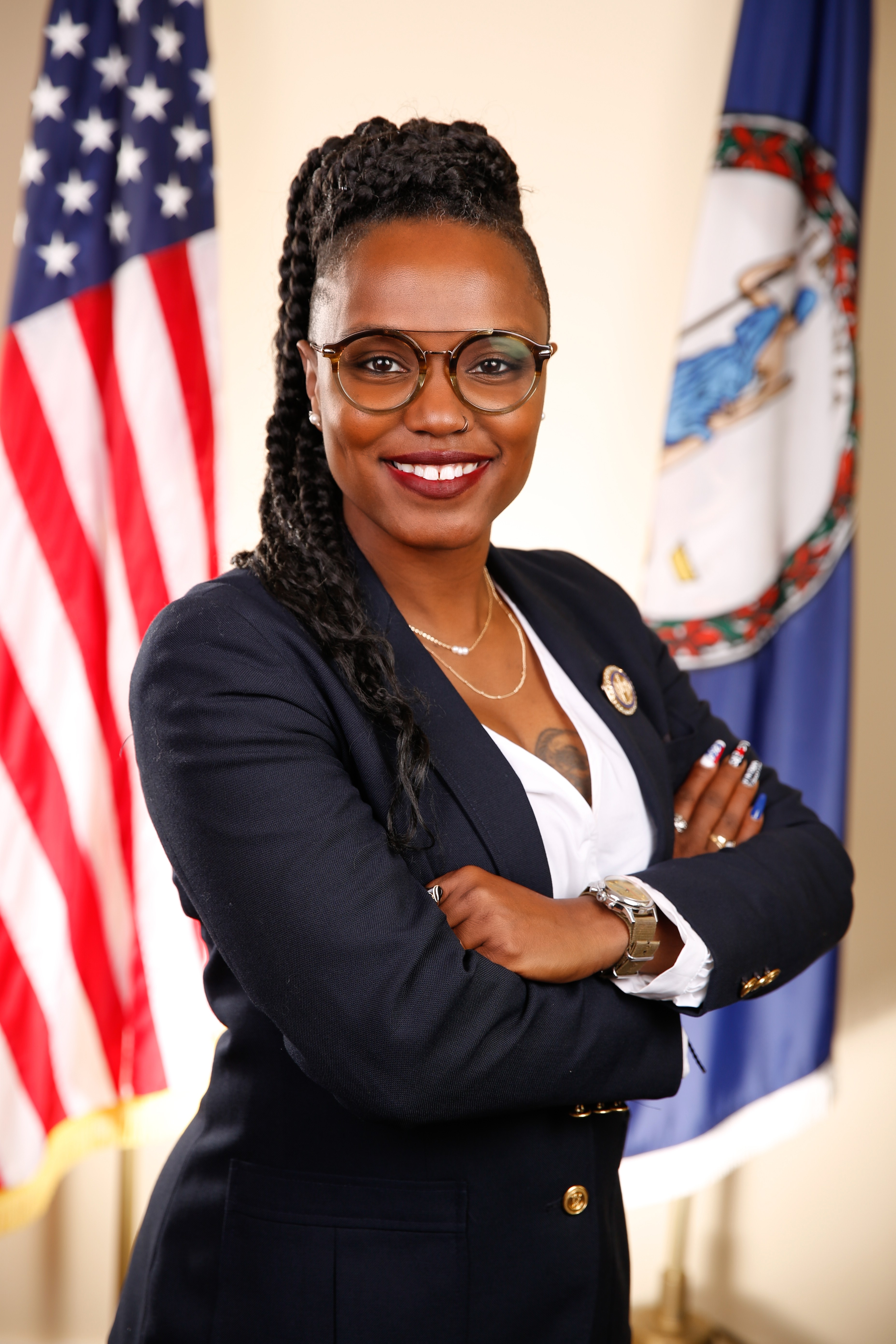
Del. Jackie Glass
Sponsored bills
Virginia Employment Commission; appeals proceedings; appeal tribunals and Board of Review; repeal. Specifies that any determination made by the Virginia Employment Commission in regard to any amount required to be deducted and withheld from unemployment compensation for purposes of child support obligations is final. The bill contains a number of technical amendments related to the Commission's appeals proceedings. The bill also repeals provisions related to appeal tribunals and the Commission-appointed Board of Review and contains technical amendments. This bill is identical to SB 655.
Baccalaureate public institutions of higher education; provision of physical evidence recovery kits. Requires each baccalaureate public institution of higher education to either (i) staff its on-campus student health center with at least one on-campus certified sexual assault forensic examiner for the purpose of administering a physical evidence recovery kit to any student who is in need of such a kit or (ii) enter into a memorandum of understanding with a local organization or entity that is capable of providing the services of a certified sexual assault forensic examiner for the purpose of administering a physical evidence recovery kit to any student who is in need of such a kit.
PA Licensure Compact. Authorizes Virginiato become a signatory to the PA Licensure Compact. The Compact permitseligible physician assistants to practice in Compact-participatingstates, provided that they are licensed in at least one participatingstate. The Compact has been passed in three states and takes effectwhen it is enacted by a seventh participating state or upon the effectivedate of the bill, whichever is later.
Virginia Law Officers' Retirement System; firefighters. Adds full-time firefighters employed by the Department of MilitaryAffairs to the Virginia Law Officers' Retirement System for serviceearned on or after July 1, 2025. The bill has a delayed effectivedate of July 1, 2025.
Electronic communication systems within statecorrectional facilities; free telephone calls and communication services.Requires the Department of Corrections to provide telephone systemsand web-based or electronic communications systems free of chargeto any person, whether such person is initiating or receiving thecommunication. The bill also requires that a minimum ratio of onetelephone per every 10 inmates be available within each housing unitat each correctional facility and that a maximum number of telephonenumbers permitted on an approved call list must be no fewer than20. This bill has a delayed effective date of July 1, 2026.
Standards for attorneys appointed to represent parents or guardians; child dependency cases; compensation; multidisciplinary law offices or programs; report. Requires the Judicial Council of Virginia, in conjunction with the Virginia State Bar, beginning July 1, 2026, to adopt standards for the qualification and performance of attorneys appointed to represent a parent or guardian of a child when such child is the subject of a child dependency case, as defined in the bill. The bill also requires the Judicial Council of Virginia, beginning July 1, 2026, to maintain a list of attorneys admitted to practice law in Virginia who are qualified to be appointed to represent indigent parents involved in a child dependency case. Prior to July 1, 2026, counsel must be appointed from the list of attorneys qualified to serve as guardians ad litem. The bill provides that beginning January 1, 2025, court-appointed counsel for a parent, guardian, or other adult in a child dependency case will be compensated in an amount no greater than $330, or in a case for the termination of residual parental rights, $680.The bill authorizes the establishment of up to two multidisciplinary law offices or programs in localities, jurisdictions, or judicial districts that affirm they have met specified criteria for the purpose of representing parents in a child dependency court proceeding or in a child protective services assessment or investigation prior to such proceeding. During any calendar year that such an office or program is in effect for at least six months, the office or program must submit a report on program outcomes, expenses, recommendations, and other pertinent information to the Office of the Children's Ombudsman and the Chairmen of the House Committees for Courts of Justice and on Health and Human Services and Appropriations and the Senate Committees for Courts of Justice and on Education and Health and Finance and Appropriations by November 1.

Historic rehabilitation tax credit; maximum amount of tax credit. Increases from $5 million to $10 million the maximum amount of the historic rehabilitation tax credit, including amounts carried over from prior taxable years, that may be claimed by a taxpayer in any taxable year beginning in taxable year 2024. Beginning July 1, 2024, the aggregate amount of credits available shall not exceed $75 million per fiscal year.
Virginia Verified Meat certification. Prohibitsany person from labeling any product as Virginia Verified Meat ifit does not meet the definition of that term in the bill and requiresthe Commissioner of Agriculture and Consumer Services to establisha licensing protocol and auditing process whereby persons and businessesnot employed by the Department of Agriculture and Consumer Servicesare eligible to certify Virginia Verified Meat claims.
Department of Education; establishment of Farm to School Program Task Force. Requires the Department of Education to establish and appoint such members as it deems necessary or appropriate to the Farm to School Program Task Force for the purpose of increasing student access throughout the Commonwealth to high-quality farm to school programs, defined in the bill as programs (i) whereby public schools purchase and feature prominently in school meals locally produced food or (ii) that involve experiential student learning opportunities relating to local food and agriculture, including school and community garden programs and local farm visits. The bill requires the Task Force to collaborate with local school boards, community-based organizations, farmers, relevant state and local agencies, and other relevant stakeholders to (a) assess existing farm to school programs within the Commonwealth to identify and disseminate to each local school board best practices for implementing and sustaining such programs, (b) establish and distribute to each local school board a guidance document for the establishment and operation of school garden programs, (c) provide information and resources to each local school board to assist it in leveraging grant funds to support farm to school programs, and (d) collect such data and make such policy recommendations to local school boards, the Board of Education, and the General Assembly as it deems appropriate. This bill is identical to SB 314.