

Creation of Office of the Department of Corrections Ombudsman. Creates the Office of the Department of Corrections Ombudsman (the Office). The bill enumerates the duties and powers of the Office, which include (i) providing information, as appropriate, to inmates, family members, representatives of inmates, Department of Corrections (the Department) employees and contractors, and others regarding the rights of inmates; (ii) monitoring conditions of confinement and assessing compliance with applicable federal, state, and local rules, regulations, policies, and best practices as related to the health, safety, welfare, and rehabilitation of inmates; (iii) providing technical assistance to support inmate participation in self-advocacy; (iv) providing technical assistance to local governments in the creation of correctional facility oversight bodies, as requested; (v) establishing a statewide uniform reporting system to collect and analyze data related to complaints received by the Department and data related to (a) deaths, suicides, and suicide attempts in custody; (b) physical and sexual assaults in custody; (c) the number of inmates placed in solitary confinement; (d) the number of facility lockdowns lasting longer than 24 hours; (e) the number of staff vacancies at each facility; (f) the inmate-to-staff ratios at each facility; (g) staff tenure and turnover; and (h) the number of in-person visits to inmates that were made and denied at each facility; (vi) establishing procedures to gather stakeholder input into the Office's activities and priorities, which must include, at a minimum, an annual 30-day period for receipt of and Office response to public comment; (vii) inspecting each state correctional facility at least once every three years and at least once every year for any maximum security facility and any facility where the Office has found cause for more frequent inspection or monitoring; and (viii) issuing publicly periodic facility inspection reports and an annual report with recommendations on the state correctional facilities and a summary of data and recommendations arising from any complaints investigated and resolved.The bill also establishes a Corrections Oversight Committee, which is responsible for selecting the Department of Corrections Ombudsman. The bill additionally outlines the Office's authority to conduct inspections of each Department or Board of Local and Regional Jails facility and requires the submission of an annual report to the Governor, the Attorney General, the Senate Committee on the Judiciary, the House Committee on Public Safety, and the Director of the Department.
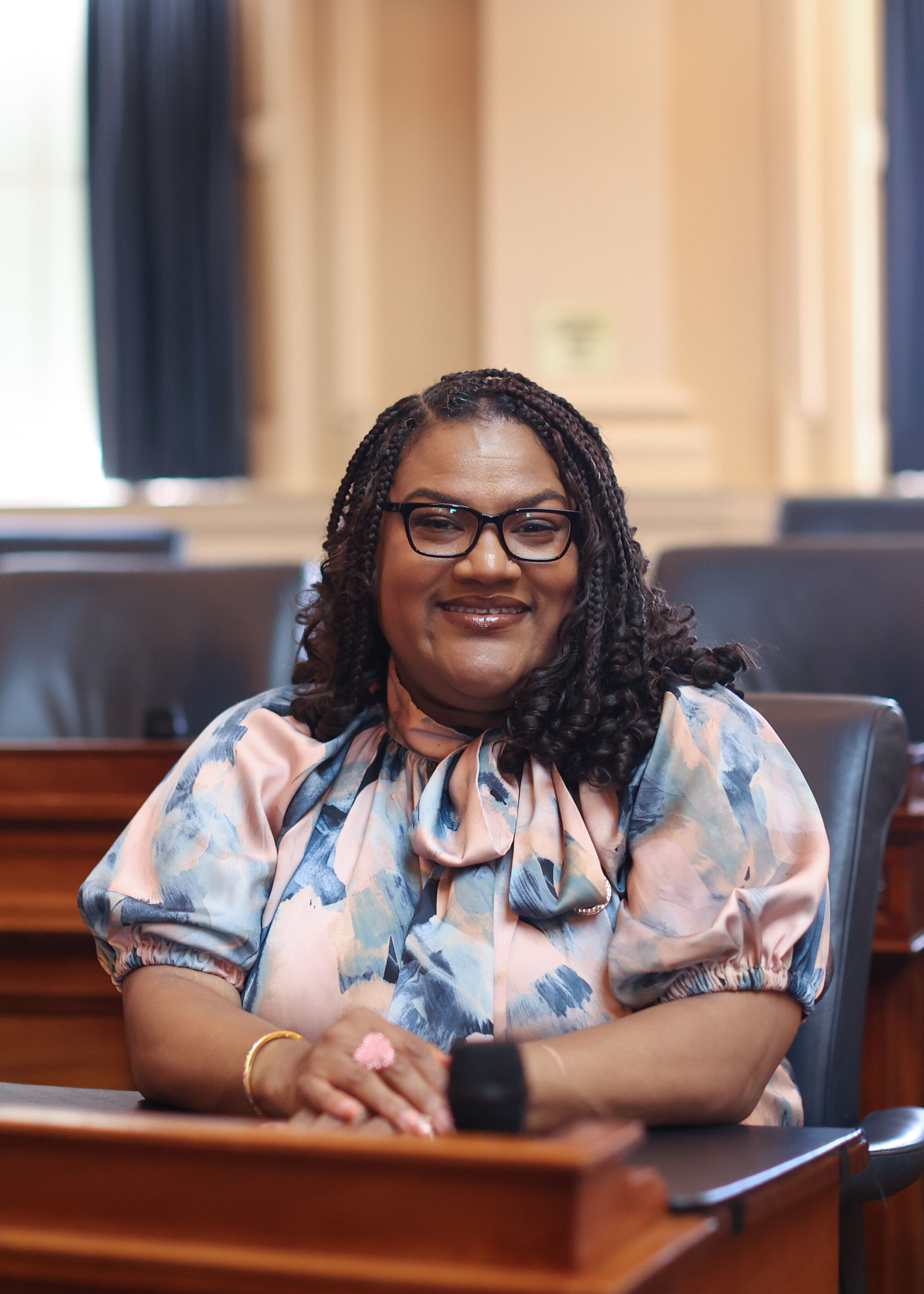
Del. Cia Price
Sponsored bills
Study; JLARC; effects of gun violence on communities;report. Directs the Joint Legislative Audit and Review Commissionto study the social, physical, emotional, and economic effects ofgun violence on communities across the Commonwealth.
Study; Department of Transportation; transitequity and engagement opportunities for people with disabilities;report. Requests the Department of Transportation to study transitequity and modernization in the Commonwealth, with an emphasis ontransit services and engagement opportunities for people with disabilities.
Unlawful dissemination of sexually explicit visual material to another; penalty. Provides that any person 18 years of age or older who knowingly transmits sexually explicit visual material by computer or other electronic means to another person 18 years of age or older when such other person has not requested or consented to the transmittal of such material or has expressly forbidden the transmittal of such material is subject to a civil penalty of not more than $250 for a first offense and not more than $500 for a second or subsequent offense.
Campaign finance; prohibited personal use ofcampaign funds; complaints, hearings, civil penalty, and advisoryopinions. Prohibits any person from converting contributionsto a candidate or a candidate's campaign committee for their personal use. Current law only prohibits such conversion of contributionswith regard to disbursement of surplus funds at the dissolution ofa campaign or political committee. The bill provides that a contributionis considered to have been converted to personal use if the contribution,in whole or in part, is used to fulfill any commitment, obligation,or expense that would exist irrespective of the person's seeking,holding, or maintaining public office but excepts from "personaluse" the ordinary and accepted expenses related to campaigning foror holding elective office, including the use of campaign funds topay for the candidate's child care expenses that are incurred as adirect result of campaign activity. Any person subject to the personaluse ban may request an advisory opinion from the State Board of Electionson such matters. The bill directs the State Board of Elections toadopt emergency regulations similar to those promulgated by the FederalElection Commission to implement the provisions of the bill and toprovide an updated summary of Virginia campaign finance law that reflects the Attorney General's opinion and any new regulations promulgatedby the State Board of Elections.
Paid sick leave; health care providers and grocery store workers. Requires employers to provide paid sick leave to health care providers, grocery store workers, and home health workers who provide agency-directed services. Under current law, employers are only required to provide paid sick leave to home health workers who provide consumer-directed services. The bill removes requirements that workers work on average at least 20 hours per week or 90 hours per month to be eligible for paid sick leave. Additionally, the bill provides that certain health care providers may waive their right to accrue and use paid sick leave and provides an exemption for certain other health care providers.
Produce Rx Program established; report.Directs the Department of Social Services to establish a Produce Rx Program as a three-year pilot program to incentivize consumptionof qualifying fruits and vegetables by eligible individuals for whomincreased consumption of fruits and vegetables is recommended bya qualified care provider, as such terms are defined in the bill,and to report to the Governor and the General Assembly by December1 of each year on the operation of the Program.
Constitutional amendment (second reference); qualifications of voters and the right to vote; persons not entitled to vote. Provides that every person who meets the qualifications of voters set forth in the Constitution shall have the fundamental right to vote in the Commonwealth and that such right shall not be abridged by law, except for persons who have been convicted of a felony and persons who have been adjudicated to lack the capacity to understand the act of voting. A person who has been convicted of a felony shall not be entitled to vote during any period of incarceration for such felony conviction but upon release from incarceration for that felony conviction and without further action required of him, such person shall be invested with all political rights, including the right to vote. Currently, in order to be qualified to vote a person convicted of a felony must have his civil rights restored by the Governor or other appropriate authority. The amendment also provides that a person adjudicated by a court of competent jurisdiction as lacking the capacity to understand the act of voting shall not be entitled to vote during this period of incapacity until his capacity has been reestablished as prescribed by law. Currently, the Constitution provides that a person who has been adjudicated to be mentally incompetent is not qualified to vote until his competency is reestablished.
Virginia Asian American, Pacific Islander, Latino,and Indigenous Education Advisory Board; establishment. Establishesthe 29-member Virginia Asian American, Pacific Islander, Latino,and Indigenous Education Advisory Board as an advisory board in theexecutive branch of state government for the purpose of advisingthe Governor, his Cabinet members, and the General Assembly on the current ways that Asian American, Pacific Islander, Latino, and Indigenous history is described in the relevant Standards of Learning and associated curriculum frameworks; how that content is taught in classrooms;and strategies to develop Asian American and Pacific Islander historyand social studies elective courses, Latino history and social studies elective courses, and Indigenous history and social studies electivecourses.
Study; Department of Education; root causesof public school bus driver shortages and working conditions of publicschool bus drivers in the Commonwealth; report. Requests thatthe Department of Education, with the assistance of each local schoolboard, to study the root causes of public school bus driver shortagesand the working conditions of public school bus drivers in the Commonwealthby (i) administering to each public school bus driver in each localschool division in the Commonwealth and as many former public school bus drivers as is feasible a survey to determine the level of satisfactionwith and the need for improvement to the working conditions of publicschool bus drivers in the Commonwealth, (ii) analyzing such surveydata and such other information and data as it deems necessary andadvisable, including information from other states and school districtscontained therein that have had success in addressing public schoolbus driver shortages by addressing working conditions, and (iii)making recommendations for statutory, regulatory, or budgetary changesthat may contribute to the improvement of the working conditionsof public school bus drivers.