

Use of canines in correctional and juvenile correctional facilities; prohibited acts. Makes it unlawful for any correctional officer or other employee of a state correctional facility who is permitted to handle canines to use a patrol or security canine in any state correctional facility unless such correctional officer or other employee (i) reasonably believes that the use of a patrol or security canine is immediately necessary to protect any prisoner or any officer or employee from the threat of serious bodily injury or death or (ii) has the prior approval of the warden or a supervisor to use a patrol or security canine to intervene in an altercation, fight, or other incident between three or more prisoners. The bill also makes it unlawful for any juvenile correctional officer or other employee of a juvenile correctional facility to use a patrol or security canine in any juvenile correctional facility. The bill specifies that such provisions shall not apply to the training or use of detector canines or detector canine handlers.
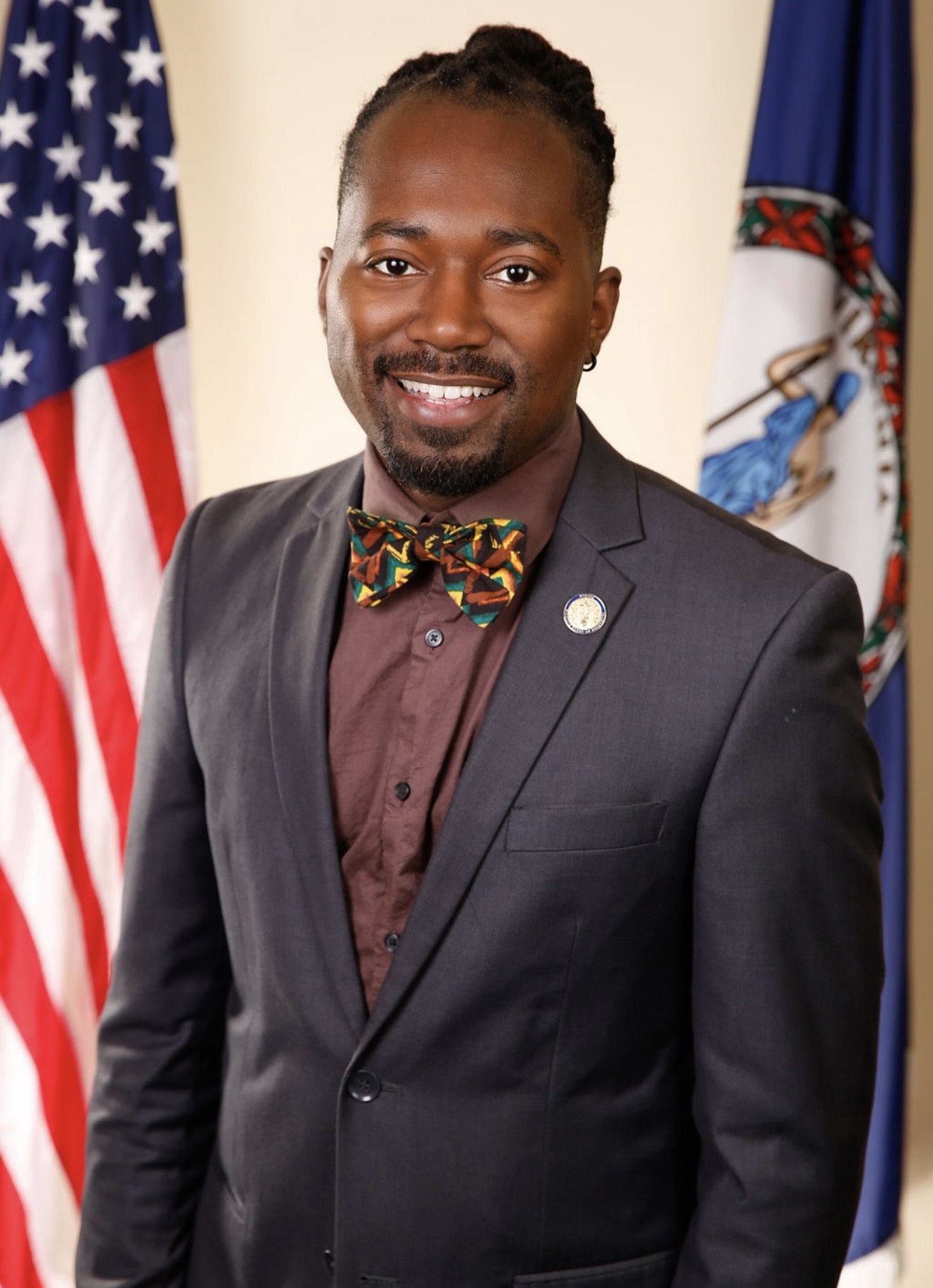
Del. Nadarius Clark
Sponsored bills
Exemptions from jury service upon request; age. Increases from 70 to 73 the age at which a person is exempt from jury service upon request. This bill is identical to SB 638.
Electric Vehicle Rural Infrastructure Programand Fund created. Creates the Electric Vehicle Rural InfrastructureProgram and Fund to assist private developers with non-utility costsassociated with the installation of electric vehicle charging stationsin certain localities. The bill provides that a private developeris eligible to receive grants of 70 percent of such non-utility costsfor electric vehicle charging stations installed in a city or countythat meets the criteria of a distressed locality, as defined in thebill, and caps the total amount of grants awarded in any fiscal yearat $25 million.
Prevailing wage rate for underground infrastructure works by public service companies. Directs the Department of Labor and Industry to determine and make available the prevailing wage rate for underground infrastructure work. Under the bill, each public service company shall ensure that its bid specifications or other contracts applicable to underground infrastructure works require payment at the prevailing wage rate. The bill requires contractors and subcontractors to post the prevailing wage rate in a prominent and accessible place at the work site. The bill also requires each public service company, contractor, or subcontractor subject to the provisions of the bill to comply with certain recordkeeping requirements. Provisions of the bill apply to contracts entered into on or after July 1, 2024.
School board duties; appointment and employmentof division superintendents; oversight. Requires each schoolboard to appoint, employ, and provide oversight for a division superintendentand provides that nothing in the Code of Virginia or the regulationsof the Board of Education shall be construed to prohibit the schoolboard from providing such oversight.
Public school funding; At-Risk Program established. Establishes the At-Risk Program, defined in the bill as any state funding provided for programs of prevention, intervention, or remediation or pursuant to the at-risk add-on for the purpose of supporting programs for students who are educationally at risk. The bill requires (i) the determination of the amount of state funding for which a school division is eligible pursuant to the At-Risk Program to be based on the school division's identified student percentage, defined in the bill as the fraction, expressed as a percentage, that results from dividing the number of identified students enrolled in a school division by the total number of students enrolled in such school division, weighted by the factor of 1.5, and then adjusted by the addition of a percentage that corrects for undercounting English language learner students as identified students and (ii) such funding to be distributed as follows: 60 percent on a flat per-student rate and 40 percent on a variable rate set out in the general appropriation act based on the concentration of poverty in the school division. The bill provides that any school division that would have received more state funds for the at-risk add-on and programs of prevention, intervention, or remediation than it would pursuant to the consolidation of such state funding sources under the At-Risk Program established in the bill shall be held harmless and shall not have its share of such state funding reduced, effective for the 2024–2025 school year through the 2026–2027 school year.
Purchase of firearms; demonstrated competencewith a firearm or completion of a firearms safety or training course;penalty. Requires that a prospective purchaser of a firearm presentproof that such prospective purchaser has demonstrated competencewith a firearm or completed a firearms safety or training course,as specified in the bill, within the past five years.
Commending the Honorable L. Kaye Kory.
Employee Child Care Assistance Program and Fund; established. Establishes the Employee Child Care Assistance Programand Fund to provide matching funds to in order to incentivize employersto contribute to the child care costs of their employees. To participatein the program, an employer is required to enter into an agreementwith its employee and an eligible mixed-delivery provider, definedin the bill, to make child care contributions to the eligible mixed-deliveryprovider on behalf of the employee, and the Department of Educationwill issue a state match directly to such eligible mixed-deliveryprovider or to a third-party administrator. The bill provides thatthe state match shall not exceed 100 percent of the employer contributionmade by an employer on behalf of an employee whose annual gross wagesare equal to or less than the local median household income, definedin the bill, and shall not exceed 80 percent of the employer contributionmade by an employer on behalf of an employee whose annual gross wagesare greater than the local median household income. The bill requiresthat 25 percent of the Fund be used to provide state matching fundsfor employees of small businesses.
Public institutions of higher education; admissions applications; legacy admissions and admissions based on donor status prohibited. Prohibits any public institution of higher education from providing any manner of preferential treatment in the admissions decision to any student applicant on the basis of such student's legacy status, defined in the bill, or such student's familial relationship to any donor to such institution. This bill is identical to SB 46.