SNAP benefits program; inmates of state or local correctional facilities. Requires the Department of Social Services(the Department) to establish a process that (i) allows inmatesof state or local correctional facilities to submit within 45 daysof the inmate's expected release date an application to participatein the SNAP benefits program and (ii) enables eligible inmates toreceive SNAP benefits immediately upon release. The bill requiresthe Department to distribute to the Department of Corrections andthe Board of Local and Regional Jails information regarding suchprocess and certain other information described in the bill. Thebill has a delayed effective date of October 1, 2023.
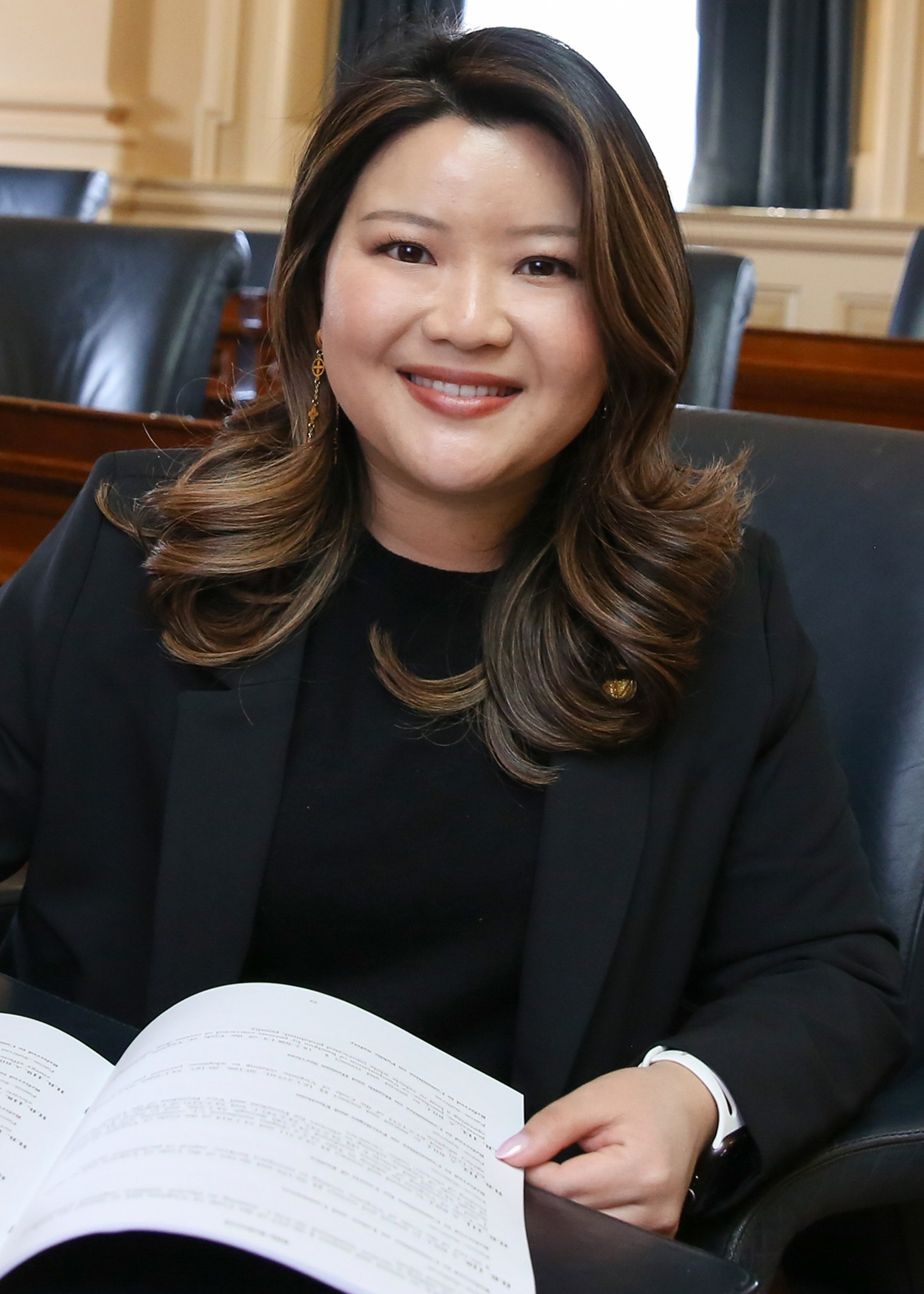
Del. Irene Shin
Sponsored bills
Selective Service; Two-Year College TransferGrant; Virginia Tuition Assistance Grant Program. Removes therequirement that individuals register for the Selective Service incompliance with federal law in order to be eligible for the Two-YearCollege Transfer Grant and the Virginia Tuition Assistance GrantProgram.
Medicaid; program information; accessibility. Directs the Board of Medical Assistance Services to require every person that provides program information to ensure that all program information, defined in the bill, be made available in a manner that is accessible to (i) individuals with limited English proficiency through the provision of language access services, including oral interpretation and written translations, and (ii) individuals with disabilities through the provision of auxiliary aids services, when doing so is a reasonable step to providing meaningful access to health care coverage. The bill provides that language access services and auxiliary aids services shall be provided free of charge to such individuals and that information regarding how to receive the language access services and auxiliary aids services shall be included with program information documents on a website maintained by the Department of Medical Assistance Services and on the website of every agency of the Commonwealth and person with whom the Department has entered into a contract that disseminates program information. The bill also requires every person that makes program information available to use an objective readability measure approved by the Department to test the readability of its program information documents and requires such persons to make program information documents available to the Department for review upon request. Under current law, use of a specific readability formula is required and a minimum total readability score is prescribed.
Transit Ridership Incentive Program. Changes from a maximum of 25 percent to a minimum of 25 percent the percentage of Transit Ridership Incentive Program (TRIP) funds required to be used to support the establishment of programs to reduce the impact of fares on low-income individuals. This change expires on July 1, 2024. The bill also requires at least 25 percent of TRIP funds to be used to support regional transit initiatives and provides that the Commonwealth Transportation Board has the discretion to allocate the remaining funds available as authorized by law and based on the programs and initiatives submitted during the application process.
Broadband service; new residential and commercial development; stakeholder advisory group. Provides that the Department of Housing and Community Development shall convene a stakeholder advisory group for the purpose of evaluating local and state policies, procedures, or ordinances to facilitate the expansion of high-speed broadband service and associated infrastructure in new residential and commercial development. The stakeholder advisory group shall be composed of representatives from the commercial and residential land development and construction industry, local government, high-speed broadband providers, and other stakeholders as determined by the Department and shall report its findings and recommendations to the Broadband Advisory Council no later than September 30, 2022. This bill is identical to SB 446.
Lyme disease; signage; instructional resources and materials. Requires the Department of Conservation and Recreation to develop and post in each state park and interstate park signage addressing the appropriate steps a visitor can take to prevent tick bites, how to identify Lyme disease, and where to seek treatment. The bill requires the Department to install such signage first in those areas in the Commonwealth that have been identified as most susceptible to Lyme disease and to complete the installation of such signage in all state parks and interstate parks by January 1, 2028. The bill also requires the Secretary of Education, in collaboration with the Secretary of Health and Human Resources and the Secretary of Natural Resources, to develop instructional resources and materials to assist school boards and local and regional public libraries in establishing an education and awareness program to protect children from Lyme disease and other tick-borne infections. The bill provides that such instructional resources and materials (i) shall be appropriate for individuals of school age; (ii) shall provide information on the identification of ticks, recommended procedures for safe tick removal, and best practices to provide protection from ticks; (iii) may include video productions, pamphlets, and demonstration programs to illustrate the sizes of various ticks, including sizes before and after each variety has become engorged, to assist with the identification of a tick and the reaction on the skin that may result from a tick bite; and (iv) shall be made available to school boards and local and regional public libraries upon request at no charge.
Historical African American cemeteries. Changes the date of establishment that qualifies historical African American cemeteries for appropriated funds to care for such cemeteries from prior to January 1, 1900, to prior to January 1, 1948, and provides that the total number of graves in a qualifying cemetery shall be the number of markers of African Americans who were interred in such cemetery prior to January 1, 1948. Under current law, the total number of graves is the number of markers of African Americans who lived at any time between January 1, 1800, and January 1, 1900. This bill is identical to SB 477.
Institutions of higher education; hazing; policies. Establishes mandates at nonprofit private institutions of higher education and public institutions of higher education relating to hazing and defines different types of organizations at such institutions to which the mandates apply. The bill requires student organizations officially recognized by an institution of higher education structured in such a way that upon invitation for membership, individuals do not automatically become members of such organization and have a period of time between invitation for membership and being initiated into membership, to have an advisor present at all official events where new members and members of the student organization hosting the event are invited or are instructed to attend, except that such advisors may be asked to leave the room during ceremonies, rituals, or other such events that are only permitted to be attended by the new members and members. Such advisors shall provide extensive, current, and in-person education and information on hazing to all members and new members of such organizations. The bill requires the governing board of each institution to include as part of its policy, code, rules, or set of standards governing sexual violence a provision for immunity from disciplinary action based on hazing or personal consumption of drugs or alcohol where such disclosure is made in conjunction with a good faith report of an act of hazing in advance of or during an incident of hazing that causes injury to a person. Beginning with the 2022–2023 academic year, the bill requires each institution to maintain and publicly report actual findings of violations of the institution's code of conduct or of federal or state laws pertaining to hazing that are reported to campus authorities or local law enforcement. This bill shall be known as Adam's Law.

Retail sales and use tax; exemption for medicine and drugs purchased by veterinarians. Exempts veterinarians from sales and use tax on the purchase of prescription medicines and drugs that are administered or dispensed to patients within a veterinarian-client-patient relationship. The bill repeals provisions of current law that provide that a veterinarian dispensing or selling medicines or drugs on prescription shall be deemed to be the user or consumer of all such medicines and drugs. The bill provides that the exemption shall be in effect from July 1, 2022, until July 1, 2025. This bill is identical to SB 517.
Virginia Public Procurement Act; moderate-risk contracts; federal General Services Administration programs. Provides that all public bodies shall report to the Department of General Services on programs offered through the federal General Services Administration for all contracts with anticipated costs of over $250,000. The Department is required by the bill to review the report by the public body find whether the public body either correctly identified that programs are available or are not available or failed to identify programs which the public body should consider, and make such finding public record. The bill requires the Department to notify the public body of any programs that may lead to savings for the Commonwealth related to the procurement within 30 days of receipt of the report.