Parole Board; voting requirements. Provides that notwithstanding any other provision of law or regulation, if the Parole Board adopts a rule or regulation requiring the concurrence of four or more members of the Board to grant discretionary parole or conditional release, in the event that there are less than four members but at least three members on the Parole Board, then such requirement shall be satisfied upon a unanimous vote of the members on the Board.
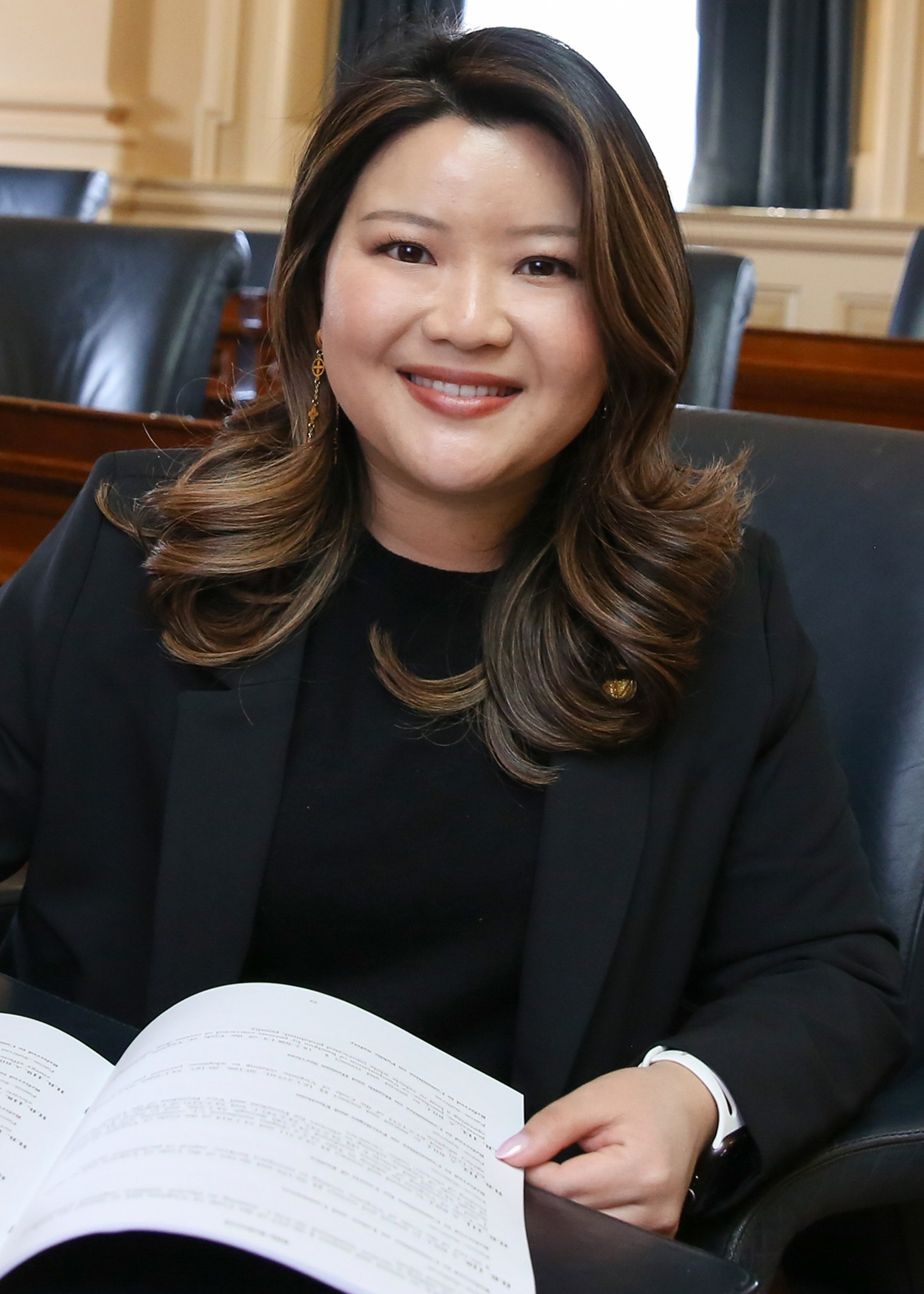
Del. Irene Shin
Sponsored bills
Constitutional amendment (voter referendum); real property tax exemption; surviving spouses of soldiers who died in the line of duty. Provides for a referendum at the November 5, 2024, election to approve or reject an amendment to the Constitution of Virginia that would expand the real property tax exemption that is currently available to the surviving spouses of soldiers killed in action to be available to the surviving spouses of soldiers who died in the line of duty with a Line of Duty determination from the U.S. Department of Defense. This bill is identical to SB 4.
Stores and telephone systems in local correctional facilities; fees. Provides that the net profits from the operation of stores and telephonic communication systems in local correctional facilities shall be used within each facility respectively for educational, recreational, or medical purposes for the benefit of the inmates to include behavioral health, substance abuse, reentry, and rehabilitative services and may be expended to pay for the training, salaries, and benefits of employees or contractors whose primary job is to provide such programs and services to the inmates.
Standards for attorneys appointed to represent parents or guardians; child dependency cases; compensation; multidisciplinary law offices or programs; report. Requires the Judicial Council of Virginia, in conjunction with the Virginia State Bar, beginning July 1, 2026, to adopt standards for the qualification and performance of attorneys appointed to represent a parent or guardian of a child when such child is the subject of a child dependency case, as defined in the bill. The bill also requires the Judicial Council of Virginia, beginning July 1, 2026, to maintain a list of attorneys admitted to practice law in Virginia who are qualified to be appointed to represent indigent parents involved in a child dependency case. Prior to July 1, 2026, counsel must be appointed from the list of attorneys qualified to serve as guardians ad litem. The bill provides that beginning January 1, 2025, court-appointed counsel for a parent, guardian, or other adult in a child dependency case will be compensated in an amount no greater than $330, or in a case for the termination of residual parental rights, $680.The bill authorizes the establishment of up to two multidisciplinary law offices or programs in localities, jurisdictions, or judicial districts that affirm they have met specified criteria for the purpose of representing parents in a child dependency court proceeding or in a child protective services assessment or investigation prior to such proceeding. During any calendar year that such an office or program is in effect for at least six months, the office or program must submit a report on program outcomes, expenses, recommendations, and other pertinent information to the Office of the Children's Ombudsman and the Chairmen of the House Committees for Courts of Justice and on Health and Human Services and Appropriations and the Senate Committees for Courts of Justice and on Education and Health and Finance and Appropriations by November 1.

Department of Professional and Occupational Regulation; definition of a real estate broker. Adds to the definition of "real estate broker" any individual or business entity who sells or offers to sell, buys or offers to buy, negotiates, or otherwise deals in real estate contracts, including assignable contracts, on two or more occasions in any 12-month period for compensation or valuable consideration. The bill contains technical amendments and is identical to SB 358.
Board of Housing and Community Development; stakeholder advisory group; report. Directs the Board of Housing and Community Development (the Board) to convene a stakeholder advisory group including fire code officials to evaluate and recommend revisions to the Uniform Statewide Building Code to permit Group R-2 occupancies to be served by a single exit, provided that the building has not more than six stories above grade plane. The bill requires the stakeholder advisory group to submit its findings and recommendations to the Board and to the Chairmen of the House Committee on General Laws and the Senate Committee on General Laws and Technology no later than December 1, 2024. This bill is identical to SB 195.
Elections administration; change to location of polling place, additional notice requirement. Requires notice of a change in the location of a polling place to be posted, to the extent practicable, at the location last used for such polling place on the day of the first primary election and first general election conducted in the new location. This notice is required to include information on how voters may find their polling place.
State Council of Higher Education for Virginia; public institutions of higher education; policies for establishing eligibility for accommodations; report. Requires the State Council of Higher Education for Virginia, in consultation with representatives of public institutions of higher education, disability advocacy organizations, students enrolled at public institutions of higher education, higher education disability accommodation professionals, and a subject matter expert, to (i) study the processes by which each public institution of higher education in the Commonwealth determines the eligibility for accommodations of an admitted or enrolled student with a temporary or permanent disability, (ii) identify in such processes any potential barriers to establishing eligibility, and (iii) make recommendations on reducing any such barriers and on the development and establishment of a uniform accommodations eligibility determination in the Commonwealth. This bill is identical to SB 21.
Board of Medicine; Board of Dentistry; Board of Optometry; Boards of Medicine and Nursing; patient counseling; treatment with opioids. Directs the Board of Medicine, the Board of Dentistry, the Board of Optometry, and the Boards of Medicine and Nursing to amend their regulations to require the provision of certain information to patients being prescribed an opioid for the treatment of acute or chronic pain. The bill requires that the regulations include an exception to the required provision of such information for patients who are (i) in active treatment for cancer, (ii) receiving hospice care from a licensed hospice or palliative care, (iii) residents of a long-term care facility, (iv) being prescribed an opioid in the course of treatment for substance abuse or opioid dependence, or (v) receiving treatment for sickle cell disease. The bill directs the Boards to adopt emergency regulations to implement the provisions of the bill.
Historic rehabilitation tax credit; increase.Increases from $5 million to $10 million, beginning in taxable year2024, the maximum amount of the historic rehabilitation tax credit,including amounts carried over from prior taxable years, that maybe claimed by a taxpayer in any taxable year. In addition, shouldthe taxpayer incur expenses toward the rehabilitation of a certifiedhistoric structure in a locality that has a designated enterprise zone, as defined in relevant law, the taxpayer may claim up to anadditional $10 million in any taxable year.