

Virginia Residential Landlord and Tenant Act; enforcement by localities. Provides that if a condition exists in a rental dwelling unit that constitutes a material noncompliance by the landlord with the rental agreement or with any provision of law that, if not promptly corrected, constitutes a fire hazard or serious threat to the life, health, or safety of tenants or occupants of the premises, a locality may institute an action for injunction and damages to enforce the landlord's duty to maintain the rental dwelling unit in a fit and habitable condition, provided that (i) the property where the violation occurred is within the jurisdictional boundaries of the locality and (ii) the locality has notified the landlord who owns the property, either directly or through the managing agent, of the nature of the violation and the landlord has failed to remedy the violation to the satisfaction of the locality within a reasonable time after receiving such notice.
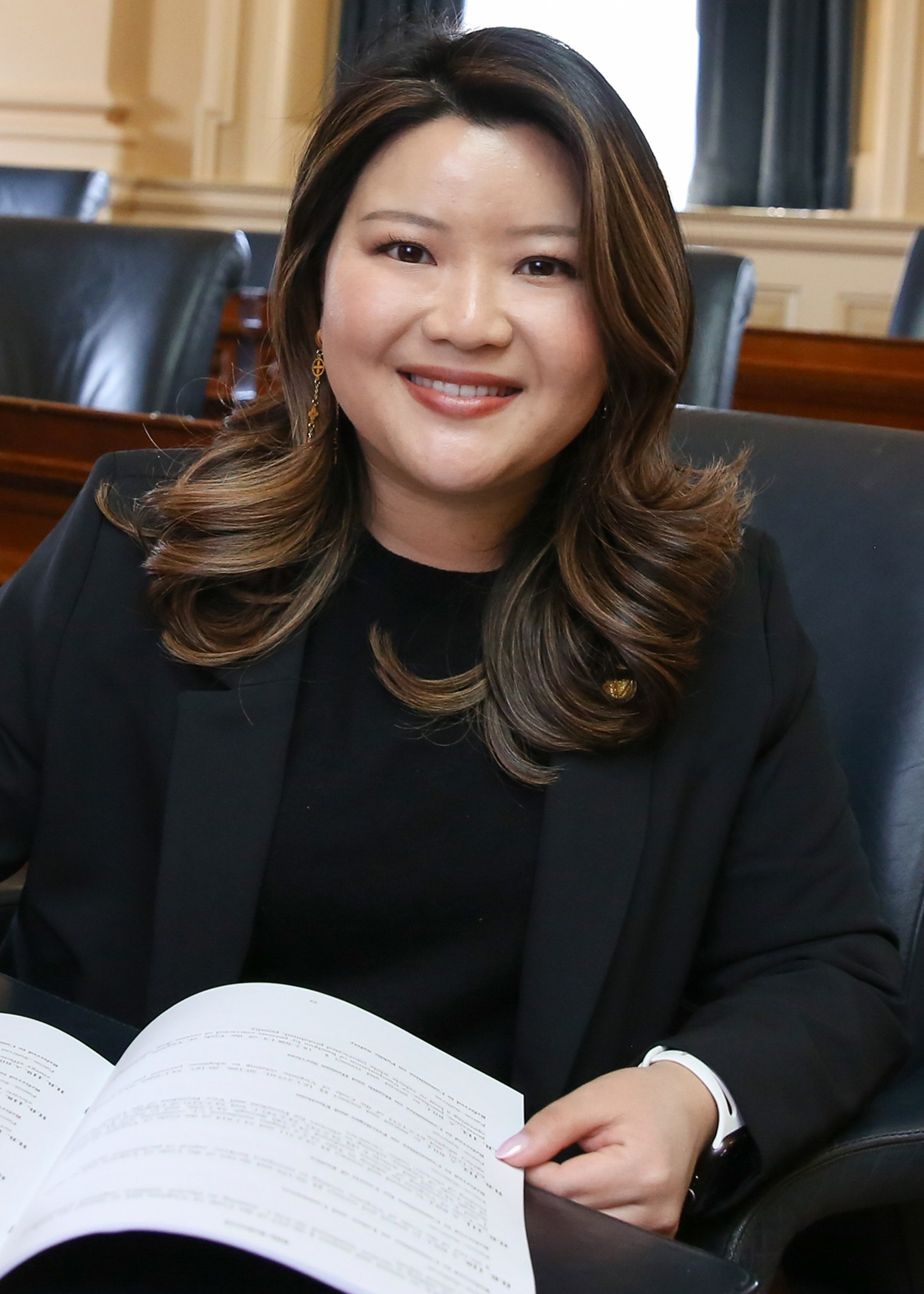
Del. Irene Shin
Sponsored bills
Storage of firearms in a residence where a minor or person prohibited from possessing a firearm is present; penalty. Requires any person who possesses a firearm in a residence where such person knows that a minor or a person who is prohibited by law from possessing a firearm is present to store such firearm and the ammunition for such firearm in a locked container, compartment, or cabinet that is inaccessible to such minor or prohibited person. The bill provides that a violation is a Class 4 misdemeanor. The bill exempts (i) any person in lawful possession of a firearm who carries such firearm on or about his person and (ii) the storage of antique firearms and provides that the lawful authorization of a minor to access a firearm is not a violation of the bill's provisions. The bill also requires firearm dealers to post a notice stating such firearm storage requirements and the penalty for improperly storing such firearms.
Minimum wage. Increases the minimum wage incrementally to $15.00 per hour by January 1, 2027. The bill codifies the adjusted state hourly minimum wage of $12.41 per hour that is effective January 1, 2025, and increases the minimum wage to $13.50 per hour effective January 1, 2026, and to $15.00 per hour effective January 1, 2027. The bill requires the Commissioner of Labor and Industry to establish an adjusted state hourly minimum wage by October 1, 2027.
Conservation and replacement of trees during development process. Expands certain existing local government authority to conserve or replace trees during the development process by expanding such authority statewide. The bill allows localities to establish higher tree canopy replacement percentages based on density per acre. The bill also alters the current process for granting exceptions to a local ordinance by altering a provision that requires the granting of an exception when strict application of the ordinance would result in unnecessary or unreasonable hardship to the developer and requiring that the locality concur with such alteration. The bill permits localities to monitor and assess the condition and coverage of tree canopies at development sites during the time period up to 20 years' maturity of the planted trees. The bill contains technical amendments.
Purchase, possession, or transportation of firearm; assault and battery of a family or household member or intimate partner; penalties. Adds to the definition of "family or household member," as such definition relates to juvenile and domestic relations district court, a person's intimate partner, defined in the bill as an individual who, within the previous 12 months, was in a romantic, dating, or sexual relationship with the person as determined by the length, nature, frequency, and type of interaction between the individuals involved in the relationship. The bill also adds to the definition of "family or household member," as such definition relates to a person's purchase, possession, or transportation of a firearm following an assault and battery of a family or household member, any individual who cohabits or who, within the previous 12 months, cohabitated with the person. Finally, the bill provides that any person who knowingly and intentionally purchases, possesses, or transports any firearm following a misdemeanor conviction for an offense that occurred on or after July 1, 2025, for the offense of assault and battery against an intimate partner or an offense substantially similar under the laws of any other state or of the United States is guilty of a Class 1 misdemeanor. This bill is identical to SB 883.
Firearm transfers to another person from a prohibited person. Provides that a person who is prohibited from possessing a firearm because such person is subject to a protective order or has been convicted of an assault and battery of a family or household member may transfer a firearm owned by such prohibited person to any person who is not otherwise prohibited by law from possessing such firearm, provided that such person who is not otherwise prohibited by law from possessing such firearm is 21 years of age or older and does not reside with the person who is subject to the protective order. Under current law, there is no requirement that such transferee cannot be younger than 21 years of age and cannot reside with such prohibited person. The bill also provides that such prohibited person who transfers, sells, or surrenders a firearm pursuant to the provisions of the bill shall inform the clerk of the court of the name and address of the transferee, the federally licensed firearms dealer, or the law-enforcement agency in possession of the firearm and shall provide to the transferee a copy of the form certifying that such person does not possess any firearms or that all firearms possessed by such person have been surrendered, sold, or transferred. The bill also provides that a person who is prohibited from possessing a firearm because such person is subject to a protective order or has been convicted of an assault and battery of a family or household member shall be advised that a law-enforcement officer may obtain a search warrant to search for any firearms from such person if such law-enforcement officer has reason to believe that such person has not relinquished all firearms in his possession. This bill is identical to SB 744.
Public school teachers; written notice of noncontinuation of continuing contract. Provides that written notice of noncontinuation of a continuing teacher contract by the teacher must be given by June 15 of each year; otherwise, the contract continues in effect for the ensuing year in conformity with local salary stipulations, including increments. Current law provides that written notice of noncontinuation of a continuing teacher contract by either the teacher or the school board must be given by June 15 of each year; otherwise, the contract continues in effect for the ensuing year in conformity with local salary stipulations, including increments. This bill is identical to SB 1032.
Department of Medical Assistance Services; appeals of agency determinations. Allows health care providers to appeal any adverse action or determination by the Department of Medical Assistance Services (DMAS) or a DMAS contractor. Under current law, such appeal is allowed for a determination of overpayment to a provider by DMAS. The bill adds provisions allowing for DMAS and an appealing provider to stay the deadline for their appeal decision to facilitate settlement discussions. The bill further specifies that DMAS contractors are required to represent themselves during appeal proceedings. This bill is identical to HB 2082.
Importation, sale, manufacture, etc., of assault firearms and certain ammunition feeding devices prohibited; penalties. Creates a Class 1 misdemeanor for any person who imports, sells, manufactures, purchases, or transfers an assault firearm, as that term is defined in the bill with some exceptions, and prohibits a person who has been convicted of such violation from purchasing, possessing, or transporting a firearm for a period of three years from the date of conviction. The bill provides that an assault firearm does not include any firearm that is an antique firearm, has been rendered permanently inoperable, is manually operated by bolt, pump, lever, or slide action, or was manufactured before July 1, 2025. The bill also prohibits the sale of a large capacity ammunition feeding device, as that term is defined in the bill. The bill provides that any person who willfully and intentionally (i) sells an assault firearm to another person or (ii) purchases an assault firearm from another person is guilty of a Class 1 misdemeanor and that any person who imports, sells, barters, or transfers a large capacity ammunition feeding device is guilty of a Class 1 misdemeanor. The bill also makes it a Class 1 misdemeanor for any person younger than 21 years of age to import, sell, manufacture, purchase, possess, transport, or transfer an assault firearm regardless of the date of manufacture of such assault firearm with some exceptions. This bill is identical to SB 1181.
Trigger activator definition; penalty. Defines "trigger activator" as a conversion kit, tool, accessory, or device designed to alter the rate of fire of a semi-automatic firearm to mimic automatic weapon fire or used to increase the rate of fire to a rate faster than such semi-automatic firearm not equipped with a conversion kit, tool, accessory, or device. The bill clarifies that "trigger activator" includes a bump stock, trigger crank, hellfire trigger, binary trigger system, burst trigger system, or a copy thereof, but does not include a semi-automatic replacement trigger, designed for use in competitive shooting, that improves performance and functionality over the stock trigger. This bill is identical to SB 886.