Department of Medical Assistance Services; enhanced oversight of services facilitators. Directs the Department of Medical Assistance Services to enhance oversight of Medicaid services facilitation for consumer directed services, including incorporation of such services into the statewide Fiscal Employer Agent contract and development of a contract monitoring and oversight plan.
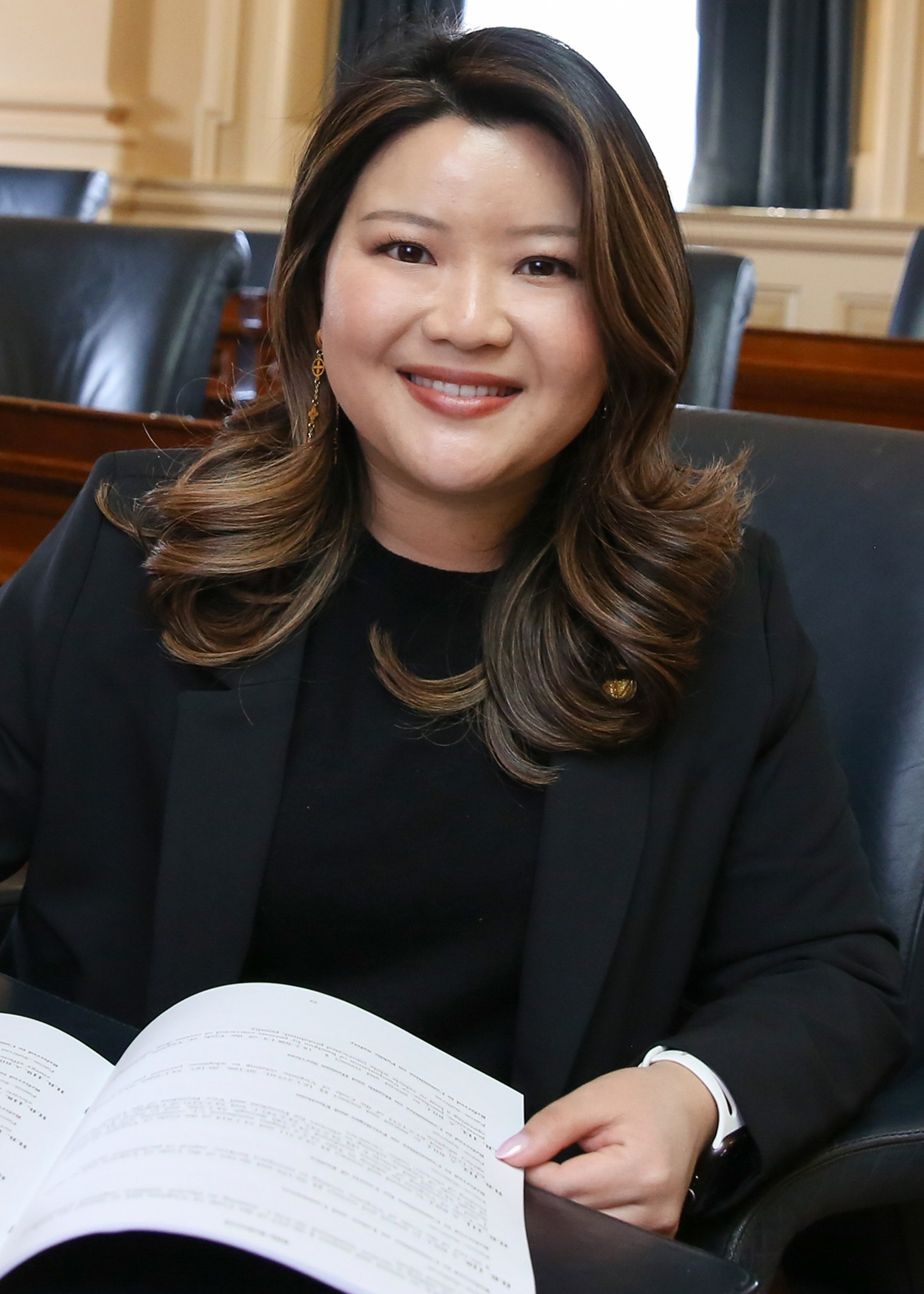
Del. Irene Shin
Sponsored bills
Department of Environmental Quality; standby generators study; report. Directs the Department of Environmental Quality to conduct a one-year study of all standby generators used by a commercial facility with an air permit in the Commonwealth. The bill requires the study to (i) identify commercial facilities with an air permit that use standby generators, (ii) identify the type of pollutants emitted from such standby generators, and (iii) analyze and describe the amount of pollutants from such standby generators. The Department is required to report its findings and recommendations to the Chairs of the House Committee on Agriculture, Chesapeake and Natural Resources and the Senate Committee on Agriculture, Conservation and Natural Resources by July 1, 2027.
State correctional facilities; participation of prisoners in employment and educational programs; reentry planning. Expands the program assignments in which the Director of the Department of Corrections may place a prisoner while such prisoner is confined in a state correctional facility. The bill requires the Director to place a prisoner in an appropriate program assignment within (i) 90 days of the arrival of a prisoner sentenced to a new term of confinement to a state correctional facility or (ii) 60 days of a prisoner already in custody being transferred to a new state correctional facility and provides that participation in such program assignments shall be for an average of 30 hours per week, calculated individually across the calendar year. Finally, the bill expands upon the requirements for a prisoner's reentry plan, including requiring an assessment, if necessary, of a prisoner's readiness to take a high school equivalency test and any modifications needed for the prisoner to take or improve upon such test, and making available peer and group educational programs developed and led by qualified prisoners.
Retail sales and use tax; exemption for data centers. Requires a data center operator, in order to be eligible for the existing data center sales and use tax exemption, to (i) beginning July 1, 2027, not use co-located generating facilities that emit carbon dioxide, other than backup generators; (ii) beginning July 1, 2029, contract for a certain percentage of energy, capacity, and renewable energy certificates from clean energy resources, as evidenced by a certification from the State Corporation Commission, or contracts and service agreements; (iii) utilize only non-carbon dioxide-emitting backup power sources, such as energy storage resources, beginning on a date dependent on the data center's initial service date; and (iv) demonstrate, for any new data center issued a final certificate of occupancy or its equivalent on or after January 1, 2030, or for any data center operator seeking an amended memorandum of understanding, sufficient investment in environmental management and energy efficiency measures to provide system-wide benefits, as defined in the bill. Finally, the bill has a delayed effective date of July 1, 2027.
Public institutions of higher education; in-state tuition; children of active duty service members or veterans. Provides that any child of an active duty service member or veteran who claims Virginia as his home state and filed Virginia tax returns for at least four years during active duty service is eligible for in-state tuition charges, regardless of domicile. Under current law, any such child is eligible for in-state tuition charges if such service member or veteran claims Virginia as his home state and filed Virginia tax returns for at least 10 years during active duty service.
Elections; election offenses; intimidation and threats toward election officials; penalty. Removes the requirement that a person willfully hinder or prevent an election official from administering elections in order to be found guilty of intimidation and threats toward such official, which is a Class 5 felony under current law.
Local ordinances; regulation of pet shops. Authorizes the governing body of any locality to, by ordinance, regulate or prohibit the sale of animals in a pet shop. Such ordinance may distinguish between certain types of pet shops and include provisions for special licensing, inspections, reporting, restrictions, or prohibitions on the sale of certain types of animals. The bill also includes certain existing statewide provisions related to pet shops in the list of sections for which a locality may adopt parallel or more stringent ordinances. The provisions of the bill do not become effective unless reenacted by the 2027 Session of the General Assembly.
State Corporation Commission; cost allocation proceedings for certain electric utilities. Directs the State Corporation Commission to conduct proceedings to review cost allocation among different customer classifications for certain electric utilities. For Dominion Energy and Appalachian Power, the Commission is directed to determine if the cost allocation of transmission costs require customers that are not data centers to unreasonably subsidize the transmission costs attributable to serving customers that are data centers by January 1, 2027. For Dominion Energy, the Commission is directed to determine if the current allocation of generation and distribution costs require customers that are not data centers to unreasonably subsidize the generation and distribution costs attributable to serving customers that are data centers by January 1, 2028.
Memorializing Congress; National Infrastructure Bank. Urges the Congress of the United States to create a National Infrastructure Bank to finance urgently needed infrastructure projects.
Professions and occupations; impersonation of certain licensed professionals by chatbot; notice; civil liability. Provides that a proprietor that owns, operates, or deploys a chatbot, defined in the bill, shall not permit such chatbot to provide any substantive response, information, or advice, or take any action that, if taken by a natural person, would (i) constitute the unlawful practice of architecture, engineering, surveying, landscape architecture, geology, dentistry, medicine, nursing, optometry, pharmacy, physical therapy, certain mental health professions, psychology, social work, or veterinary medicine; (ii) violate the provisions of law making it unlawful for any person to practice medicine, osteopathic medicine, chiropractic, or podiatry or as a physician assistant in the Commonwealth without a valid unrevoked license or to practice law without being authorized or licensed; or (iii) violate the provisions of law making it unlawful for a teacher to be employed without a license or provisional license or relating to division superintendents, members of a school board or other school officers, or principals or teachers in a public school. The bill allows a person injured by a proprietor who engages in any such conduct to sue therefor no more than two years after the cause of action accrues and recover compensatory damages and reasonable attorney fees and costs. The bill also requires a proprietor operating or deploying a chatbot to provide a clear, conspicuous, and explicit notice to users that they are interacting with a chatbot but specifies that the provisions of such notice shall not be a defense to liability.