

Standards of Quality; work-based learning; teacher leadersand mentors; principal mentors; certain personnel positions and initiatives. Makesseveral changes to the Standards of Quality, including requiring the establishmentof units in the Department of Education to oversee work-based learning andprincipal mentorship statewide in Standard 1 and requiring the Board ofEducation to establish and oversee the local implementation of teacher leaderand teacher mentor programs in Standard 5. The bill also makes several changesrelating to school personnel in Standard 2, including (i) establishingschoolwide ratios of students to teachers in certain schools with highconcentrations of poverty and granting flexibility to provide compensationadjustments to teachers in such schools; (ii) requiring each school board toassign licensed personnel in a manner that provides an equitable distributionof experienced, effective teachers and other personnel among all schools in thelocal school division; (iii) requiring each school board to employ teacherleaders and teacher mentors at specified student-to-position ratios; (iv)requiring state funding in addition to basic aid to support at-risk studentsand granting flexibility in the use of such funds by school boards; (v)lowering the ratio of English language learner students to teachers; (vi)requiring each school board to employ reading specialists and establishing astudent-to-position ratio for such specialists; (vii) requiring school boardsto employ one full-time principal in each elementary school; (viii) loweringthe ratio of students to assistant principals and school counselors inelementary, middle, and high schools; and (ix) requiring each school board toprovide at least four specialized student support positions, including schoolsocial workers, school psychologists, school nurses, and other licensed healthand behavioral positions, per 1,000 students.
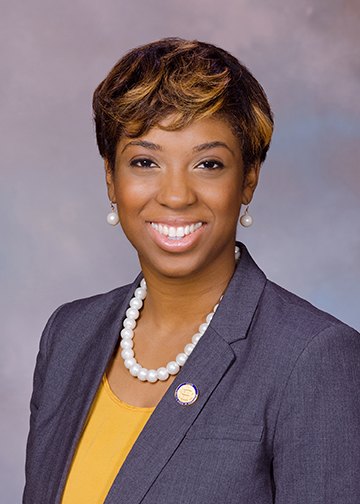
Del. Lashrecse D. Aird
Sponsored bills
Industrial hemp grower; public notice; buffer zone; odor mitigation. Requires any applicant for registration as a grower of industrial hemp to state either that the growing premises are more than 100 yards from any residential area or that the applicant has complied with pre-registration public notice and comment requirements set by the Commissioner of Agriculture and Consumer Services. The bill directs the Board of Agriculture and Consumer Services to adopt regulations requiring each registered grower of industrial hemp to maintain a buffer zone from the property lines of the growing premises and to perform odor mitigation at such premises during peak blooming season.
Study; JLARC; adequacy of prisoner educationaland vocational training programs; report. Directs the Joint LegislativeAudit and Review Commission to (i) identify all educational and vocationaltraining programs provided to prisoners in the Commonwealth; (ii)calculate the percentage of prisoners who participate in such educational and vocational training programs; (iii) identify and analyze anycorrelation between participation in such programs and successfulreentry into the community, including correlations related to employmentand recidivism; (iv) identify trades and industries within the Commonwealthwith the greatest current need for employees and determine if educationaland vocational training programs exist to prepare prisoners for suchtrades or industries; and (v) make recommendations to improve currenteducational and vocational training programs, create additional programs,and increase the number of prisoners participating in such programs.
Virginia Brownfield and Coal Mine Renewable Energy Grant Fund and Program; handbook. Establishes the Virginia Brownfield Renewable Energy and Coal Mine Grant Fund and Program. The fund and program shall be administered by the Department of Mines, Minerals and Energy for the purpose of awarding grants to renewable energy projects that are located on brownfields or previously coal mined lands. Grants are to be awarded on a basis of $500 per kilowatt of nameplate capacity from renewable energy sources that are located on previously coal mined lands and $100 per kilowatt of nameplate capacity from renewable energy sources that are located on brownfields.No more than $10 million shall be awarded to any previously coal mined lands project and no more than $5 million to any single brownfield project. No more than $35 million shall be allocated per year by the grant program. Of the $35 million, $20 million shall be reserved for previously coal mined lands projects. If less than $20 million is distributed to such projects, the remaining funds may be reallocated to brownfield projects. The bill also provides that, subject to appropriation, the Department shall, in consultation with stakeholders, develop a guidebook for renewable energy and energy storage development on brownfields and previously coal mined lands.
Demographic statements for bills; preparationby JLARC. Permits, beginning October 1, 2020, the Speaker of the House of Delegates, the Minority Leader of the House of Delegates,the Majority Leader of the Senate, and the Minority Leader of theSenate to request that a demographic statement, defined in the billas a statement that uses available data to outline the potentialeffects of a bill on specified demographic disparities within the Commonwealth, including a statement of whether the bill is likelyto increase or decrease such disparities, to the extent that suchdata is available, be prepared by the Joint Legislative Audit andReview Commission. Each requester may request the preparation ofup to five demographic statements per regular session of the GeneralAssembly. If a bill for which a demographic statement is preparedis introduced, the demographic statement shall be made availableto the public.
Family caregiver tax credit. Creates a nonrefundable income tax credit beginning in taxable year 2020 for expenses incurred by an individual in caring for an eligible family member, defined in the bill, who requires assistance with one or more activities of daily living, also defined in the bill. The credit equals 50 percent of eligible expenditures incurred by the caregiver, but shall not exceed $1,000. In order to qualify for the credit, the family caregiver must (i) not receive any compensation or reimbursement for the eligible expenditures and (ii) have federal adjusted gross income that is no greater than $75,000 for an individual or $150,000 for married persons. Both the caregiver and the eligible family member must be residents of Virginia. The bill requires the Tax Commissioner to establish guidelines for claiming the credit and provides that any unused credit may be carried forward by the taxpayer for five taxable years following the taxable year for which the credit was issued. The credit expires beginning with taxable year 2025.
Study; facial recognition; artificial intelligence;report. Directs the Joint Commission on Technology and Scienceto convene a working group of relevant agencies, law enforcement,private industry, and academics to study the proliferation and implementationof facial recognition and artificial intelligence. The Commissionshall make recommendations and report its findings no later thanthe first day of the 2021 Regular Session of the General Assembly.
Study; Department of Rail and Public Transportation; Commonwealth Corridor passenger rail service; report. Requeststhe Department of Rail and Public Transportation to study the feasibilityof an east-west Commonwealth Corridor passenger rail service connectingHampton Roads, Richmond, and the New River Valley.
Certain school boards; school buildings; assessment; compliance. Requires any local school board in a local schooldivision that (i) is under a division-level corrective action plan,(ii) contains any school that is under a corrective action plan,or (iii) receives at-risk add-on payments pursuant to the generalappropriation act to annually assess each school building in thelocal school division for compliance with the Board of Education'sminimum standards for school buildings and report the results to the Board. The bill requires, in any case of noncompliance with suchstandards, such report to include an assessment of the extent towhich local funds are available to remedy such noncompliance. Thebill provides that when the Board determines, on the basis of anysuch report, that a local governing body has not provided the localschool board sufficient funds to ensure compliance with the minimumstandards for school buildings, the Board may petition the relevant circuit court to compel the local governing body to provide suchfunds to the local school board.
War memorials for veterans. Removes a prohibition on (i) disturbing or interfering with any war monument or memorial erected by a locality or (ii) preventing citizens from maintaining such monument or memorial. The bill authorizes a locality to remove, relocate, or alter any such monument or memorial on the locality's public property upon the affirmative vote of its governing body, regardless of when the monument or memorial was erected, and removes certain criminal and civil penalties for such removal, relocation, or alteration. The bill also restricts bringing a cause of action pursuant to such penalties to the attorney for the locality in which the memorial or monument is located. Current law authorizes any person having an interest in the matter to bring such action if no action is brought within 60 days of the violation. The bill repeals an 1890 act of assembly related to the placement of a statue in the City of Alexandria. This bill was incorporated into HB 1537.