Submetering or energy allocation equipment;billing requirements; unit owners. Provides that for the purposesof rules promulgated by the State Corporation Commission related tobilling requirements and all other rules related to submetering orenergy allocation equipment, those rules applicable to tenants willbe applicable to residential and nonresidential unit owners.
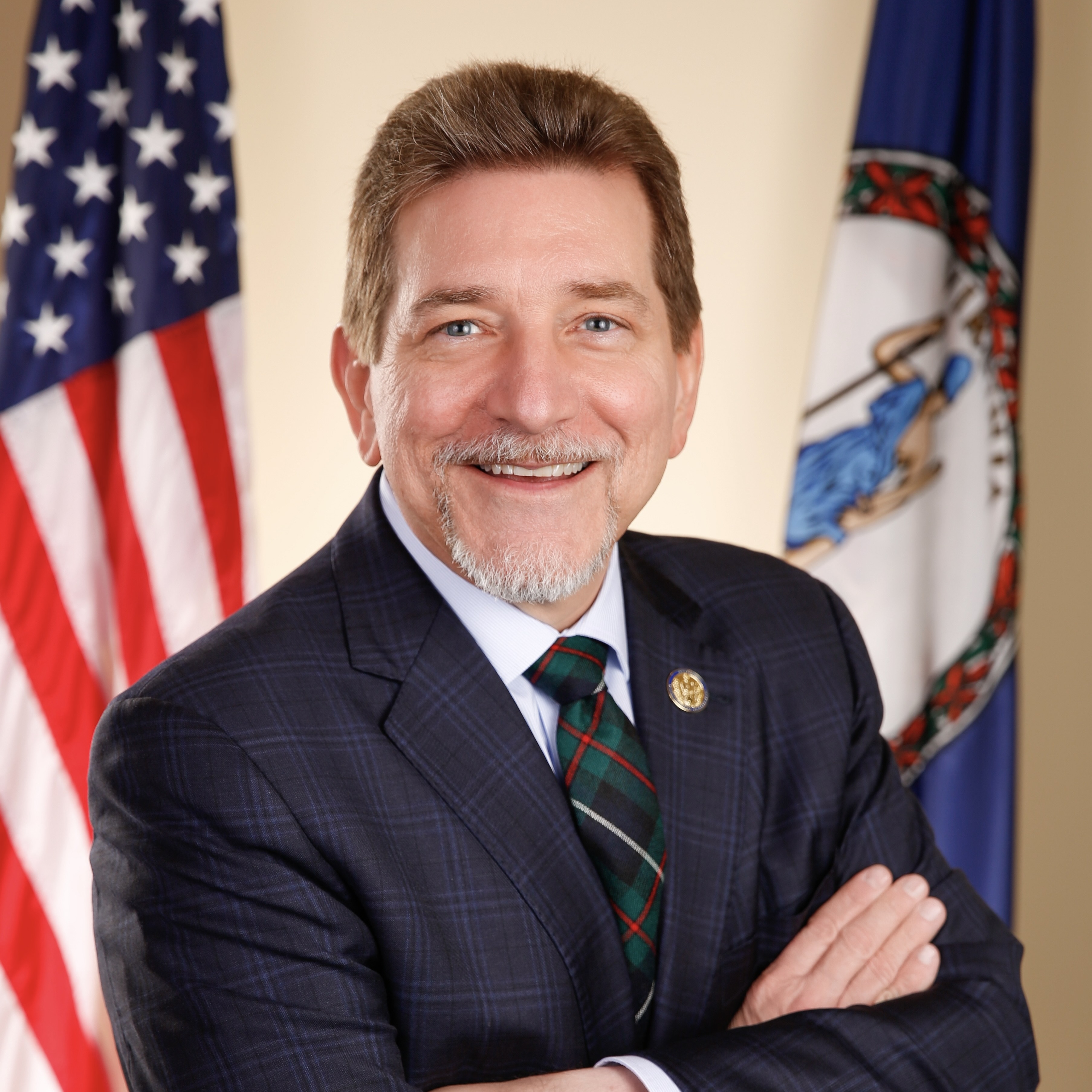
Del. David Reid
Sponsored bills
Railroad safety; civil penalties. Adds various requirements for railroad companies, including (i) prohibiting placing stationary cars or trains on its track within 1,500 feet on bothsides of any crossing of a railroad with a highway; (ii) prohibitingtrains that exceed 8,500 feet in length on any mainline or branchline; (iii) requiring a crew of at least two qualified individualson all trains, locomotives, or light engines used in connection withmoving freight; (iv) requiring warning signs or devices for certaintrack obstructions that could endanger a railroad company employee; and (v) requiring walkways adjacent to yard tracks where employeesregularly perform switching service. The bill requires that finesfor a violation of the train-length requirement be deposited in theShortline Railway Preservation and Development Fund for railway safetyprojects.
Plastic bag tax; distribution to towns. Providesthat any town located within a county that has imposed a disposableplastic bag tax shall receive a distribution of revenues collectedby the county based on the local sales tax distribution formula forappropriations to towns. The bill requires that towns use such revenuesfor the same purposes allowable for a county or city.
Concealed handgun permits; reciprocity with other states. Provides that the Superintendent of State Police, in consultation with the Office of the Attorney General, shall determine whether states meet the statutory qualifications for Virginia to recognize the concealed handgun permit of a person from another state. Under current law, any out-of-state permit is recognized in the Commonwealth provided that (i) the issuing authority provides the means for instantaneous verification of the validity of all such permits or licenses issued within that state, accessible 24 hours a day; (ii) the permit or license holder carries a photo identification issued by a government agency of any state or by the U.S. Department of Defense or U.S. Department of State and displays the permit or license and such identification upon demand by a law-enforcement officer; and (iii) the permit or license holder has not previously had a Virginia concealed handgun permit revoked. The bill also provides that a Virginia resident who has not been issued a valid resident concealed handgun permit may not use a concealed handgun or concealed weapon permit or license issued by another state to carry a concealed handgun in the Commonwealth. The bill requires the Superintendent of State Police, in consultation with the Office of the Attorney General, to review any agreements for reciprocal recognition that are in place with any other states as of July 1, 2024, to determine whether the requirements and qualifications of those states' laws are adequate to prevent possession of a permit or license by persons who would be denied a permit in the Commonwealth and revoke any reciprocity agreement or recognition of any states that do not meet such requirements or qualifications by December 1, 2024. The bill requires the Attorney General to provide a written explanation for any determination that a state's laws are adequate to prevent possession of such permit or license by persons who would be denied such permit in the Commonwealth.
Invasive plant species; retail sales; civil penalty. Requires, for the retail sale of any invasive plant species for outdoor use on a list established by the Department of Conservation and Recreation, a retail establishment to post in a conspicuous manner on the property located in proximity to each invasive plant display signage identifying such plant as invasive, educating consumers regarding invasive plant species, and encouraging consumers to ask about alternatives. The bill requires the Commissioner of Agriculture and Consumer Services to designate the format, size, and content of such signage no later than October 1, 2024, and requires the Commissioner to issue a stop sale order and mark or tag a plant in a conspicuous manner when an invasive plant is for sale at a retail establishment without appropriate signage. In such case, the bill requires the Commissioner to give written notice of a finding made to the owner, tenant, or person in charge of such retail establishment and requires the stop sale order issued to remain in effect until the required signage is posted. Any retail establishment that violates the provisions of the bill is subject to a civil penalty not to exceed $500. This bill is identical to SB 306.
Additional local sales and use tax to support schools; referendum. Authorizes all counties and cities to impose an additional local sales and use tax at a rate not to exceed one percent with the revenue used only for capital projects for the construction or renovation of schools if such levy is approved in a voter referendum. The bill removes the requirement that such a tax must have an expiration date on either (i) the date of the repayment of any bonds or loans used for such capital projects or (ii) a date chosen by the governing body. Under current law, only Charlotte, Gloucester, Halifax, Henry, Mecklenburg, Northampton, Patrick, and Pittsylvania Counties and the City of Danville are authorized to impose such a tax. This bill incorporates HB 60, HB 193, HB 458, HB 600, HB 616, HB 1159, and HB 1437 and is identical to SB 14.
Carrying a firearm or explosive material within Capitol Square or building owned or leased by the Commonwealth; exemptions; public institutions of higher education; penalty. Limits the exemption from the prohibition on the carrying of any firearm or explosive material within any building owned or leased by the Commonwealth or agency thereof or any office where employees of the Commonwealth or any agency thereof are regularly present for the purpose of performing their official duties that currently applies to any property owned or operated by a public institution of higher education to instead apply to any individual within a building owned or operated by a public institution of higher education who possesses a weapon as part of such public institution of higher education's curriculum or activities or as part of any organization authorized by such public institution of higher education to conduct its programs or activities within such building, as such uses are approved through the law-enforcement or public safety unit of such institution. This bill is identical to SB 383.
Purchase, possession, sale, transfer, etc.,of assault firearms and certain ammunition feeding devices prohibited;penalty. Creates a Class 1 misdemeanor for any person who imports,sells, manufactures, purchases, possesses, transports, or transfersan assault firearm, as that term is defined in the bill, and prohibitsa person who has been convicted of such violation from purchasing,possessing, or transporting a firearm for a period of three yearsfrom the date of conviction. The bill provides that an assault firearmdoes not include any firearm that is an antique firearm, has been rendered permanently inoperable, is manually operated by bolt, pump,lever, or slide action, or was manufactured before July 1, 2024.The bill also prohibits the sale of a large capacity ammunition feedingdevice, as that term is defined in the bill. The bill provides thatany person who willfully and intentionally (i) sells an assault firearmto another person or (ii) purchases an assault firearm from anotherperson is guilty of a Class 1 misdemeanor and that any person whoimports, sells, barters, or transfers a large capacity ammunition feeding device is guilty of a Class 1 misdemeanor. The bill alsomakes it a Class 1 misdemeanor for any person younger than 21 yearsof age to import, sell, manufacture, purchase, possess, transport,or transfer an assault firearm regardless of the date of manufactureof such assault firearm.

Voter identification; accepted forms of identification; private entities licensed or certified by certain state agencies.Adds to the list of accepted forms of identification for purposesof voting a valid identification card that contains a photographof the voter and is issued by any private entity that is licensedor certified, in whole or in part, by the Department of Health, Departmentof Social Services, Department of Medical Assistance Services, orDepartment of Behavioral Health and Developmental Services.
Equity in public school funding; student need; English language learner, special education, and at-risk students. Places several parameters on Standards of Quality funding calculations performed by the Department of Education, including (i) requiring the Department, when calculating the cost of salaries under the Standards of Quality funding formula, to include facilities staff and transportation staff salaries in the calculation of any cost of competing adjustment to salaries for instructional and support positions that is provided as part of the state share of basic aid pursuant to the general appropriation act; (ii) requiring the Department, when estimating the cost of any compensation supplement for instructional and support positions under the Standards of Quality funding formula, to include and estimate the cost of such a compensation supplement for facilities staff; (iii) prohibiting the Department from applying any cap on inflation rate adjustments to non-personal cost categories during the biennial process of rebenchmarking the direct aid to public education budget; and (iv) requiring the Department to utilize a three-year average of the most recently available data to calculate the composite index of local ability-to-pay for each school division. The bill also amends Standard of Quality 2 by (a) including in the definition of "support services position" any central office clerical position that is not otherwise set forth in such definition, (b) requiring a per-pupil Standards of Quality funding add-on to be provided for English language learner and special education students, (c) requiring, in addition to the positions supported by basic aid, state funding, pursuant to the general appropriation act, to be provided to cover the actual average school division cost to educate children with disabilities, and (d) establishing the At-Risk Program, defined in the bill as any state funding provided for programs of prevention, intervention, or remediation or pursuant to the at-risk add-on for the purpose of supporting programs for students who are educationally at risk. The bill requires (1) the determination of the amount of state funding for which a school division is eligible pursuant to such At-Risk Program to be based on the school division's identified student percentage, defined in the bill as the fraction, expressed as a percentage, that results from dividing the number of identified students enrolled in a school division by the total number of students enrolled in such school division, weighted by the factor of 1.5, and then adjusted by the addition of a percentage that corrects for undercounting English language learner students as identified students and (2) such funding to be distributed as follows: 60 percent on a flat per-student rate and 40 percent on a variable rate set out in the general appropriation act based on the concentration of poverty in the school division. The bill is a recommendation of the Joint Legislative Audit and Review Commission.