Home-based firearms dealers; prohibited nearschools; penalties. Provides that no home-based firearms dealer,as defined in the bill, shall be engaged in the business of selling,trading, or transferring firearms at wholesale or retail within 1.5miles of any elementary or middle school, including buildings andgrounds. The bill provides that any person who willfully violatessuch prohibition is guilty of a Class 2 misdemeanor for a first offenseand guilty of a Class 1 misdemeanor for a second or subsequent offense.
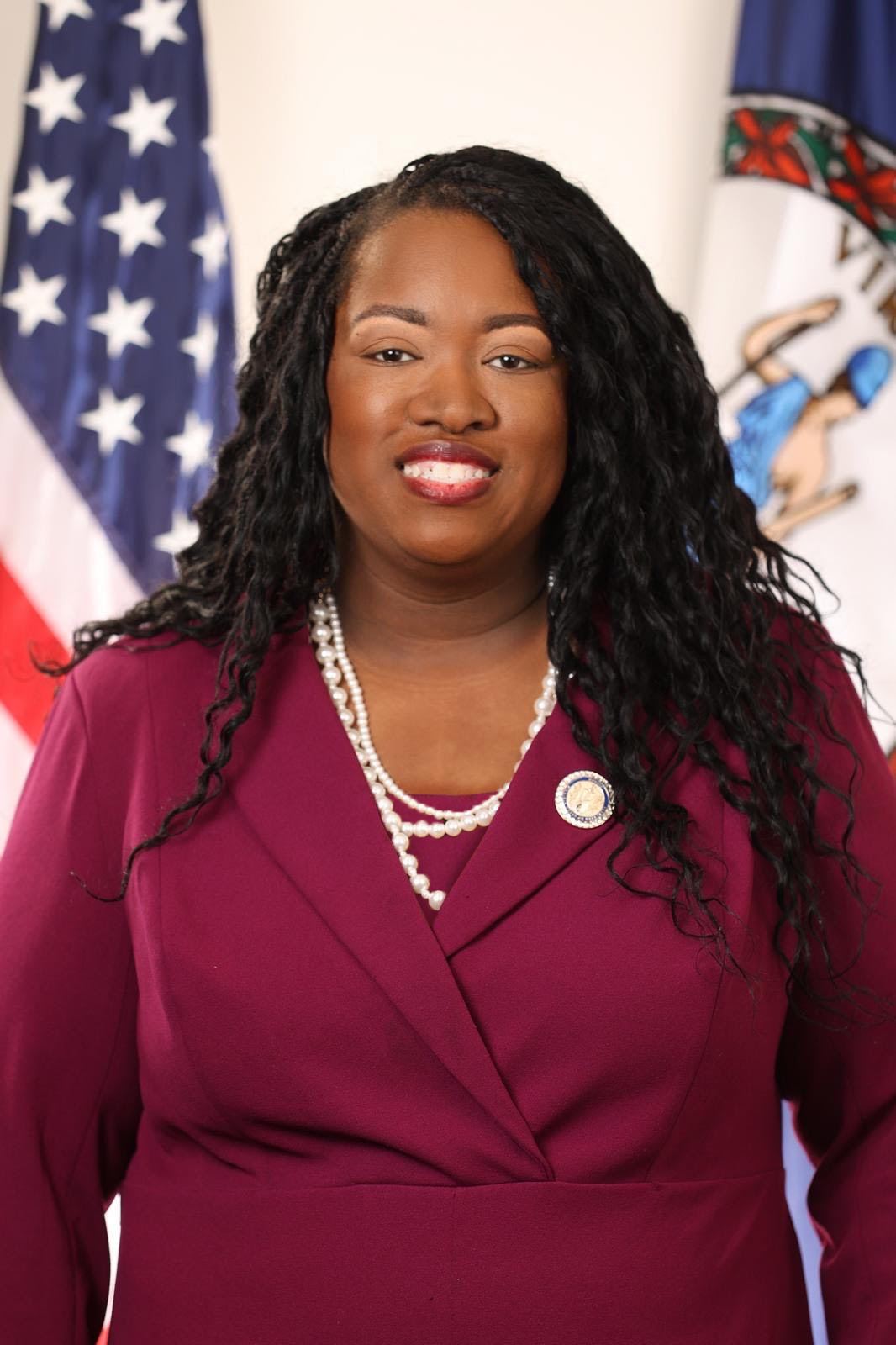
Del. Candi King
Sponsored bills
Additional local sales and use tax to support schools; referendum. Authorizes all counties and cities to impose an additional local sales and use tax at a rate not to exceed one percent with the revenue used only for capital projects for the construction or renovation of schools if such levy is approved in a voter referendum. The bill removes the requirement that such a tax must have an expiration date on either (i) the date of the repayment of any bonds or loans used for such capital projects or (ii) a date chosen by the governing body. Under current law, only Charlotte, Gloucester, Halifax, Henry, Mecklenburg, Northampton, Patrick, and Pittsylvania Counties and the City of Danville are authorized to impose such a tax. This bill incorporates HB 60, HB 193, HB 458, HB 600, HB 616, HB 1159, and HB 1437 and is identical to SB 14.
Board of Medicine; unprofessional conduct. Prohibits the Board of Medicine from taking disciplinary action against a doctor based on the alleged provision or receipt of abortion care that is not prohibited under the laws of the Commonwealth, regardless of where such abortion care was provided or received. The bill also specifies that grounds for refusal to issue a certificate or license to any applicant or to take disciplinary action for procuring or performing an abortion apply to such action only as it is prohibited by the laws of the Commonwealth. Under current law, such grounds for refusal or disciplinary action apply for procuring or performing a criminal abortion. This bill is identical to SB 716.
Restorative housing and isolated confinement; restrictions on use. Prohibits the use of isolated confinement, defined in the bill, in state correctional facilities, subject to certain exceptions. The bill requires that before placing an incarcerated person in restorative housing or isolated confinement for his own protection, the facility administrator shall place an incarcerated person in a less-restrictive setting, including by transferring such person to another institution or to a special-purpose housing unit for incarcerated persons who face similar threats. The bill requires that if an incarcerated person is placed in restorative housing or isolated confinement, such placement shall be reviewed every 48 hours and the facility administrator shall ensure that the incarcerated person receives a medical and mental health evaluation from certified medical and mental health professionals within one working day of placement in restorative housing or any form of isolated confinement. The bill also requires the facility administrator to notify the regional administrator in writing that an incarcerated person was placed in restorative housing or isolated confinement within 24 hours of such placement. Finally, the bill requires that formal reviews of an incarcerated person's placement in any form of isolated confinement shall be held in such person's presence, inform him of any reason or reasons administrative officials believe isolated confinement remains necessary, and give the incarcerated person an opportunity to respond to those reasons, and a formal ruling shall be provided to the incarcerated individual within 24 hours. This bill is identical to SB 719.
Health insurance; coverage for contraceptivedrugs and devices. Requires health insurance carriers to providecoverage, under any health insurance contract, policy, or plan thatincludes coverage for prescription drugs on an outpatient basis,for contraceptive drugs and contraceptive devices, as defined inthe bill, approved for use as prescribed products or for over-the-counteruse. The bill prohibits a health insurance carrier from imposingupon any person receiving contraceptive benefits pursuant to theprovisions of the bill any copayment, coinsurance payment, or fee, except in certain circumstances. The provisions of the bill applyto health insurance contracts, policies, or plans delivered, issuedfor delivery, or renewed on and after January 1, 2025.
Equity in public school funding; student need; English language learner, special education, and at-risk students. Places several parameters on Standards of Quality funding calculations performed by the Department of Education, including (i) requiring the Department, when calculating the cost of salaries under the Standards of Quality funding formula, to include facilities staff and transportation staff salaries in the calculation of any cost of competing adjustment to salaries for instructional and support positions that is provided as part of the state share of basic aid pursuant to the general appropriation act; (ii) requiring the Department, when estimating the cost of any compensation supplement for instructional and support positions under the Standards of Quality funding formula, to include and estimate the cost of such a compensation supplement for facilities staff; (iii) prohibiting the Department from applying any cap on inflation rate adjustments to non-personal cost categories during the biennial process of rebenchmarking the direct aid to public education budget; and (iv) requiring the Department to utilize a three-year average of the most recently available data to calculate the composite index of local ability-to-pay for each school division. The bill also amends Standard of Quality 2 by (a) including in the definition of "support services position" any central office clerical position that is not otherwise set forth in such definition, (b) requiring a per-pupil Standards of Quality funding add-on to be provided for English language learner and special education students, (c) requiring, in addition to the positions supported by basic aid, state funding, pursuant to the general appropriation act, to be provided to cover the actual average school division cost to educate children with disabilities, and (d) establishing the At-Risk Program, defined in the bill as any state funding provided for programs of prevention, intervention, or remediation or pursuant to the at-risk add-on for the purpose of supporting programs for students who are educationally at risk. The bill requires (1) the determination of the amount of state funding for which a school division is eligible pursuant to such At-Risk Program to be based on the school division's identified student percentage, defined in the bill as the fraction, expressed as a percentage, that results from dividing the number of identified students enrolled in a school division by the total number of students enrolled in such school division, weighted by the factor of 1.5, and then adjusted by the addition of a percentage that corrects for undercounting English language learner students as identified students and (2) such funding to be distributed as follows: 60 percent on a flat per-student rate and 40 percent on a variable rate set out in the general appropriation act based on the concentration of poverty in the school division. The bill is a recommendation of the Joint Legislative Audit and Review Commission.

Resilient Virginia Revolving Fund; projects; low-income geographic areas; nature-based solutions. Provides that the Department of Conservation and Recreation shall give additional weight to projects located in low-income geographic areas and projects that incorporate nature-based solutions when distributing loans or grants from the Resilient Virginia Revolving Fund to particular local governments.
Public elementary and secondary schools; programs of instruction; mental health education; curriculum guidelines; instruction required. Requires each public elementary, middle, and high school to provide at each grade level, in addition to health instruction, an additional age-appropriate course of instruction on mental health. The bill directs the Board of Education to develop mental health curriculum guidelines for an age-appropriate, sequential mental health curriculum for each grade level and requires such curriculum guidelines to include instruction on (i) general themes of social and emotional learning, including self-awareness, self-management, responsible decision making, relationship skills, and social awareness; (ii) the signs and symptoms of common mental health challenges; (iii) mental health wellness and healthy strategies for coping with stress and negative feelings, including conflict resolution skills; (iv) the importance of and guidance on seeking assistance from an adult or mental health professional, including information on services offered within the school or the local school division; (v) the prevalence of mental health challenges and the importance of overcoming common stigmas surrounding such mental health challenges; (vi) the importance of mental health to a student's overall well-being, including physical health and academic success; and (vii) at such grade levels as the Board deems appropriate, the connection between mental health and substance use disorders and the safe use of and risks of abuse of prescription drugs. The bill permits the Board to consult with the Department of Behavioral Health and Developmental Services and other mental health experts in developing such curriculum guidelines and requires the Board to submit such guidelines to the State Board of Health for approval. The bill requires the Board to review and update by the beginning of the 2025–2026 school year the health Standards of Learning for each grade level to include such instruction on the mental health curriculum guidelines.
Child abuse and neglect; mandatory reporters; statute of limitations; penalties. Adds aggravated sexual battery of a child and attempted rape, sodomy, aggravated sexual battery, or object sexual penetration of a child to the list of offenses for which a failure to report subjects a mandatory reporter to criminal liability. The bill further requires that a prosecution for any misdemeanor violation for failing to report certain sexual acts committed against a minor be commenced within one year of the discovery of the offense. This bill incorporates HB 449.
Annual retail sales and use tax holiday. Establishes an annual retail sales and use tax holiday that takes place on the first full weekend in August beginning on July 1, 2025, through July 1, 2030. During such weekend, state retail sales and use tax will not apply to certain (i) school supplies, (ii) clothing and footwear, (iii) qualified products designated as Energy Star or WaterSense, (iv) portable generators, or (v) hurricane preparedness equipment. This bill is identical to SB 116.