

Driver privilege cards; penalty. Authorizes the issuance of new driver privilege cards by the Department of Motor Vehicles to an applicant who (i) has reported income from Virginia sources or been claimed as a dependent on an individual tax return filed with the Commonwealth in the preceding 12 months and (ii) is not in violation of the insurance requirements for the registration of an uninsured motor vehicle. The bill provides that driver privilege cards shall confer the same privileges and shall be subject to the same provisions as driver's licenses and permits; however, driver privilege cards shall not (a) confer voting privileges, (b) permit an individual to waive any part of the driver examination, or (c) have their issuance be contingent upon the applicant's ability to produce proof of legal presence in the United States. The bill limits the release of certain information stored by the Department. The bill provides for the term "driver's license" to consistently refer to all driver's licenses, permits, driver privilege cards, and special identification cards issued by the Commonwealth or the comparable law of another jurisdiction. The bill allows the issuance of a limited-duration driver's license and special identification card to an applicant presenting valid documentary evidence that a federal court or federal agency having jurisdiction over immigration has authorized the applicant to be in the United States for a period of at least 30 days from the date of application. The bill authorizes the Tax Commissioner to provide to the Commissioner of the Department information sufficient to verify that an applicant for a driver privilege card or permit reported income from Virginia sources or was claimed as a dependent on an individual tax return filed with the Commonwealth in the preceding 12 months. The bill has a delayed effective date of January 1, 2021. This bill is identical to SB 34.
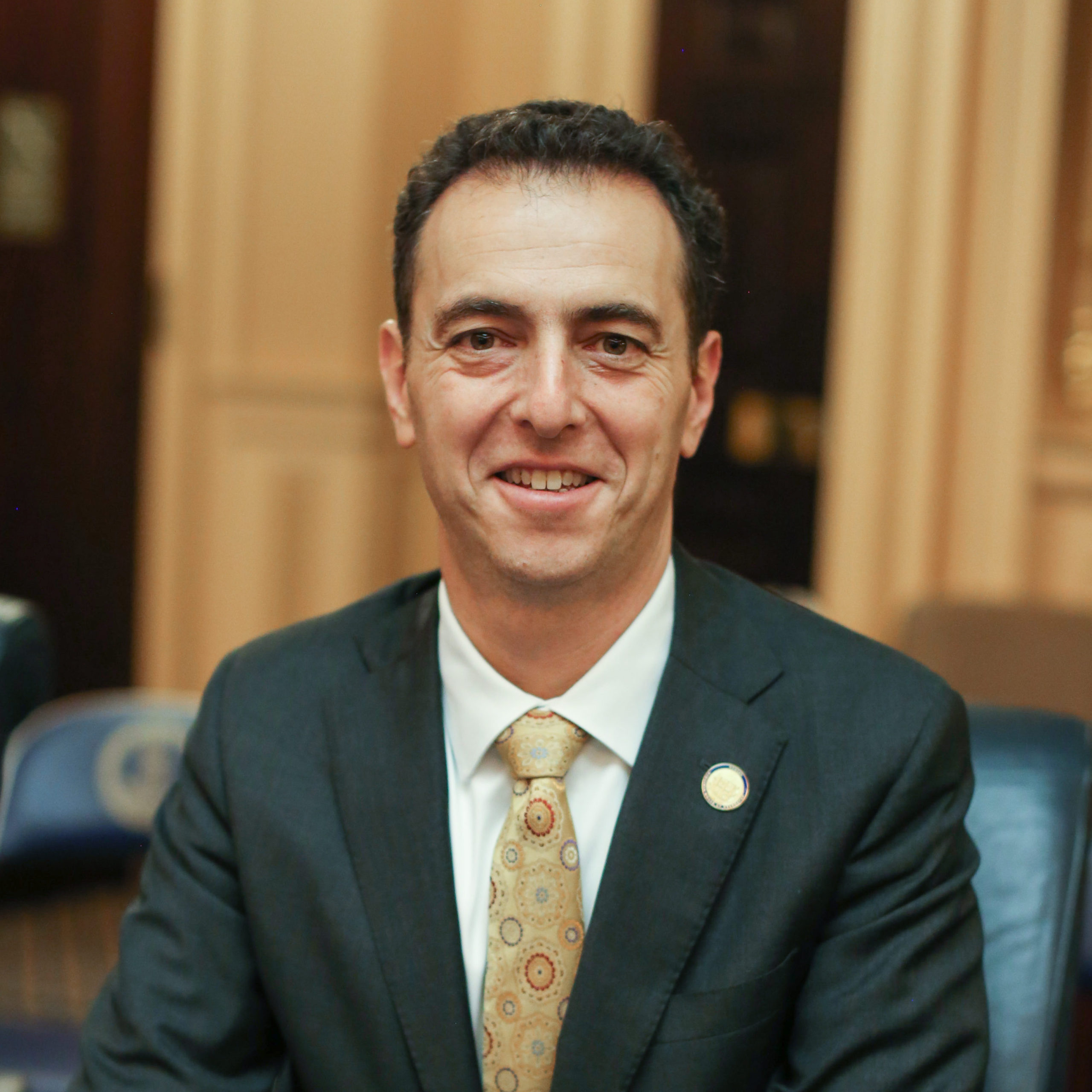
Del. Marcus Simon
Sponsored bills
Emergency laws; civil relief; citizens of the Commonwealth furloughed or otherwise not receiving wages or payments due to closure of the federal government or declaration of Emergency by the Governor. Provides a 60-day stay of an unlawful detainer for nonpayment of rent for tenants and a 30-day stay of foreclosure proceedings for homeowners of, and owners who rent to a tenant, a one-family to four-family residential dwelling unit who request a stay and provide written proof, defined in the bill, that they are (i) an employee of the United States government, (ii) an independent contractor for the United States government, or (iii) an employee of a company under contract with the United States government who was furloughed or was or is otherwise not receiving wages or payments as a result of a closure of the United States government, defined in the bill. The bill requires homeowners and owners who rent to a tenant a one-family to four-family residential dwelling unit to request such stay of foreclosure proceedings within 90 days of a closure of the United States government or 90 days following the end of such closure, whichever is later. The bill also expands the available relief to any tenant, homeowner, or owner affected by the novel coronavirus (COVID-19) pandemic public health crisis during the period for which the Governor has declared a state of emergency (the Emergency). The bill contains an emergency clause and provides that the expanded relief provisions shall expire 90 days following the end of the Emergency.
Labor and employment; collective bargaining; employees of counties, cities, and towns. Permits counties, cities, and towns to adopt local ordinances authorizing them to (i) recognize any labor union or other employee association as a bargaining agent of any public officers or employees, except for Constitutional officers and their employees, and including public school employees and (ii) collectively bargain or enter into any collective bargaining contract with any such union or association or its agents with respect to any matter relating to them or their employment. The bill provides that for any governing body of a county, city, or town that has not adopted an ordinance or resolution providing for collective bargaining, such governing body is required, within 120 days of receiving certification from a majority of public employees in a unit considered by such employees to be appropriate for the purposes of collective bargaining, to take a vote to adopt or not adopt an ordinance or resolution to provide for collective bargaining by such public employees and any other public employees deemed appropriate by the governing body. The bill provides that the prohibition against striking for public employees applies, irrespective of any such local ordinance. The bill has a delayed effective date of May 1, 2021. This bill is identical to SB 939.
Control of firearms by localities. Authorizes any locality by ordinance to prohibit the possession or carrying of firearms, ammunition, or components or any combination thereof in (i) any building, or part thereof, owned or used by such locality for governmental purposes; (ii) any public park owned or operated by the locality; (iii) any recreation or community center facility; or (iv) any public street, road, alley, sidewalk or public right-of-way or any other place of whatever nature that is open to the public and is being used by or is adjacent to a permitted event or an event that would otherwise require a permit. Provisions limiting the authority of localities and state governmental entities to bring lawsuits against certain firearms manufacturers and others are also repealed. The bill also provides that any firearm received by the locality pursuant to a gun buy-back program shall be destroyed by the locality unless the person surrendering such firearm requests in writing that such surrendered firearm be sold. The provisions of the bill do not apply to the activities of a Senior Reserve Officers’ Training Corps program operated at a public or private institution of higher education or (ii) any intercollegiate athletics program operated by a public or private institution of higher education and governed by the National Collegiate Athletic Association or any club sports team recognized by a public or private institution of higher education where the sport engaged in by such program or team involves the use of a firearm. The bill contains technical amendments. This bill is identical to SB 35.
Qualified education loan servicers. Prohibits any person from acting as a qualified education loan servicer except in accordance with provisions established by this bill. The bill requires a loan servicer to obtain a license from the State Corporation Commission (SCC) and establishes procedures pertaining to such licenses. Banks, savings institutions, credit unions, nonprofit institutions of higher education, and farm credit systems are exempt from the licensing provisions. The servicing of a qualified education loan encompasses (i) receiving any scheduled periodic payments from a qualified education loan borrower or notification of such payments; (ii) applying the payments of principal and interest and such other payments, with respect to the amounts received from a qualified education loan borrower, as may be required pursuant to the terms of a qualified education loan; (iii) during a period when no payment is required on a qualified education loan, maintaining account records and communicating with the qualified education loan borrower; and (iv) interacting with a student loan borrower, including conducting activities to help prevent default. Qualified education loan servicers are prohibited from, among other things, (a) misrepresenting the amount, nature, or terms of any fee or payment due or claimed to be due on a qualified education loan, the terms and conditions of the loan agreement, or the borrower's obligations under the loan; (b) misapplying loan payments to the outstanding balance of a qualified education loan; and (c) failing to report both the favorable and unfavorable payment history of the borrower to a nationally recognized consumer credit bureau at least annually if the loan servicer regularly reports information to such a credit bureau. Violations are subject to a civil penalty not exceeding $2,500 and are prohibited practices under the Virginia Consumer Protection Act. The bill has a delayed effective date of July 1, 2021, but provides that applications shall be accepted, and investigations commenced, by the SCC beginning March 1, 2021. This bill is identical to SB 77.
Prohibited discrimination; public accommodations, employment, credit, and housing: causes of action; sexual orientation and gender identity. Creates causes of action for unlawful discrimination in public accommodations and employment in the Virginia Human Rights Act. Currently, under the Act there is no cause of action for discrimination in public accommodations, and the only causes of action for discrimination in employment are for (i) unlawful discharge on the basis of race, color, religion, national origin, sex, pregnancy, or childbirth or related medical conditions including lactation by employers employing more than five but fewer than 15 persons and (ii) unlawful discharge on the basis of age by employers employing more than five but fewer than 20 persons. The bill allows the causes of action to be pursued privately by the aggrieved person or, in certain circumstances, by the Attorney General. Before a civil cause of action may be brought in a court of the Commonwealth, an aggrieved individual must file a complaint with the Division of Human Rights of the Department of Law, participate in an administrative process, and receive a notice of his right to commence a civil action. The bill prohibits discrimination in public and private employment on the basis of sexual orientation and gender identity. The bill also codifies for state and local government employment the current prohibitions on discrimination in employment on the basis of race, color, religion, national origin, sex, pregnancy, childbirth or related medical conditions, age, marital status, disability, or status as a veteran. Additionally, the bill (a) prohibits discrimination in public accommodations on the basis of sexual orientation, gender identity, or status as a veteran; (b) prohibits discrimination in credit on the basis of sexual orientation, gender identity, pregnancy, childbirth or related medical conditions, disability, and status as a veteran; and (c) adds discrimination on the basis of an individual's sexual orientation, gender identity, or status as a veteran as an unlawful housing practice. The bill makes technical amendments. This bill incorporates SB 66 and SB 159.
Elections; same-day registration; in-personabsentee and election day voting. Provides an exception to theclosing of registration records for any person who (i) is qualifiedto register to vote, (ii) is unregistered or registered in a localityin which the person no longer resides but is otherwise entitledto vote by absentee ballot, (iii) desires to vote absentee in personat the time that they present themselves to be registered, and (iv) provides proof of residency. The bill also permits same-day registrantsto vote absentee and provides an excuse for election day absentee voting for such voters. The bill requires all voters who registerto vote under the provisions of this bill to fill out an absenteeapplication, including the required oath, in order to vote. Thisbill has a delayed effective date of July 1, 2022.
Distributed renewable energy. Promotes the establishment of distributed renewable solar and other renewable energy. The measure (i) requires the State Corporation Commission to establish by regulation a shared solar program that allows multifamily customers of investor-owned utilities, other than American Electric Power, to purchase electric power through a subscription in a shared solar facility; (ii) raises the cap on the total amount of renewable energy that can be net metered in a utility's service territory from one percent to six percent, five percent of which is available to all customers and one percent of which is available only to low-income utility customers; (iii) raises the cap for net-metered nonresidential generation facilities from one megawatt to three megawatts; (iv) allows certain localities to install solar or wind facilities of up to five megawatts on government-owned property and use the electricity for government-owned buildings; (v) increases the cap on the capacity of generation from facilities from the customer's expected annual energy consumption to 150 percent of such amount for customers in Dominion Energy Virginia's service territory; (vi) prohibits standby charges for any residential customer-generator or agricultural customer-generator of an investor-owned utility other than Dominion Energy Virginia; and (vii) increases the cap on third party power purchase agreements to 500 megawatts for jurisdictional customers and 500 megawatts for nonjurisdictional customers of Dominion Energy Virginia and to 40 megawatts for customers of American Electric Power. The measure also amends the Commonwealth Energy Policy to include provisions supporting distributed generation of renewable energy. This bill is identical to HB 1184, HB 1647, and SB 710.
Absentee voting; postage prepaid on return envelope. Requires the envelope provided to an absentee voter for the return of the absentee ballot to include prepaid postage. The provisions of the bill do not become effective unless reenacted by the 2021 Session of the General Assembly.
Minimum wage; tipped employees; classification. Prohibits an employer from classifying an individual as a tippedemployee if the individual is prohibited by applicable federal orstate law or regulation from soliciting tips.