

Creates the Virginia Casino Gaming Commission (the Commission) as the licensing body for casino gaming. The bill specifies the licensing requirements for casino gaming and imposes penalties for violations of the casino gaming law. Casino gaming shall be limited to localities that have passed a referendum on the question of allowing casino gaming in the locality. The bill also requires the Commission to establish a voluntary exclusion program allowing persons to voluntarily exclude themselves from the gaming areas of facilities under the jurisdiction of the Commission. In addition, the bill establishes the Problem Gambling Treatment and Support Fund administered by the Commissioner of Behavioral Health and Developmental Services to provide counseling and other support services for compulsive and problem gamblers, develop problem gambling treatment and prevention programs, and provide grants to supporting organizations that provide assistance to compulsive gamblers. The bill requires proceeds of the gross receipts tax and admission tax imposed on casino gaming operators to be paid as follows: (i) one percent into the Problem Gambling Treatment and Support Fund, (ii) 10 percent to the locality in which the casino gaming operation is located, and (iii) 89 percent into the Toll Mitigation Fund, which shall be used to mitigate the tolls established to support construction and maintenance of the Dominion Boulevard Bridge and Roadway Improvement Project and the Downtown Tunnel/Midtown Tunnel/Martin Luther King Freeway Extension Project.
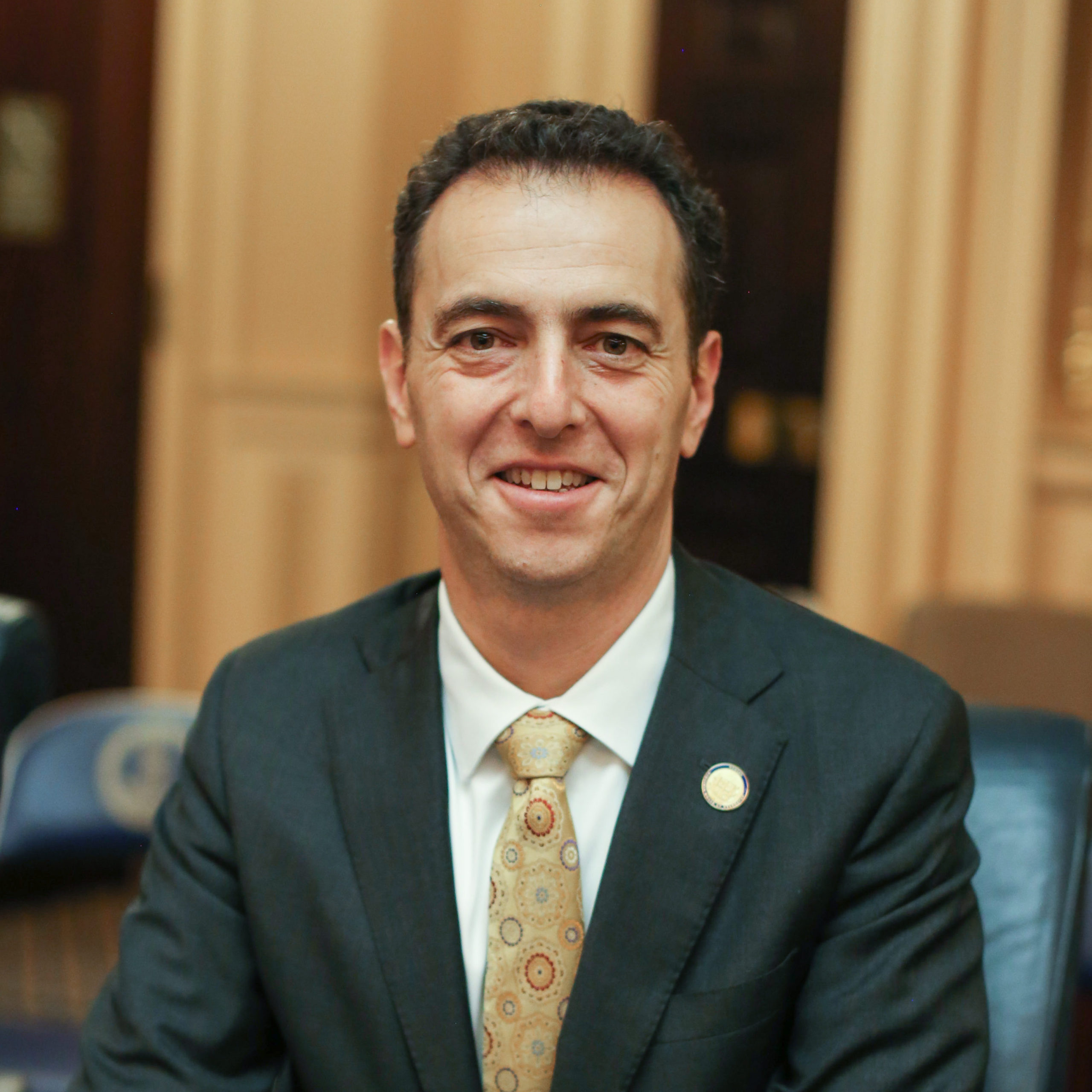
Del. Marcus Simon
Sponsored bills
Provides that the 11 members of the Board of Commissioners of the Virginia Port Authority appointed by the Governor no longer serve at the pleasure of the Governor and may be removed prior to the expiration of a five-year term only for cause. The bill changes from nonvoting ex officio member to voting member the status of two members of the Board of Commissioners of the Virginia Port Authority appointed by the Governor, one of whom represents the Port of Richmond and is from the City of Richmond or the County of Chesterfield, Hanover, or Henrico and one of whom represents the Virginia Inland Port and is from the City of Winchester or the County of Clarke, Frederick, or Warren. This bill is identical to
Requires any health benefit plan that is amended, renewed, or delivered on or after January 1, 2018, that provides coverage for hormonal contraceptives to cover up to a 12-month supply of hormonal contraceptives when dispensed or furnished at one time for a covered person or at a location licensed or otherwise authorized to dispense drugs or supplies. Such a plan is prohibited, in the absence of clinical contraindications, from imposing utilization controls or other forms of medical management limiting the supply of hormonal contraceptives that may be dispensed or furnished by a provider or pharmacy, or at a location licensed or otherwise authorized to dispense drugs or supplies, to an amount that is less than a 12-month supply. The measure does not require a provider to prescribe, furnish, or dispense 12 months of self-administered hormonal contraceptives at one time. The measure also provides that it shall not be construed to exclude coverage for hormonal contraceptives as prescribed by a provider for reasons other than contraceptive purposes, such as decreasing the risk of ovarian cancer or eliminating symptoms of menopause, or for contraception that is necessary to preserve the life or health of an enrollee.
Requires all comprehensive agreements originally entered into on or after July 1, 2017, resulting in privately funded roads open for public transportation to include a provision requiring funding for adequate staffing, defined in the bill, for general law-enforcement services by the Virginia State Police.
Provides that any officer who is convicted of a felony under the laws of any state or the United States shall be automatically suspended upon such conviction, regardless of any appeals, pleadings, delays, or motions. The bill contains an emergency clause. This bill is identical to
Requires the Veterans Services Foundation to provide an annual report on its funding levels and services to the General Assembly. The bill also (i) authorizes the board of trustees of the Foundation to appoint an Executive Director and exercise personnel authority over the position, (ii) clarifies that the Foundation may make direct request for appropriations from the General Assembly, (iii) clarifies that only the unrestricted portion of the Veterans Services Fund may be used for Foundation expenses, (iv) requires the Department of Veterans Services to provide qualified finance and development personnel to perform the duties of the treasurer and secretary of the Foundation, and (iv) provides that expenditures and disbursements from the Fund shall be made upon written authorization of the Executive Director with the approval of the board of trustees. The bill requires that allocations and expenditures of donated restricted funds be in accordance with cited provisions of the Uniform Prudent Management of Institutional Funds Act relating to the standard of conduct in managing and investing institutional funds.
Authorizes the registration of peer recovery specialists and qualified mental health professionals by the Board of Counseling. The bill defines "qualified mental health professional" as a person who by education and experience is professionally qualified and registered by the Board of Counseling to provide collaborative mental health services for adults or children. The bill requires that a qualified mental health professional provide such services as an employee or independent contractor of the Department of Behavioral Health and Developmental Services or a provider licensed by the Department of Behavioral Health and Developmental Services. The bill defines "registered peer recovery specialist" as a person who by education and experience is professionally qualified and registered by the Board of Counseling to provide collaborative services to assist individuals in achieving sustained recovery from the effects of addiction or mental illness, or both. The bill requires that a registered peer recovery specialist provide such services as an employee or independent contractor of the Department of Behavioral Health and Developmental Services, a provider licensed by the Department of Behavioral Health and Developmental Services, a practitioner licensed by or holding a permit issued from the Department of Health Professions, or a facility licensed by the Department of Health. The bill adds qualified mental health professionals and registered peer recovery specialists to the list of mental health providers that are required to take actions to protect third parties under certain circumstances and notify clients of their right to report to the Department of Health Professions any unethical, fraudulent, or unprofessional conduct. The bill directs the Board of Counseling and the Board of Behavioral Health and Developmental Services to promulgate regulations to implement the provisions of the bill within 280 days of its enactment. This bill is identical to