Lymphedema Treatment Act This bill provides for Medicare coverage of lymphedema compression treatment items. Specifically, the bill provides for coverage of (1) standard and custom fitted gradient compression garments that are prescribed by a physician or other specified health care professional to treat lymphedema, and (2) other devices determined to be effective in the prevention or treatment of lymphedema.
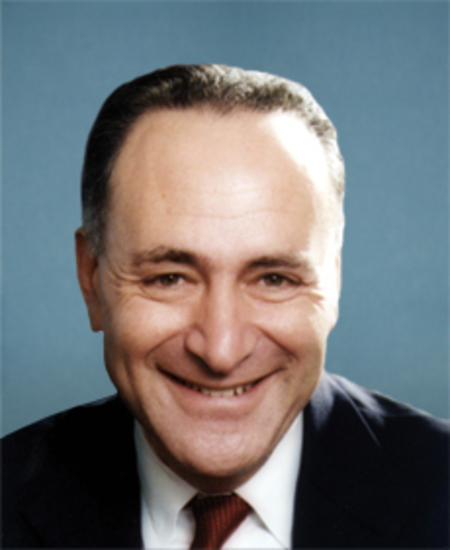
Sen. Charles E. Schumer
Sponsored bills
Child Care for Working Families Act This bill provides funds and otherwise revises certain child care and early learning programs for low- to moderate-income families. Specifically, the bill provides funds for the Child Care and Development Block Grant program and reestablishes it as a child care and development assistance program. The bill also allocates program funds for states to provide services and supports to infants, toddlers, and children with disabilities. Further, the bill revises the program to require each state to create a tiered and transparent system for measuring the quality of child care providers, which must include evidence-based standards and payment rates that are based on a certain cost estimation model; ensure that copayments are based on a sliding scale and that no family receiving assistance pays more than 7% of its household income on child care; and use quality child care amounts for certain activities, such as increasing the supply of child care providers. The bill also provides funds and establishes grants for states to create preschool programs for low- to moderate-income children between the ages of three and five years. The Department of Health and Human Services (HHS) must make grants to Head Start agencies to provide children with access to full-school-year and full-school-day services, provide access to additional service hours for migrant and seasonal agencies, or enhance the quality of existing services. Finally, the bill requires, and provides funds for, HHS to assist Head Start agencies with ensuring their teachers and staff are paid a living wage.

Clean Energy for America Act This bill provides tax incentives for investment in clean electricity, clean transportation, clean fuel production, energy efficiency, and sets forth workforce development requirements for the energy sector. The bill also terminates certain fossil fuel provisions and requires contractors on federal energy projects to ensure that not less than 15% of total labor hours be performed by qualified apprentices.
This resolution extends condolences to the family and friends of former Vice President Walter Mondale. The resolution acknowledges Mondale's lifetime service to the United States, including as a U.S. Senator and as the first presidential candidate from a major party to select a woman, Geraldine Ferraro, as his running mate.
Fourth Amendment Is Not For Sale Act This bill generally prohibits law enforcement and intelligence agencies from obtaining U.S. customer or subscriber records or any illegitimately obtained information from a third party in exchange for anything of value (e.g., purchasing such information). Records or information obtained in violation of this bill are inadmissible as evidence in any trial, hearing, or other legal proceeding.
Minority Business Resiliency Act of 2021 This bill permanently authorizes the Minority Business Development Agency (MBDA) and requires the MBDA to promote and administer programs that assist the development of minority business enterprises (MBEs). Specifically, the bill requires the MBDA to (1) provide assistance to MBEs in domestic and foreign markets by making available specified resources, (2) promote the position of MBEs in local economies, and (3) collect data on the causes of MBE success or failure and research how economic conditions affect the development of MBEs. The bill establishes formal processes for the MBDA Business Center Program and the MBDA Rural Business Center Program through which business centers provide programs and services to support MBEs. The bill also establishes new initiatives to promote economic resiliency for minority businesses, including (1) an annual forum to review problems and programs relating to capital formation by MBEs, (2) a study and report on alternative financing solutions for MBEs, and (3) entrepreneurship education grants for certain institutions of higher education to develop and implement entrepreneurship curricula. Further, the bill establishes grants for (1) certain nonprofit organizations that provide services to MBEs as one of their primary activities, and (2) MBEs for the purpose of supporting MBEs or helping MBEs remain in business. The Government Accountability Office must report on the programs carried out pursuant to the bill.
Healthy Families Act This bill provides for paid and unpaid sick leave for employees to meet their own medical needs and those of their families. It requires employers with 15 or more employees to provide their employees with at least one hour of earned paid sick leave for every 30 hours worked, up to a maximum of 56 hours of paid sick leave in a year. An employer with fewer than 15 employees may also provide the same amount of paid sick leave, but may opt out of such requirement, in which case such employer must provide its employees at least 56 hours of unpaid leave in a year. An employee may use sick leave for absences (1) resulting from a physical or mental illness, injury or medical condition; (2) resulting from obtaining professional medical diagnosis or care, or preventive medical care; (3) to care for a child, parent, spouse, a domestic partner, or other blood or close relative; and (4) resulting from domestic violence, sexual assault, or stalking. The bill makes it unlawful for any employer to interfere with, restrain, or deny the exercise of an employee's right to accrue sick leave as provided by this bill. An employee may take legal action to enforce the right to sick leave granted by this bill and the Department of Labor must investigate complaints of violations of the requirements of this bill. Labor is authorized to conduct a public awareness campaign to educate and inform the public of the requirements for paid sick leave provided by this bill.
Tax Fairness for Workers Act This bill allows an above-the-line tax deduction for union dues and expenses. (An above-the-line deduction is subtracted from gross income and is available whether or not a taxpayer itemizes other deductions.) The bill also reinstates the miscellaneous itemized tax deduction for unreimbursed expenses attributable to the performance of services as an employee (Under current law, all miscellaneous itemized deductions are suspended through 2025).
Retired Pay Restoration Act This bill authorizes the receipt of both military retired pay and veterans' disability compensation with respect to any service-connected disability. Under current law, only veterans with service-connected disabilities rated at 50% or more receive both without offset. Individuals who were retired or separated from military service due to a service-connected disability shall be eligible for the full concurrent receipt of both veterans' disability compensation and either military retired pay or combat-related special pay.
This resolution honors the memory of U.S. Capitol Police Officer William Francis "Billy" Evans for the selfless acts of heroism he displayed on April 2, 2021.