Keeping Critical Connections Act of 2021 This bill provides funds with which the Federal Communications Commission shall reimburse small business broadband providers for costs incurred during the COVID-19 (i.e., coronavirus disease 2019) emergency period to voluntarily (1) provide free or discounted service to students in need of distance learning capacity, or (2) refrain from disconnecting low-income households that cannot afford to make a full payment.
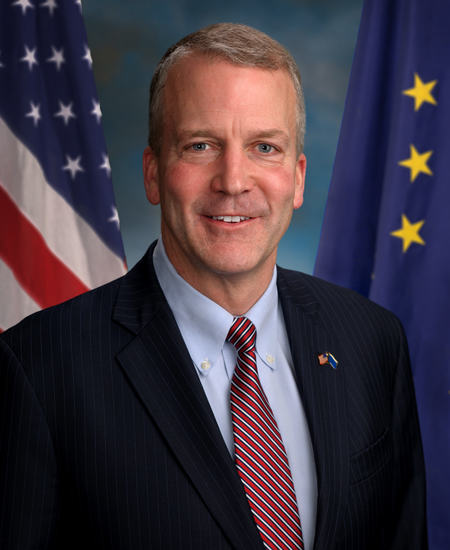
Sen. Dan Sullivan
Sponsored bills
Non-Opioids Prevent Addiction In the Nation Act or the NOPAIN Act This bill temporarily establishes separate payments for certain non-opioid treatments under the Medicare prospective payment system for hospital outpatient department services and the payment system for ambulatory surgical center services. The bill applies to pain management treatments that are able to replace or reduce opioid consumption, as shown through clinical trials or data.
VOCA Fix to Sustain the Crime Victims Fund Act of 2021 This bill adds a new source of revenue for the Crime Victims Fund and makes changes to formula grants supported by the fund. Specifically, the bill directs revenues collected from deferred prosecution and non-prosecution agreements to be deposited into the Crime Victims Fund. Currently, such revenues are deposited into the general fund of the Treasury. Additionally, the bill increases the percentage—from 60% to 75%—of state compensation payments to crime victims in the prior fiscal year used to calculate formula grants for state victim compensation programs. Finally, the bill directs states to waive the matching requirement for recipients of state victim assistance formula grants during and for one year after a pandemic-related national emergency. It also allows states to waive the matching requirement pursuant to a policy established by the state.
This resolution designates the week beginning on February 28, 2021, as National Tribal Colleges and Universities Week.
Global Electoral Exchange Act of 2021 This bill authorizes the Department of State to establish a Global Electoral Exchange Program to promote sound election-administration practices around the world. The State Department may award grants to qualified, tax-exempt, U.S.-based organizations that have expertise and experience in relevant topics, such as election-system integrity. Grants may be used to design programs to bring relevant individuals, such as election administrators and poll workers, together to study and discuss election procedures. The State Department shall periodically report to Congress on the program's activities.
Leveraging Integrated Networks in Communities to Address Social Needs Act of 2021 or the LINC to Address Social Needs Act of 2021 This bill requires the Department of Health and Human Services (HHS) to award grants to better integrate health care and social services using technology platforms and related infrastructure. To receive a grant, a state or territory must enter into a partnership with nonprofits and similar organizations or tribal nations. These public-private partnerships must foster the use of technology platforms by providers and payors of health care and social services to improve cross-sector coordination. This includes developing funding models to make the platforms financially self-sufficient. HHS must consult with stakeholders to develop data standards and guidelines for these grants, and the Government Accountability Office must evaluate the impact of the grants.
Iran Sanctions Relief Review Act of 2021 This bill restricts the President's authority to unilaterally undertake certain actions with respect to Iran and increases congressional oversight of those actions. Specifically, the President must report to Congress before terminating or waiving sanctions related to Iran or taking a licensing action that significantly alters U.S. foreign policy with respect to Iran. Each report must (1) describe the proposed action and its rationale, and (2) indicate whether or not the action is intended to significantly alter foreign policy concerning Iran. If the intention is to alter that policy, the report must provide additional information about the policy objectives and anticipated effects of the action. After the President submits a report, the bill provides Congress with a 30-day period to review it; this period is extended to 60 days for reports submitted between July 10 and September 7. During this period, Congress may enact a joint resolution approving or disapproving the action. During the review period, the President may not take the action unless Congress passes a joint resolution of approval; if Congress enacts a joint resolution of disapproval, the bill prohibits the President from taking the action. The bill also outlines procedures for the introduction and consideration of these types of joint resolutions.

This resolution opposes lifting specified sanctions on Iran and resolves that these sanctions may be terminated only after Iran has ceased providing support for acts of international terrorism and has dismantled its nuclear, biological, and chemical weapons and related technologies.
This resolution recognizes Black History Month as an opportunity to reflect on U.S. history and to commemorate the contributions of African Americans. It calls for the United States to (1) honor the contribution of pioneers who helped to ensure its legacy; and (2) move forward as a nation "indivisible, with liberty and justice for all."
Secure Rural Schools Reauthorization Act of 2021 This bill extends through FY2023 payments made to states and eligible counties containing certain federal land under the Secure Rural Schools and Community Self-Determination Act of 2000. The Department of the Interior and the Department of Agriculture shall carry out a pilot program to allow the Chief of the Forest Service or the Director of the Bureau of Land Management to nominate members of resource advisory committees. County funds may be used to provide or expand access to (1) broadband telecommunications services at local schools, or (2) the technology and connectivity necessary for students to use a digital learning tool at or outside of a local school campus. Any county funds that were obligated by a county before October 1, 2017, but are unspent on October 1, 2020, may be used by the county for any authorized use and shall be available for projects initiated after October 1, 2020. No county funds may be used for lobbying activity, regardless of the purpose for which the funds are obligated on or before the enactment of this bill.