

Maddy summaryThis Senate resolution honors the public service career of Senator Martha Jane Kitchel, recognizing her work in both the Executive Branch and the Vermont Senate. The document highlights her progression from social work to leadership roles in the Department of Social Welfare and later as Secretary of the Agency of Human Services, followed by her legislative service in the Senate. It specifically acknowledges her contributions as Chair of the Senate Committee on Appropriations, where she led budget analysis and supported infrastructure projects like the Lamoille Valley Rail Trail. The resolution formally recognizes her two decades of service and her recent announcement that she will not seek reelection in 2024.
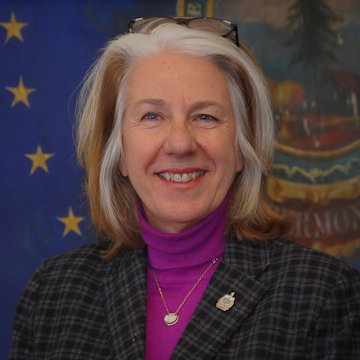
Sen. Wendy Harrison
Sponsored bills
Maddy summaryThis joint resolution declares the rising number of drug overdose deaths in Vermont to be a public health emergency. It directly affects the state government by formally recognizing the severity of the opioid crisis, which has seen overdose deaths increase from 42 in 2010 to 264 in 2022. The resolution highlights that fentanyl and other synthetic opioids are now involved in the majority of these deaths, often mixed with other substances. By making this declaration, the bill directs state officials to acknowledge the urgency of the situation, though it does not create new funding or specific policy changes. The resolution serves as an official statement of concern rather than a law that alters existing programs or regulations.
Maddy summaryThis bill expands employment protections in Vermont by prohibiting employers from discriminating against employees who decline to attend or participate in employer-sponsored meetings about religious or political matters. It also prevents employers from requiring employees to attend such meetings, while allowing exceptions for communications required by law or necessary for job performance. The law includes specific exemptions for religious institutions, political organizations, and voluntary forums, and defines what constitutes political and religious matters for enforcement purposes. Additionally, the bill creates a study committee to examine how Vermont's labor laws apply to agricultural workers and identify potential ways to extend coverage to this group.
Maddy summaryThis Vermont bill directs the Office of Professional Regulation to review whether doulas should be regulated through registration, certification, or licensure, with results due by January 2025. It also requires the Department of Vermont Health Access to calculate the estimated costs of adding doula services to Medicaid coverage and recommend whether to include them in the state's health plan. The bill defines a qualified doula as one who is registered, certified, or licensed by the state, and mandates that any Medicaid coverage for these services only apply to doulas meeting those standards.
Maddy summaryThis House concurrent resolution honors the memory of Norman Paul Bartlett, a longtime leader in Vermont education who passed away in March 2024. The measure expresses the General Assembly's condolences to his family and directs the Secretary of State to send a copy of the resolution to them. It recognizes Bartlett's half-century career with the Vermont Education Association, where he negotiated over 500 school contracts and served in various leadership roles. The resolution also acknowledges his personal contributions to community organizations and his life as a family man and avid skier. This is a commemorative document rather than a policy change.
Maddy summaryThis bill formally recognizes June 2024 as National Scoliosis Awareness Month in Vermont. It directly affects individuals with scoliosis, their families, healthcare providers, and related organizations in the state. The resolution directs the Secretary of State to send copies to the Scoliosis Research Society and the Vermont Orthopaedic Society. This is a ceremonial measure that raises awareness about scoliosis, a condition involving sideways curvature of the spine that may require monitoring, bracing, or surgery depending on severity.
Maddy summaryThis bill updates Vermont's environmental regulations to strengthen protections for wetlands, river corridors, and flood hazard areas while clarifying municipal authority over development in these zones. It requires the Department of Environmental Conservation to consult with state agencies and regional planning commissions when updating wetland maps, and it allows municipalities to regulate accessory dwelling units in flood hazard areas without requiring separate permits for certain planting projects. The legislation also establishes stricter phosphorus discharge limits for wastewater facilities in Lake Champlain and Lake Memphremagog drainage basins, mandates a cost analysis of the Green River Dam, and directs state officials to study options for waiving permit fees for low-income applicants.
Maddy summaryThis bill allows judges to consider evidence that does not strictly follow standard court evidence rules during weight of the evidence hearings. It applies to criminal cases where a judge must decide if there is enough evidence to proceed to trial. The change permits more flexible evidence submission without altering the standard for determining whether evidence of guilt is great. This means prosecutors and defense attorneys may present information in a less formal manner during these preliminary hearings. The law takes effect on July 1, 2024.
Maddy summaryThis bill establishes state regulations prohibiting the intentional addition of specific harmful chemicals to cosmetic and menstrual products, including substances like PFAS, phthalates, and formaldehyde-releasing agents. It also bans the sale of products containing lead above ten parts per million and restricts 1,4-dioxane to no more than 10 parts per million. The legislation further regulates PFAS in consumer products such as apparel, mattresses, cookware, and artificial turf fields, while allowing for trace chemical contamination that results from manufacturing processes or packaging. Manufacturers must comply with these restrictions when selling products within the state, and the Department of Health is authorized to adopt additional rules regarding formaldehyde-releasing agents if safer alternatives are available.
Maddy summaryThis bill modifies Vermont's climate change cost recovery program to allow the state to charge fossil fuel companies for climate adaptation costs without requiring them to be part of a specific support project. It changes how payment schedules work by requiring installments to be paid annually at 10% of the total amount, with interest charges and adjustments based on inflation. The law also extends the time companies have to respond to cost recovery notices from 15 to 30 days and clarifies that existing legal remedies remain available alongside this program. These changes take effect on July 1, 2024, but apply retroactively to costs incurred since January 1, 1995.