

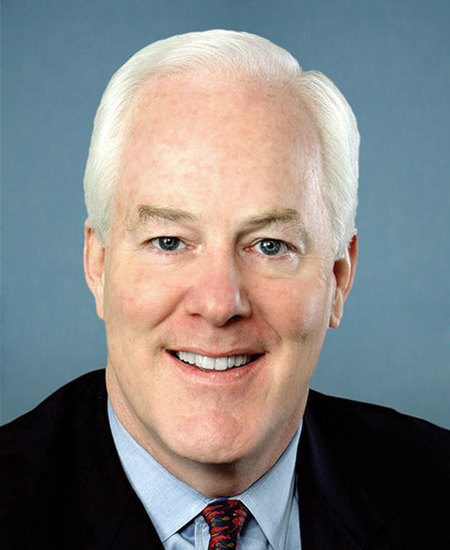
Photo of John Cornyn
R United States Senate · Texas

Sen. John Cornyn

Compare
Total votes
1,037
all sessions
Attendance
98%
19 missed
Near the chamber average
With party
93%
of cast votes
Higher than 89% of chamber peers
Bipartisan score
4%
crosses aisle rarely
Lower than 93% of chamber peers
Sponsored
1,493
bills & resolutions
Near the chamber average
Committees
17
assignments
1,493 bills and resolutions

Sponsored bills

Total
1,493
Primary
366
Co-sponsor
1,127
This page
1,493
matching current filters
Co-sponsor S 843
Passed · Utah Senate · Co-sponsor
Sea Turtle Rescue Assistance and Rehabilitation Act of 2025

Maddy summaryThis bill amends the Marine Mammal Protection Act to create new provisions specifically for sea turtles. It establishes a dedicated $5 million annual grant program (2025-2030) for sea turtle rescue and rehabilitation, funded through a new "Sea Turtle Rescue, Rehabilitation, and Rapid Response Fund" with $500,000 yearly. Eligible applicants include coastal organizations with Endangered Species Act authorizations or cooperative agreements, required to follow specific care standards and data reporting. The law directly affects wildlife rehabilitation groups and coastal communities handling stranded sea turtles by providing targeted federal funding and clear grant eligibility criteria.

Passed Mar 24, 2026 1 co-sponsor
Co-sponsor S 3315
In committee · Utah Senate · Co-sponsor
Health Care Cybersecurity and Resiliency Act of 2026

Maddy summaryThe Health Care Cybersecurity and Resiliency Act of 2025 requires the Department of Health and Human Services (HHS) to develop a cybersecurity incident response plan within one year, including strategies for risk assessment, prevention, detection, and recovery. It mandates new cybersecurity standards for healthcare entities, such as multifactor authentication for systems holding protected health information, encryption requirements, and mandatory audit protocols. The bill also updates breach reporting rules to require public disclosure of corrective actions and security practices considered during investigations, while creating grants to help rural healthcare providers adopt cybersecurity best practices. Additionally, it establishes training programs for healthcare cybersecurity staff and requires HHS to issue guidance on recognizing security practices that may reduce fines for covered entities. These provisions directly affect hospitals, clinics, and health organizations handling protected health information.

In committee Mar 23, 2026 1 co-sponsor
Co-sponsor S 4145
In committee · Utah Senate · Co-sponsor
Pro Codes Act of 2026

Maddy summaryThis bill, known as the Protecting and Enhancing Public Access to Codes Act of 2026, adds a new section to the U.S. Copyright Code to address standards that are incorporated by reference into federal, state, and local laws and regulations. The legislation requires standards development organizations to make these incorporated standards freely available online at no cost to the public, including searchable tables of contents and indexes, while still protecting the organizations' copyright rights. The bill defines key terms such as "incorporated by reference" and "standards development organization" to clarify which materials fall under these requirements. It also establishes that copyright protection for these standards continues even after they are referenced in laws, provided the organization makes them publicly accessible online within a reasonable time of being notified about the incorporation. The measure aims to balance public access to technical standards used in regulations with the ability of standards organizations to fund their work through licensing and sales.

In committee Mar 19, 2026 1 co-sponsor
Co-sponsor S 2859
In committee · Utah Senate · Co-sponsor
Equal Campus Access Act of 2025

Maddy summaryThis bill prohibits public colleges and universities receiving federal funding from denying religious student groups access to campus facilities or official recognition solely because of their religious beliefs, practices, or standards. It directly affects public higher education institutions and religious student organizations seeking equal treatment alongside secular groups. The key mechanism requires institutions to provide religious groups with the same rights, benefits, and privileges - such as meeting space, event scheduling, and official status - as non-religious student organizations. This policy change ensures religious groups cannot be discriminated against in campus activities through the threat of withheld federal funding.

In committee Mar 19, 2026 1 co-sponsor
Co-sponsor S 1756
In committee · Utah Senate · Co-sponsor
Conscience Protection Act of 2025

Maddy summaryThis bill, the Conscience Protection Act of 2025, strengthens protections for healthcare providers and organizations that refuse to participate in certain medical procedures (including abortion, assisted suicide, and sterilization) based on religious, moral, or ethical beliefs. It creates a private right of action allowing affected entities to seek legal remedies when their conscience rights are violated, addressing a gap in current law where victims could not defend their rights in court. The bill amends the Public Health Service Act to prohibit discrimination against such healthcare entities and establishes clearer enforcement mechanisms through the Department of Health and Human Services, including administrative investigations and civil actions. It directly affects healthcare providers, hospitals, insurers, and other health-related organizations operating under federal funding. The bill aims to address inconsistent enforcement of existing conscience protections like the Weldon Amendment, which has been challenged in cases such as California's abortion coverage mandate.

In committee Mar 19, 2026 1 co-sponsor
Co-sponsor S 4134
In committee · Utah Senate · Co-sponsor
Stop Insider Trading Act

Maddy summaryThis bill, titled the Stop Insider Trading Act, would restrict Members of Congress and their spouses and dependents from purchasing stocks in publicly traded companies. It requires these individuals to provide advance public notice at least seven days before selling any covered investments, with the notice filed with the Clerk of the House or Secretary of the Senate. The law includes exceptions for certain occupational transactions and reinvested dividends, and establishes penalties including fees and mandatory sales for violations.

In committee Mar 18, 2026 1 co-sponsor
Primary S 2807
In committee · Utah Senate · Lead sponsor
RESPECT Act of 2025

Maddy summaryThis bill amends a provision in the U.S. Code regarding national cemetery interments, specifically changing the legal definition used to determine who is barred from burial. It updates references from "tier III sex offender" under outdated law (34 U.S.C. § 20901) to the current definition (34 U.S.C. § 20911) for the Sex Offender Registration and Notification Act. This change directly affects individuals classified as tier III sex offenders under current law, altering the criteria applied when reviewing burial eligibility in national cemeteries. The bill makes a technical correction to align the cemetery policy with the existing sex offender registration statute, with no broader changes to cemetery access or policy.

In committee Mar 18, 2026 0 co-sponsors
Primary S 2683
In committee · Utah Senate · Lead sponsor
VSAFE Act of 2025

Maddy summaryThe VSAFE Act of 2025 creates a new "Veterans Scam and Fraud Evasion Officer" within the Department of Veterans Affairs to combat fraud targeting veterans. This position serves as the central point of contact for veterans, families, and caregivers, responsible for developing fraud prevention communication, training VA staff, promoting the VSAFE Fraud Hotline and website, and coordinating with agencies like the IRS and DOJ. The bill requires the officer to monitor fraud metrics, establish consistent guidance for identifying and reporting scams, and consult with veterans' organizations. It does not authorize new full-time staff and includes a minor extension of a pension payment deadline (Section 3).

In committee Mar 18, 2026 0 co-sponsors
Co-sponsor S 2309
In committee · Utah Senate · Co-sponsor
Veteran Burial Timeliness and Death Certificate Accountability Act

Maddy summaryThis bill requires VA-employed physicians or nurse practitioners to sign a veteran's death certificate within 48 hours of learning of their death (for natural causes), addressing delays that have lasted up to eight weeks. It directly affects veterans' families and survivors who face blocked burial arrangements and delayed access to benefits due to these certification delays. The bill also mandates annual VA reports to Congress on compliance, including the percentage of timely certifications and reasons for delays. Key provisions focus on setting a clear 48-hour deadline for VA providers and creating transparency through mandatory reporting. It does not override state medical certification laws or require VA staff to violate their licensing requirements.

In committee Mar 18, 2026 1 co-sponsor
Co-sponsor S 410
In committee · Utah Senate · Co-sponsor
Love Lives On Act of 2025

Maddy summaryThe Love Lives On Act of 2025 modifies veterans' and military survivors' benefit rules to prevent remarriage from automatically ending eligibility. It directly affects surviving spouses of veterans or military members who remarried, ensuring they retain access to key benefits. Key provisions include: (1) preventing termination of veterans' dependency compensation (under 38 U.S.C. §1311/1562) due to remarriage; (2) stopping termination of military Survivor Benefit Plan annuities solely for remarriage, with specific rules for those who remarried before age 55; and (3) expanding TRICARE coverage to include remarried widows/widowers whose subsequent marriage ended (via death, divorce, or annulment). These changes restore or maintain benefits that were previously lost upon remarriage.

In committee Mar 18, 2026 1 co-sponsor
Showing 101 to 110 of 1,493 bills
Previous 1 10 11 12 150 Next