

Back the Blue Act of 2021 This bill establishes new criminal offenses for killing, assaulting, and fleeing to avoid prosecution for killing a judge, law enforcement officer, or public safety officer. Additionally, the bill expands the list of statutory aggravating factors in death penalty determinations to also include the killing or attempted killing of a law enforcement officer, judge, prosecutor, or firefighter or other first responder; broadens the authority of federal law enforcement officers to carry firearms; and limits federal court review of challenges to state court convictions for killing a public safety officer or judge. Finally, it directs the Department of Justice to make grants to law enforcement agencies and nongovernmental organizations to promote trust and improve relations between law enforcement agencies and the communities they serve.
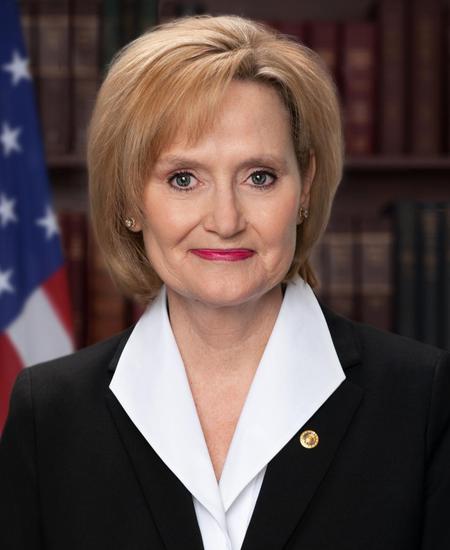
Sen. Cindy Hyde-Smith
Sponsored bills
Long-Term Care Pharmacy Definition Act of 2021 This bill establishes a statutory definition for long-term care pharmacy under the Medicare prescription drug benefit. Currently, there is no statutory definition. Regulations from the Centers for Medicare & Medicaid Services (CMS) define a long-term care pharmacy as a pharmacy that is owned by or under contract with a long-term care facility to provide prescription drugs to the facility's residents. Additional requirements are set out in CMS guidance relating to the Medicare prescription drug benefit; pharmacies are also subject to regulations and guidance from other agencies (e.g., packaging requirements from the Food and Drug Administration). The bill defines a long-term care pharmacy as a state-licensed pharmacy that is able to provide enhanced pharmacy and clinical services to individuals who have certain comorbid and medically complex chronic conditions and who reside in skilled nursing facilities, nursing facilities, or any other applicable setting (as determined by the CMS). The term enhanced pharmacy and clinical services includes medication dispensed in special packaging, drug utilization review, and 24-7 availability of medication delivery and on-call pharmacists.
Restoring the Armed Career Criminal Act This bill modifies the prior convictions that trigger a 15-year enhanced mandatory minimum prison term for a defendant who commits a firearms offense after three or more such prior convictions.
Technical Reset to Advance the Instruction of Nurses Act or the TRAIN Act This bill modifies the methodology and application of Medicare Advantage nursing and allied health education payments for hospitals. Specifically, for 2010-2019, the bill eliminates the annual cap on total payments and excludes any resulting increase from factoring into calculations for graduate medical education payments for such hospitals. (The Centers for Medicare & Medicaid Services recently issued guidance providing for the recalculation and correction of certain payments to account for the annual payment cap.)
This concurrent resolution declares that Congress should not impose any new performance fee, tax, royalty, or other charge relating to the public performance of sound recordings on a local radio station for broadcasting sound recordings over the air, or on any business for such public performance of sound recordings.
This resolution thanks the teachers of the United States and promotes the teaching profession by encouraging students, parents, school administrators, and public officials to recognize National Teacher Appreciation Week.
Creating Opportunities Now for Necessary and Effective Care Technologies (CONNECT) for Health Act of 2021 or the CONNECT for Health Act of 2021 This bill expands coverage of telehealth services under Medicare. Among other provisions, the bill allows the Centers for Medicare & Medicaid Services (CMS) to waive certain restrictions, such as restrictions on the types of technology that may be used; permanently removes geographic restrictions on originating sites (i.e., the location of the beneficiary) and allows the home of the beneficiary to serve as the originating site for all services; permanently allows federally qualified health centers and rural health clinics to serve as the distant site (i.e., the location of the health care practitioner); and allows the CMS to generally waive coverage restrictions during any public health emergency. Additionally, the CMS must report on the effects of expanded telehealth services during the COVID-19 public health emergency, including with respect to the utilization, quality, and outcomes of services. The Center for Medicare and Medicaid Innovation may also test alternative payment models relating to expanded telehealth services.
Constitutional Concealed Carry Reciprocity Act of 2021 This bill allows a qualified individual to carry a concealed handgun into or possess a concealed handgun in another state that allows its residents to carry concealed firearms. A qualified individual must (1) be eligible to possess, transport, or receive a firearm under federal law; (2) carry a valid photo identification document; and (3) carry a valid state-issued concealed carry permit, or be eligible to carry a concealed firearm in his or her state of residence.
Drug Price Transparency Act of 2021 This bill provides statutory authority for the limitation on which type of prescription drug rebates are exempt from federal anti-kickback laws. Specifically, a rebate from a drug manufacturer to a health insurer or pharmacy benefit manager is exempt only if the rebate (1) is disclosed to the consumer at the point of sale, or (2) is a flat fee paid for pharmacy benefit management services.
This resolution recognizes and honors the late Gilbert Metz as the last survivor of the Holocaust in Mississippi. The resolution also recognizes the declining awareness of the atrocities committed during the Holocaust and commends the educators who teach about the Holocaust and all genocide.