

Maddy summaryS 3632 creates two new federal tax credits to incentivize renewable chemical production: a 15% production credit per pound of qualifying chemicals sold (Section 45BB) and a 30% investment credit for facilities producing them (Section 48F). The bill directly affects U.S. manufacturers meeting strict criteria: chemicals must be 95% biobased, USDA-certified, produced domestically from renewable biomass, and used as chemical intermediates (not for food, fuel, or pharmaceuticals). Credits are limited to $500 million nationally and $25 million per company, with allocations prioritizing job creation, reduced fossil fuel dependence, and sustainability metrics. Both credits expire after five years from enactment.
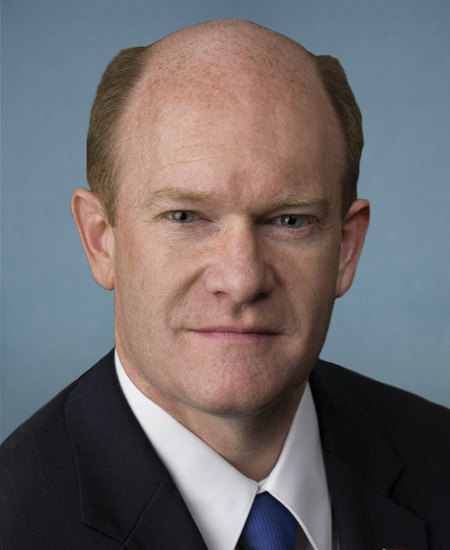
Sen. Christopher A. Coons
Sponsored bills
Maddy summarySJRES 84 is a joint resolution seeking to block a rule issued by the Centers for Medicare & Medicaid Services (CMS) under the Affordable Care Act. The rule, published in the Federal Register on June 25, 2025, aimed to improve affordability and integrity in health insurance marketplaces. If approved, this resolution would invalidate the rule under a federal disapproval process, preventing its implementation. This directly affects how health insurance plans are structured and priced for consumers using ACA marketplaces.
Maddy summaryThis resolution commemorates the fifth anniversary of the January 6, 2021, Capitol attack and honors the U.S. Capitol Police, Metropolitan Police Department, and Capitol staff (including custodial, janitorial, and maintenance personnel) who protected the building during the assault. It recognizes their bravery in defending Congress during the attack, which injured over 100 officers and contributed to five officer deaths, and acknowledges their ongoing essential work in maintaining Capitol operations. The resolution expresses Senate gratitude for their service and reaffirms commitment to protecting democratic processes. As a commemorative resolution, it does not create new laws or funding.
Maddy summaryThis bill prohibits the use of federal funds to compensate individuals prosecuted for the January 6 Capitol attack, including those later pardoned. It bans using funds from the Judgment Fund, victim compensation programs, or creating new compensation funds for these individuals. Additionally, it prevents refunds of court-ordered restitution, fines, or special assessments paid by convicted rioters, directing any such funds to the Architect of the Capitol instead. The law directly affects people convicted (or pardoned) for involvement in the January 6 attack.
Maddy summaryS 3581, the "No Settlements for January 6 Law Enforcement Assaulters Act," prohibits using federal funds (including the Judgment Fund) to settle claims by individuals convicted of assaulting law enforcement during the January 6, 2021, Capitol breach. It directly affects those convicted under federal or D.C. law for assaulting officers during the Capitol events, banning settlements for claims related to harm suffered during the events or prosecution for those acts. The bill's key mechanism blocks all federal financial obligations for such settlements, regardless of the claim's basis. This is a substantive policy change affecting legal settlements for specific convicted individuals, not a procedural measure.
Maddy summarySJRES 82 is a joint resolution seeking to block a rule issued by the Department of Health and Human Services (HHS) regarding how the agency should follow the text of the Administrative Procedure Act (APA), a federal law governing how agencies create regulations. The rule, published in March 2025, was identified by the Government Accountability Office as a "rule" subject to the Congressional Review Act. If enacted, this resolution would void the HHS policy, preventing it from taking effect and requiring HHS to disregard this specific internal guideline. The bill directly affects HHS's rulemaking procedures by invalidating the policy statement on APA adherence.
Maddy summaryThe Auto Theft Prevention Act (S 3577) establishes a federal grant program to fund state and local law enforcement agencies in combating auto theft and stolen vehicle trafficking. It allocates $30 million annually from 2026 to 2030, requiring states to apply with evidence of need and a plan to prioritize high-theft areas. At least 50% of each grant must support local agencies in high-theft zones, and 25% must fund state agencies, with funds covering equipment, staffing, training, and data collection. This bill directly affects all state and local law enforcement entities across U.S. states, territories, and the District of Columbia.
Maddy summarySRES 547 is a Senate resolution expressing strong support for the U.S.-Japan alliance amid recent tensions with China. It condemns China's economic, military, and diplomatic pressure on Japan - including actions like blocking cultural events, suspending trade, and naval incursions - and reaffirms the U.S. commitment to the security treaty covering the Senkaku Islands. The resolution commends Japan's stance against unilateral changes to regional stability, particularly regarding the Taiwan Strait, and supports Japan's increased defense spending to enhance regional deterrence. It directly affects U.S. diplomatic relations with Japan and China, reinforcing alliance unity without proposing new laws or funding.
Maddy summaryThe GRACE Act (S 3535) sets a minimum annual refugee admission target of 125,000 for the U.S., requiring the President to determine this number based on humanitarian needs and national interest. It introduces community/private sponsorship for refugees, allowing groups to provide initial resettlement services instead of traditional agency support. The bill mandates quarterly public reports to Congress on admissions numbers, regional allocations aligned with UN resettlement needs, processing times, security checks, and any shortfall in meeting targets. This directly affects refugees seeking admission, the Department of Homeland Security (which administers processing), and Congress (through transparency requirements).
Maddy summaryS 3519, the Remote Access Security Act, amends the Export Control Reform Act of 2018 to regulate remote access to U.S.-controlled items (like dual-use technology) via cloud services from outside the U.S. by "foreign persons of concern" (including governments of specified countries and their entities). It defines prohibited remote access as activities posing national security risks, such as enabling weapons development, offensive cyber operations, or human rights violations through spyware. The bill requires new licensing for remote access, imposes penalties for violations, and mandates annual reports to Congress on implementation, with controls set to expire after 10 years. It directly affects U.S. cloud service providers and foreign entities seeking remote access to controlled items.