

Affordable and Safe Prescription Drug Importation Act This bill allows expanded importation of eligible prescription drugs and addresses related issues. Current law allows the Department of Health and Human Services (HHS) to authorize the importation of certain eligible prescription drugs from Canada if HHS certifies to Congress that doing so would pose no additional risk to public health and safety and would result in significant cost savings for consumers. The bill removes this certification requirement and requires HHS to issue regulations that permit the importation of qualifying prescription drugs from Canada. After a certain amount of time, HHS may authorize importation from certain other countries if it determines that importation from Canada has resulted in cost savings for consumers and increased access to safe medication. The bill also expands the types of prescription drugs eligible for importation to include, for example, biologics such as insulin. Furthermore, the bill allows individuals to use an eligible licensed foreign pharmacy to fill a U.S.-issued prescription for a qualifying drug for personal use. Currently, an individual seeking to import a prescription drug generally must acquire a waiver from HHS. The bill imposes various requirements related to certification of foreign sellers, labeling of imported drugs, and supply chain security. The bill also (1) prohibits certain acts that discriminate against foreign sellers, such as charging higher prices to foreign sellers than to other sellers in the same country; and (2) imposes criminal penalties for online websites that sell counterfeit drugs or dispense drugs without a required prescription.
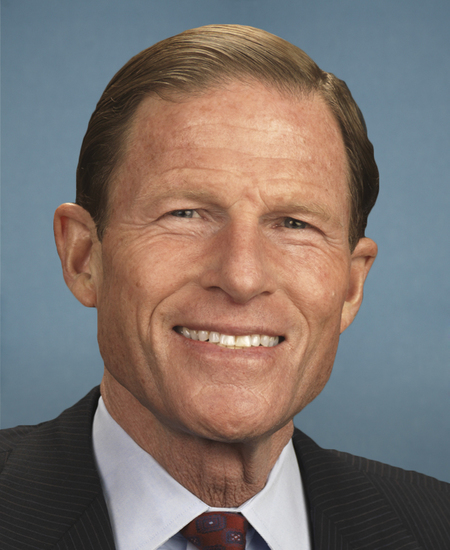
Sen. Richard Blumenthal
Sponsored bills
Creating a Respectful and Open World for Natural Hair Act of 2021 or the CROWN Act of 2021 This bill prohibits discrimination based on a person's hair texture or hairstyle if that style or texture is commonly associated with a particular race or national origin. Specifically, the bill prohibits this type of discrimination against those participating in federally assisted programs, housing programs, public accommodations, and employment. Persons shall not be deprived of equal rights under the law and shall not be subjected to prohibited practices based on their hair texture or style. The bill provides for enforcement procedures under the applicable laws.
Roadless Area Conservation Act of 2021 This bill bars the Department of Agriculture from allowing the construction of roads, the reconstruction of roads, or logging in an inventoried roadless area where those activities are prohibited by the Roadless Rule (i.e., certain federal regulations relating to roadless area management).
Social Determinants for Moms Act This bill directs various federal departments to address social determinants of maternal health. These are nonclinical factors, such as economic or social factors, that impact maternal health outcomes. First, the Department of Health and Human Services (HHS) must convene a task force to coordinate federal efforts on social determinants of maternal health. HHS must also award grants to support access to free child care during prenatal and postpartum appointments; and address social determinants of, and eliminate racial and ethnic disparities in, maternal health. Second, the Department of Housing and Urban Development must award grants to community-based organizations and government entities to assist pregnant and postpartum individuals with affordable housing. Grantees may use funds to, for example, provide individuals with direct financial assistance. Third, the Department of Transportation must report on transportation barriers that prevent pregnant and postpartum individuals from accessing health care and other services. Fourth, the bill extends to 24 months the postpartum eligibility period for the Special Supplemental Nutrition Program for Women, Infants, and Children (WIC). Currently, WIC eligibility lasts for six months postpartum or one year for those breastfeeding. The Department of Agriculture (USDA) must evaluate the impact of this extension. USDA must also establish a grant program to deliver healthy foods and supplies to pregnant and postpartum individuals in food deserts. Last, the Environmental Protection Agency must enter into an agreement with the National Academies of Sciences, Engineering, and Medicine to study the impact of environmental conditions and contaminants on maternal and infant health outcomes.
Ellie Helton, Lisa Colagrossi, Kristen Shafer Englert, Teresa Anne Lawrence, and Jennifer Sedney Focused Research Act or Ellie's Law This bill authorizes appropriations for the National Institute of Neurological Disorders and Stroke to conduct or support research on unruptured brain aneurysms in a patient population diversified by age, sex, and race.
Mental Health Access Improvement Act of 2021 This bill provides for coverage of marriage and family therapist services and mental health counselor services under Medicare. It also excludes such services from the skilled nursing facility prospective payment system, and authorizes marriage and family therapists and mental health counselors to develop discharge plans for post-hospital services.
Resident Physician Shortage Reduction Act of 2021 This bill increases the number of residency positions eligible for graduate medical education payments under Medicare for qualifying hospitals, including hospitals in rural areas and health professional shortage areas. Current law provides for an increase of up to 200 positions per fiscal year beginning in FY2023, with a total increase of 1,000 positions; each hospital may receive up to 25 additional positions. The bill provides for an additional increase of 2,000 positions per fiscal year from FY2023-FY2029; during this period, each hospital may receive up to 75 additional positions in total under the bill and current law. The bill also requires the Government Accountability Office to report on strategies to increase the diversity of the health professional workforce, including with respect to representation from rural, low-income, and minority communities.
Huntington's Disease Disability Insurance Access Act of 2021 This bill expedites payment of Social Security Disability Insurance (SSDI) benefits and eligibility for Medicare coverage for those with Huntington's disease. This is an inherited disorder that causes brain cells to die, including in areas of the brain that help to control voluntary movement. Specifically, the bill eliminates the 5-month waiting period for SSDI benefits and the subsequent 24-month waiting period for Medicare coverage for individuals with Huntington's disease. Under current law, individuals generally must wait five months after the onset of disability to begin receiving SSDI benefits and an additional 24 months to become eligible for Medicare.
Jumpstart Our Businesses by Supporting Students Act of 2021 or the JOBS Act of 2021 This bill expands student eligibility for Pell Grants by establishing the Job Training Federal Pell Grant program. Specifically, the bill requires the Department of Education to award a job training Pell Grant to a student who does not have a degree; attends an institution of higher education (IHE); is enrolled in a career and technical education program at an IHE that provides 150 to 600 clock hours of instructional time over a period of 8 to 15 weeks and provides training aligned with high-skill, high-wage, or in-demand industry sectors (i.e., job training programs); and meets all other eligibility requirements for a Pell Grant. It also specifies that any period during which a student receives a job training Pell Grant counts toward that student's Pell Grant eligibility period.
Protect DREAMer Confidentiality Act of 2021 This bill directs the Department of Homeland Security (DHS) to prevent disclosing information from applications to the Deferred Action for Childhood Arrivals (DACA) program to U.S. Immigration and Customs Enforcement (ICE) or U.S. Customs and Border Protection (CBP), except to implement the program. Application information may be shared only to identify or prevent fraudulent claims, for particularized national security purposes relating to the applicant, or to investigate or prosecute a felony not related to immigration status. The bill also prohibits DHS from referring any individual with deferred action status to ICE, CBP, the Department of Justice, or any law enforcement agency.