

Maddy summaryS 3717 establishes the Opportunities in Organic program to assist farmers and handlers with organic certification costs and transition to organic practices. It covers up to $1,500 annually in certification fees (with higher payments for socially disadvantaged farmers or regions with disproportionately high costs), provides technical assistance for soil health and organic management, and funds supply chain development like processing facilities. The program allocates $50 million annually for 2027-2028, increasing to $100 million by 2030, targeting socially disadvantaged farmers, farms near schools/residential areas, and under-resourced agricultural regions.
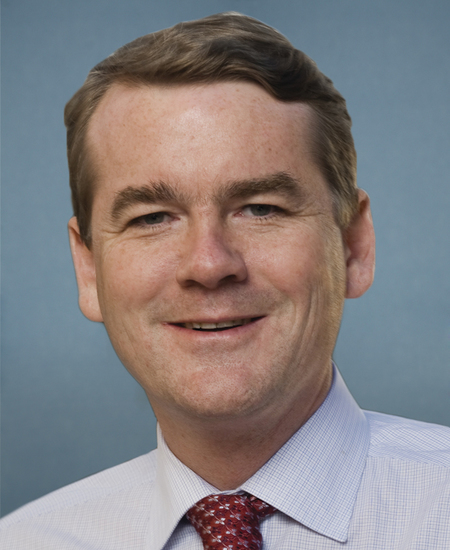
Sen. Michael F. Bennet
Sponsored bills
Maddy summarySRES 585 is a commemorative resolution honoring Ben Nighthorse Campbell, a former U.S. Senator from Colorado and the first Native American to chair the Senate Committee on Indian Affairs. It recognizes his military service, Olympic judo career, legislative work (including authoring the National Museum of the American Indian Act), and advocacy for tribal communities. The resolution has no policy impact - it formally expresses the Senate’s respect for his legacy, requests transmission to his family, and directs a moment of silence. It directly affects Campbell’s legacy and family, not any current policy or population. (Note: This is a procedural resolution, not a bill with legislative provisions.)
Maddy summaryThis bill prohibits using federal funds to reimburse corporations for investments in Venezuela's oil sector. It blocks U.S. taxpayer money from covering "qualified capital expenditures" (like new facilities or permanent property improvements) made by any corporation in Venezuela's oil and gas industry. The law applies to all U.S. and foreign corporations operating in Venezuela's oil sector, preventing federal reimbursement for these specific investments. It does not ban the investments themselves, only the use of public funds to cover them.
This joint resolution directs the President to terminate the use of U.S. Armed Forces for hostilities within or against Venezuela unless a declaration of war or authorization to use military force for such purpose has been enacted. The joint resolution specifies that it shall not be construed to prevent the United States from defending itself from an armed attack or threat of an imminent armed attack.
Maddy summaryThis bill, S 3631 (PUBLIC SAFETY Act), increases federal funding for local law enforcement programs. It amends the COPS Hiring Program to redirect funds from U.S. Immigration and Customs Enforcement to the Attorney General, extends grant deadlines to 2030, and waives certain requirements for small local governments (under 175 officers) and tribal governments. It also allocates $45 billion for fiscal year 2025 to the Edward Byrne Memorial Justice Assistance Grant (Byrne JAG) Program, which supports state and local crime prevention and justice initiatives. These changes directly affect cities, counties, townships, and tribal governments seeking federal funding to hire officers and support public safety programs.
Maddy summaryThe ACE Agriculture Act of 2026 amends USDA research programs to expand their focus on water conservation, greenhouse gas reduction, and resilience against climate impacts like drought and pests. It increases annual funding for the Agriculture Advanced Research and Development Authority (AGARDA) from $50 million to $100 million (2027-2031) and requires the program to prioritize water conservation, emissions mitigation, and protection from diseases and pests. The bill redesignates a former "Pilot" program as a permanent initiative, clarifies the Director’s role to work directly with the Chief Scientist (without reporting to other USDA program heads), and allows use of unobligated funds for implementation. This primarily affects USDA research operations and agricultural producers adopting new technologies for sustainability and climate adaptation.
Maddy summarySJRES 84 is a joint resolution seeking to block a rule issued by the Centers for Medicare & Medicaid Services (CMS) under the Affordable Care Act. The rule, published in the Federal Register on June 25, 2025, aimed to improve affordability and integrity in health insurance marketplaces. If approved, this resolution would invalidate the rule under a federal disapproval process, preventing its implementation. This directly affects how health insurance plans are structured and priced for consumers using ACA marketplaces.
Maddy summaryThis bill modifies tax code to help businesses in disaster-affected areas use unused tax credits. It allows businesses operating in qualified disaster zones (federally declared after 2023 or state-recognized under specific criteria) to treat certain carried-over tax credits as transferrable credits for eligible expenses. Eligible expenses include costs for business operations in these areas within two years of the disaster declaration. The change applies to tax years ending after the bill's enactment, making it easier for affected businesses to access credit benefits they previously couldn't utilize.
Maddy summarySRES 503 is a symbolic Senate resolution recognizing the third anniversary of the November 19-20, 2022, mass shooting at Club Q, an LGBTQ+ bar in Colorado Springs, Colorado. It commemorates the five victims killed (Raymond Green Vance, Ashley Paugh, Daniel Aston, Kelly Loving, and Derrick Rump) and 17 injured in the attack, which targeted an LGBTQ+ safe space. The resolution expresses the Senate's solidarity with survivors, families, and the Colorado Springs LGBTQ+ community but does not create new laws, allocate funds, or impose policy changes. It serves solely as a ceremonial acknowledgment of the tragedy and ongoing community efforts toward healing.
Maddy summarySRES 288 is a Senate resolution condemning recent ideologically motivated attacks on Jewish individuals, including a violent assault in Boulder, Colorado, on June 1, 2025, and other incidents like the attack on Israeli Embassy staff in Washington, D.C., and fires at the Pennsylvania Governor’s Residence. The resolution formally expresses the Senate’s condemnation of these acts as part of a growing pattern of antisemitism and politically motivated violence. It reaffirms the Senate’s commitment to protecting peaceful assembly and religious practice, while urging federal, state, and local law enforcement to thoroughly investigate such incidents and calling on community leaders to publicly oppose antisemitism. This resolution has no legal effect but serves as a formal statement of the Senate’s position.